

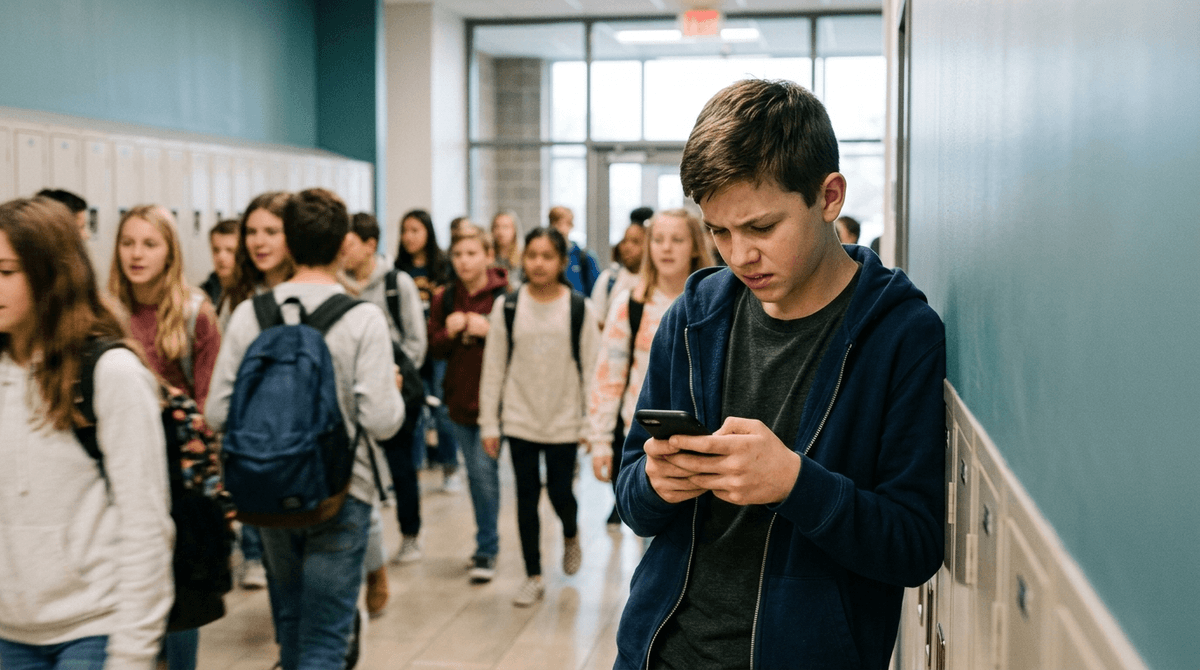

Middle schoolers who use social media to escape real-world stress are far more likely to develop severe social anxiety than those who scroll out of simple boredom. The phone itself isn't creating the anxiety—it's acting as a digital shield for kids who do not know how to handle uncomfortable feelings.
Social media does not cause social anxiety on its own in middle schoolers; it only triggers anxiety when kids use scrolling to escape stress because they lack emotional coping skills.
Confiscating your middle schooler's phone won't cure their social anxiety if the underlying stress remains unaddressed. Parents often blame screen time for a child's retreat from real-world interaction, but the device is usually a coping tool of last resort for a child who feels overwhelmed by daily pressure.
Focusing exclusively on screen limits misses the emotional engine driving the behavior. Helping your teen build mental flexibility—learning to sit with uncomfortable emotions rather than hiding behind a screen—directly interrupts the pipeline between middle school stress and social dread.
Middle school marks a crucial transition where academic workloads spike alongside intense peer pressure. Researchers wanted to unpack whether social media directly fuels social anxiety, or if it merely acts as a refuge for kids who already feel overwhelmed and mentally rigid.
Stress directly predicts social anxiety in seventh and eighth graders, but a distinct two-step psychological sequence turns daily pressure into crippling social fear.
- Mental rigidity bridges the gap: The main driver connecting stress to anxiety was "psychological inflexibility"—a tendency to get stuck on negative thoughts and aggressively avoid uncomfortable feelings.
- Screens are an escape hatch, not the root cause: Excessive social media use did not independently increase social anxiety. It only became a threat when driven by a student's urge to flee from stress.
- The chain reaction is clear: High stress leads to rigid emotional coping, which drives kids to hide in endless scrolling, which ultimately heightens their fear of real-life social judgment. Seventh and eighth graders who fused strongly with negative self-talk were the most vulnerable to this loop.
The finding that social media usage alone does not predict social anxiety challenges the popular narrative that screens inherently destroy teenage social skills. Scrolling only becomes toxic when a child uses it as a tactical shield to avoid real-world peer interactions.
When a middle schooler retreats into TikTok or Instagram after a hard day, they are practicing avoidance coping. Every hour spent escaping awkward social moments on a phone robs them of the chance to learn that real-life distress is temporary, making future face-to-face interactions feel exponentially more intimidating.
This study captures a single moment in time among 682 seventh and eighth graders in China's Anhui Province. Because the research is cross-sectional and relies entirely on self-reported questionnaires, it proves that stress, mental rigidity, and screen habits cluster together, but it cannot guarantee that one directly causes the other over time.
- If your teen uses social media to hide from bad days… …pivot from enforcing time limits to asking what specific stress or social awkwardness they are trying to retreat from.
- If your middle schooler gets stuck in negative self-talk loops… …teach them to notice thoughts without trying to fight them, using simple acceptance techniques that detach self-worth from temporary feelings.
- If you notice your child panicking before social gatherings… …resist letting them cancel or use their phone as a prop in public, and instead help them practice sitting with mild social discomfort for short stretches.
Stop treating screen time as the sole villain in your teen's social anxiety, and start addressing the emotional pressure they are trying to escape. Focus your energy on teaching your child how to tolerate stressful feelings instead of numbing them, and the phone will naturally lose its power as an emergency exit.
Fang M, Wang Z (2026). The Relationship Between Perceived Stress and Social Anxiety in Junior High School Students: The Chain Mediating Role of Psychological Inflexibility and Problematic Social Media Use. Behavioral sciences (Basel, Switzerland). doi:10.3390/bs16060900 — pubmed.ncbi.nlm.nih.gov