

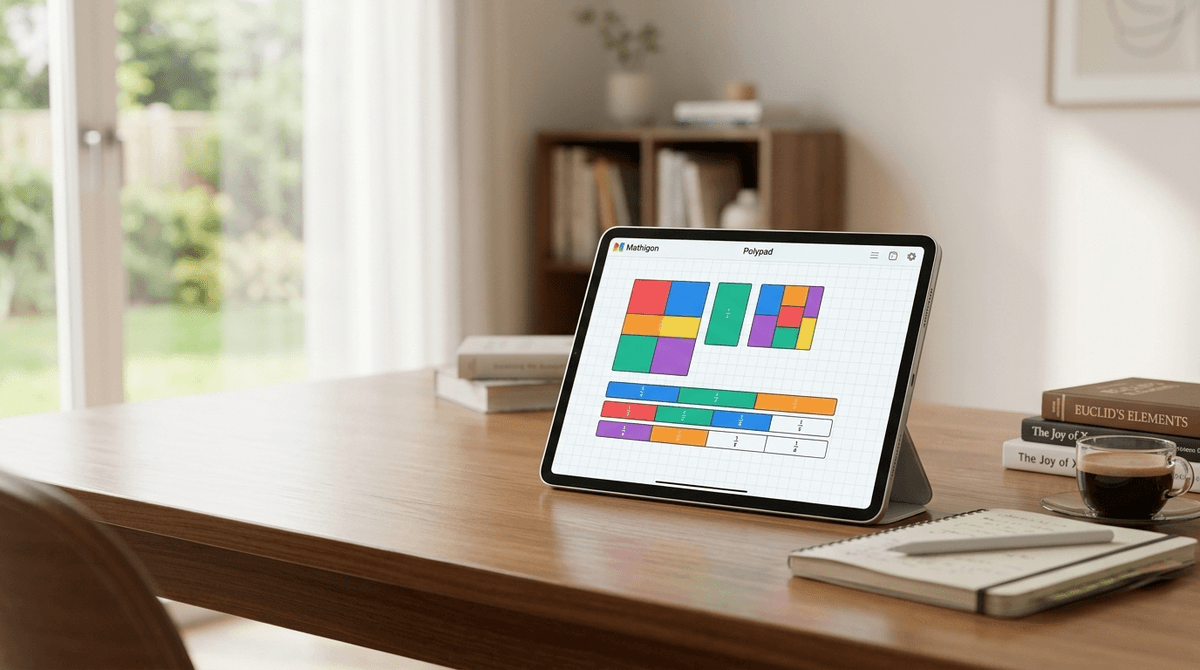
TL;DR: If you’re tired of the "drill and kill" math apps that feel like a digital version of a dusty 1990s workbook, Mathigon is the upgrade your family needs. It’s a "textbook of the future" that replaces static pages with interactive puzzles and a digital playground called Polypad. It’s free, it’s beautiful, and it’s one of the few educational sites that middle schoolers don't immediately label as "mid" or "Ohio."
Quick Links for the Math-Curious:
- Best for deep learning: Mathigon
- Best for gamified drills: Prodigy Math
- Best for logic puzzles: Brilliant
- Best for visual algebra: DragonBox Algebra 5+
- Best for quick math breaks: Coolmath Games
Think of the last time you tried to help your kid with common core math and ended up staring at a YouTube tutorial for forty minutes just to understand the "new" way to do long division. Mathigon is designed to kill that frustration.
It isn't just a collection of digitized worksheets. It’s a highly interactive platform that treats math like a narrative and a playground. Instead of a teacher (or a screen) telling a kid that $A^2 + B^2 = C^2$, Mathigon lets them drag shapes around, unfold 3D solids, and manipulate variables in real-time until the concept actually clicks.
It’s often called the "Textbook of the Future," and honestly, for once, that’s not just tech-bro marketing. It’s a legitimate leap forward in how we teach kids who are used to the high-interactivity of Minecraft or Roblox.
We know the drill: you suggest an "educational website" and your kid looks at you like you’ve just suggested a weekend trip to the DMV. But Mathigon manages to dodge the "brain rot" label for a few reasons:
1. The Polypad
This is the crown jewel of the site. It’s a digital canvas where kids can play with "virtual manipulatives." We’re talking fraction bars, algebra tiles, prime factor circles, and even pentominoes. For kids who are visual learners or who struggle with the abstract nature of numbers on a page, being able to physically (well, digitally) snap pieces together makes math feel like building with Legos.
2. No "Wrong Answer" Shaming
A lot of math tech, like IXL, relies on a "streak" system. You get ten right, you feel great; you miss one, and your score plummets. It’s high-stress and low-reward. Mathigon focuses on exploration. If a kid gets stuck, the system provides hints that guide them toward the logic rather than just flashing a red "X" and making them feel like they’re in "Ohio" (slang for weird/bad, for the uninitiated).
3. The Gamified Narrative
The courses are structured like a journey. Kids can unlock "achievements" and customize their experience. It’s not quite the dopamine hit of Fortnite, but it’s engaging enough to keep a 6th grader curious about fractal geometry for longer than you’d expect.
When we look at the Screenwise community data, we see parents constantly cycling through different math tools. Here’s how Mathigon stacks up against the usual suspects:
- Vs. Prodigy Math: Prodigy is basically a Pokemon-style RPG with math problems tacked on. Kids love it because it’s a game, but they often spend 80% of their time battling monsters and only 20% doing math. Mathigon is 100% math, but the math itself is the game.
- Vs. Khan Academy: We love Sal Khan, but Khan Academy is very "watch a video, then do a quiz." It’s passive. Mathigon is active. You can't just sit back and let the video wash over you; you have to interact to move the lesson forward.
- Vs. Coolmath Games: Let’s be real—Coolmath Games is where kids go to play [Run 3](https://screenwiseapp.com/media/run-3-website when they’re supposed to be in the computer lab. It has very little to do with actual math. Mathigon is the site you point them to when you want them to actually learn something.
Check out our guide on how to balance educational tech with pure entertainment
While the site says it’s for everyone, here’s the reality of how it fits different age groups:
Upper Elementary (Ages 9-11)
This is a great age to introduce the Polypad. They can explore symmetry, area, and fractions. The "Tangram" puzzles are a huge hit here. It helps build spatial reasoning that will be vital for middle school geometry.
Middle School (Ages 12-14)
This is the "sweet spot." Mathigon shines when it comes to early algebra and geometry. The interactive lessons on probability and data visualization are much better than anything you’ll find in a standard textbook. It’s also a great age for the Timeline of Mathematics, which shows the history of math and the diverse people who "discovered" it (no, it wasn't just old European guys).
High School (Ages 15-18)
The courses on Mathigon go all the way up to advanced topics like Graph Theory and Cryptography. If you have a kid who is bored in their standard Algebra II class, send them here. It will give them a "why" for the abstract concepts they’re memorizing in class.
As a Screenwise parent, you’re probably wondering: What’s the catch? Is this another data-harvesting machine?
Actually, no. Mathigon was acquired by Amplify a couple of years ago, but it remains free for individual students and teachers.
- Privacy: They are COPPA and FERPA compliant. You can create an account to save progress, but you don't have to for many of the tools (like Polypad).
- Social Features: There are no chat rooms, no "friend requests," and no way for strangers to contact your kids. It is a walled garden in the best sense of the word.
- Costs: There are no "Skibidi" micro-transactions here. No Robux, no skins, no "pay to win." It is purely educational.
Learn more about how to vet educational websites for privacy
Here is the thing: Mathigon is not a "babysitter" app.
If you hand your kid a tablet and tell them to "play Mathigon," they might spend five minutes on it and then pivot back to YouTube. Because it requires actual thinking, it’s "harder" than a mindless game.
To get the most out of it, you might need to sit with them for the first 15 minutes. Explore the Polypad together. Ask them to "build" a multiplication problem. Once they see that it’s a sandbox and not a test, they’re much more likely to explore it on their own.
Also, if your kid is already struggling with "math anxiety," Mathigon is a godsend. It lowers the stakes. There’s no timer ticking down, no scary buzzer sounds. It’s a calm, aesthetic environment that treats math as a beautiful part of the world rather than a hurdle to jump over.
If your kid's digital life is currently a mix of TikTok dances and MrBeast challenges, Mathigon is the perfect "palate cleanser." It’s high-quality, intentional, and actually respects your child’s intelligence.
It won't turn them into a math genius overnight, but it might stop them from asking, "When am I ever going to use this in real life?" because, for the first time, they can actually see the math working.
Next Steps for Intentional Parents:
- Explore the Polypad together: Go to the Mathigon website and open the Polypad. Challenge your kid to make a pattern using only prime number tiles.
- Check the Timeline: Look at the "Timeline of Mathematics" together. It’s a great way to talk about history and science without it feeling like a lecture.
- Compare notes: If your school uses Zearn or ST Math, see how your kid feels about Mathigon in comparison. Often, the "non-school" vibe of Mathigon makes it more palatable for homework help.