

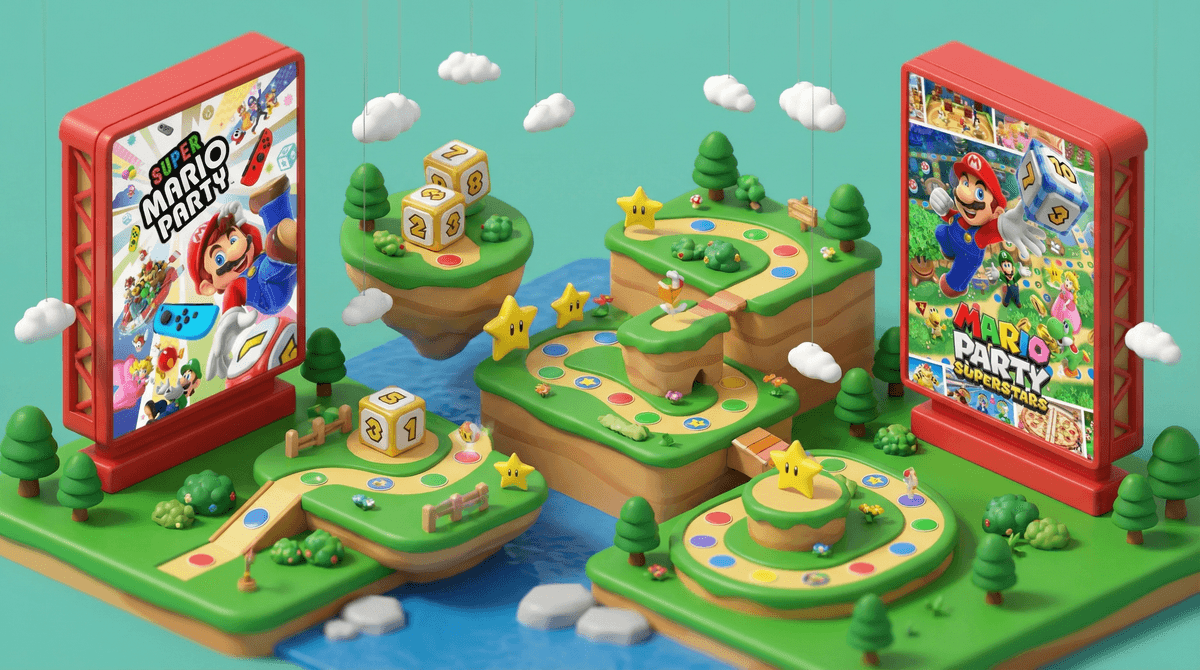
So your kid is asking for their first "real" video game, and you're standing in Target staring at a wall of colorful boxes wondering what the heck to choose. Let me save you some analysis paralysis: Mario Party is actually a pretty solid choice for a first game, and here's why.
Mario Party is basically a digital board game where up to four players (your kids, you, the neighbor kid, whoever) roll dice, move around a board, and play mini-games. Think Monopoly meets Minute to Win It, but with Mario and friends. The Nintendo Switch currently has two main versions: Super Mario Party (2018) and Mario Party Superstars (2021). Superstars is generally considered the better pick—it's a greatest hits collection with boards and mini-games from the series' heyday on Nintendo 64.
Each game takes about 15-30 minutes depending on settings, players compete to collect stars by landing on specific spaces, and between turns everyone plays quick mini-games (like memory matches, racing challenges, or rhythm games). The person with the most stars at the end wins, though there are always some chaos-inducing bonus stars awarded at the finish that can completely flip the results. Yes, your kid will complain about this. Yes, it's still fun.
Here's the thing about Mario Party that makes it different from a lot of "first games"—it's genuinely designed for group play. Not the "everyone takes turns watching one person play" kind of multiplayer, but actual everyone-plays-at-once action.
Kids love it because:
- The mini-games are quick and varied - No one gets bored watching someone else play for 20 minutes
- Luck plays a role - Your 6-year-old can actually beat your 10-year-old (and you), which keeps everyone engaged
- It's colorful and silly - Mario characters are inherently goofy and non-threatening
- There's always a chance to catch up - Unlike some games where falling behind early means you're done, Mario Party keeps everyone in the running
And honestly? You might find yourself actually wanting to play. I've seen plenty of parents get genuinely competitive about these mini-games. There's something about frantically button-mashing to pump a balloon faster than your 8-year-old that brings out your inner child.
Ages 4-6: They can play, but they'll need help. The mini-game instructions flash on screen quickly, and reading is required. You'll be sitting next to them explaining what to do, which honestly makes it a nice together activity. Just set your expectations that "playing together" means "you're going to be very involved."
Ages 7-9: This is the sweet spot. They can read the instructions, understand the basic strategy, and actually compete. This is also the age where the "it's not fair!" complaints reach peak volume, so maybe have a conversation about good sportsmanship before you start. Learn more about teaching kids to lose gracefully .
.
Ages 10+: They'll probably want more complex games soon, but Mario Party still works great for family game nights or when friends come over. It's one of those rare games that works across age ranges—your 10-year-old and 6-year-old can actually play together without the older one being completely bored.
The Good Stuff
It teaches turn-taking and patience - Revolutionary concept, I know, but in an age of instant gratification, waiting for your turn is actually a useful skill.
It's genuinely social - Unlike games where kids are just sitting next to each other staring at screens, Mario Party creates actual interaction. There's trash talk, alliances, celebrations, and yes, some tears, but that's family game night, baby.
The learning curve is gentle - Unlike Minecraft where you need a PhD to figure out crafting recipes, or Roblox where you're navigating a whole platform of games, Mario Party is straightforward. Roll dice, play mini-game, repeat.
No online strangers - This is huge for a first game. Mario Party is local multiplayer only (except for a limited online mode in Superstars). You're not dealing with chat features, friend requests, or your kid accidentally talking to a 40-year-old pretending to be 12.
No in-game purchases - You buy the game once (yes, it's $60, we'll get to that), and you're done. No "Mom, can I buy this skin?" or "I need Robux for this limited edition thing." Just... the game. Remember when that was normal?
The Real Talk
It can get loud - Between the game's enthusiastic announcements and your kids' reactions, Mario Party is not a quiet activity. If you're hoping for peaceful screen time while you make dinner, this isn't it.
Someone will cry - Probably. Especially in the 7-9 age range. The combination of competition, luck, and those end-game bonus stars that can snatch victory away creates emotional moments. This is actually a teaching opportunity about handling disappointment, but I'm not going to pretend it's always fun in the moment.
The price point - Nintendo games rarely go on sale. You're looking at $50-60 for Mario Party Superstars. However, unlike some games that get played once and forgotten, Mario Party tends to have staying power because it works for groups. Think of it as a board game investment—you wouldn't blink at $30 for a physical board game, and this one doesn't have pieces to lose.
You'll need extra controllers - The Switch comes with two Joy-Cons, which means two players. For the full four-player experience, you'll need more controllers. This is a hidden cost that catches parents off guard. You can find third-party controllers for cheaper, but Nintendo's official ones are more reliable.
Screen Time Considerations
Here's where Mario Party is interesting from a digital wellness perspective: it has a natural end point. You set the number of turns at the start (10, 15, or 20), and when the game ends, it ends. There's no "just one more level" negotiation. It's like a board game—you play, someone wins, you're done.
That said, "one game" can still mean 30 minutes of screen time. In our house, we count Mario Party time differently than solo screen time because of the social element, but every family is different. Some parents count all screens the same, others differentiate between passive watching and active playing. Figure out what works for your family.
Start with shorter games - Set it to 10 turns for your first few games. This keeps the time commitment reasonable and prevents attention from wandering.
Play together initially - Even if your kid is old enough to play independently, the first few games together help you understand what they're experiencing and let you talk through the frustrating moments.
Use it as a family activity - Friday night Mario Party tournament becomes a thing in a lot of families. It's screen time, yes, but it's together screen time with laughing and interaction.
Set expectations before you start - "We're playing one game, and when it's over, we're done" is much easier to enforce if you say it before the game starts rather than during the inevitable "one more game!" negotiation.
Is Mario Party the perfect first video game? There's no such thing as perfect, but it's pretty darn good. It's age-appropriate, has no concerning content, teaches some useful skills, and—here's the kicker—it's actually fun for the whole family.
You're not buying something that's going to make your kid a gaming prodigy or teach them to code. You're buying something that might become a legitimate family activity that doesn't involve arguing over restaurant choices or sitting in separate rooms on devices.
The fact that it has a built-in end point, no online strangers, and no microtransactions makes it a relatively low-stress entry into gaming. Your biggest challenge will be managing the emotional reactions to losing, but honestly, that's a useful life skill to practice anyway.
- Choose your version: Mario Party Superstars is generally the better pick
- Consider controller needs: Can you start with two players, or do you need four-player capability right away?
- Set family expectations: Decide how Mario Party time fits into your screen time rules
- Plan to play together: At least for the first few sessions, make it a together activity
And remember, if Mario Party becomes a hit and your kid starts asking about other games, Screenwise can help you evaluate those too. Because trust me, after Mario Party comes the "can I get Fortnite?" conversation, and that's a whole different ballgame. But we'll be here to help you figure that out too.