

Here's the thing: our kids are learning about the world through screens more than ever, and when it comes to Latino representation in entertainment, there's a lot of... let's call it "creative interpretation" happening. And by creative interpretation, I mean stereotypes that have been recycled since before we were kids.
You know the tropes. The fiery Latina. The gangster or drug dealer. The maid. The gardener. The "spicy" personality. The heavily accented comic relief. And sure, there are more nuanced Latino characters now than there were in the 90s, but these stereotypes are still everywhere—and kids are absorbing them whether we realize it or not.
This matters for all kids, not just Latino children. If your kid isn't Latino, the media they consume is teaching them what to expect from Latino people in real life. If your kid is Latino, they're learning what roles they're "supposed" to fill, what personalities they're "supposed" to have, and what dreams are "realistic" for them.
The "One Type" Problem
Turn on most family shows or movies, and if there's a Latino character, they're often one of these: the loud, passionate character who gestures wildly; the tough guy with a troubled past; the wise abuela dispensing folksy wisdom; or the "exotic" love interest. These aren't inherently bad traits, but when they're the only Latino characters your kid sees, it creates a really narrow view of what it means to be Latino.
The Language Thing
Notice how Latino characters often speak in heavily accented English, even when it doesn't make sense for their character? Or how Spanish is used for "flavor" but rarely for actual communication? Or how speaking Spanish is sometimes played for laughs? Kids pick up on this. They learn that accents are "funny" or that speaking Spanish is somehow less legitimate than speaking English.
The Socioeconomic Stereotype
How often do your kids see Latino characters who are doctors, scientists, teachers, or tech entrepreneurs versus characters who are service workers, criminals, or struggling immigrants? The latter shows up way more often. There's nothing wrong with service work or immigrant stories—these are important and real—but when that's the only representation, kids internalize some pretty limiting ideas about social mobility and opportunity.
The Monolith Problem
"Latino" isn't one culture. It's not even ten cultures. We're talking about people from 20+ countries across multiple continents, with vastly different histories, traditions, and experiences. But in most kids' entertainment? Latino characters are treated as interchangeable, with a generic "Latino-ness" that mashes together Mexican, Puerto Rican, Dominican, Colombian, and other cultures into one spicy stew.
When your 8-year-old watches the same stereotypes over and over, they're not thinking "ah yes, this is a reductive portrayal." They're building a mental model of how the world works. They're learning:
- What roles different people are "supposed" to play in society
- Who gets to be the hero, the genius, the leader
- What accents are "normal" versus "funny"
- Which cultures are "default" and which are "exotic"
- Who they can imagine themselves becoming
For Latino kids specifically, the impact is even more direct. They're looking for themselves on screen, and when they mostly see maids, gangsters, and comic relief, that's a message about their own potential and worth.
Not everything is terrible! There's been real progress, and some creators are doing thoughtful, nuanced work:
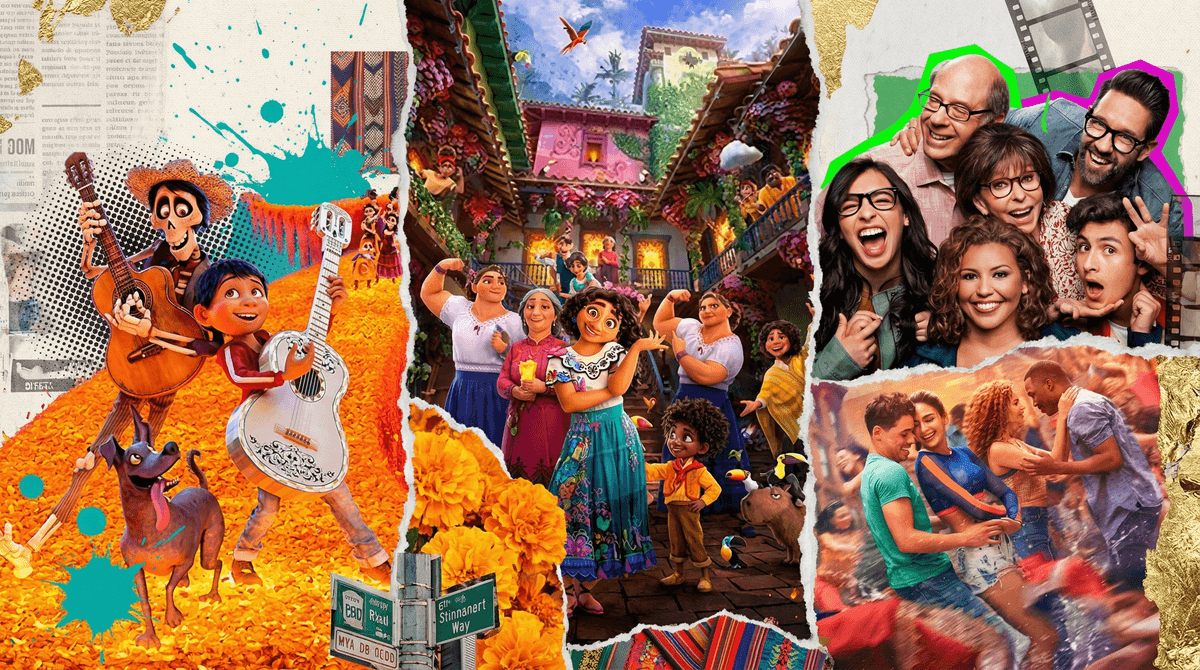
Encanto is the obvious recent win—a Disney movie that actually engaged with Colombian culture specifically, featured a multi-generational Latino family with complex characters, and didn't rely on tired stereotypes. The music is by Lin-Manuel Miranda, who's also behind In the Heights, which centers Dominican-American culture in Washington Heights with real depth.
Coco did something similar for Mexican culture and Día de los Muertos—it's gorgeous, respectful, and actually researched. Kids love it, and they're learning about a real cultural tradition without it being exoticized or dumbed down.
For older kids, Gentefied on Netflix is a really honest look at gentrification, family dynamics, and what it means to be Mexican-American across generations. One Day at a Time (the reboot) features a Cuban-American family and tackles everything from immigration to mental health to LGBTQ+ identity with humor and heart.
The Casagrandes is a Nickelodeon show that spun off from The Loud House, featuring a Mexican-American family in the city. It's not perfect, but it's a step toward normalizing Latino families in everyday kid-friendly content.
Watch together and talk about it. You don't need to turn every viewing into a sociology lecture, but when you notice a stereotype, point it out. "Hey, have you noticed that the only Spanish-speaking characters on this show are the cleaning staff?" or "Why do you think they made that character's accent so exaggerated?"
Seek out diverse creators. Look for shows and movies actually created by Latino writers, directors, and producers. The perspective matters. A lot.
Expand beyond entertainment. Follow Latino scientists, artists, athletes, and activists on social media (age-appropriately). Read books by Latino authors. Listen to music beyond Despacito. The goal is to give your kid a fuller picture of Latino culture and achievement beyond what Hollywood serves up.
Check your own assumptions. Kids pick up on what we say and don't say, who we consider "normal" versus "different," and whose stories we prioritize. If you're not Latino, think about how you talk about Latino people and culture. If you are Latino, think about what messages you're sending about your own culture and identity.
Use Screenwise to dig deeper. Before you commit to a new show or movie, check out what other parents are saying about representation and whether it's reinforcing stereotypes or breaking them down.
Your kid is going to consume a ton of media. You can't control all of it, and you shouldn't try to. But you can help them develop a critical eye for stereotypes and a broader understanding of Latino culture beyond what Hollywood has traditionally offered.
The goal isn't to ban everything with imperfect representation—good luck with that. It's to make sure your kid has enough diverse, nuanced exposure that they don't mistake the stereotype for the whole story. Because the whole story is so much richer, more complex, and more interesting than the myths we keep recycling.
And honestly? When kids see real, multidimensional Latino characters on screen—characters who are nerdy, ambitious, flawed, heroic, funny, serious, and everything in between—everybody wins. Latino kids see themselves as full human beings with unlimited potential. Non-Latino kids learn to see their Latino peers the same way. That's not just good representation. That's good parenting.