

Last Stop on Market Street: Using This Award-Winning Book to Talk About Gratitude and Perspective
TL;DR: Last Stop on Market Street is a Newbery Medal-winning picture book that follows CJ and his grandmother on a Sunday bus ride through their city. It's a beautiful conversation starter about gratitude, finding beauty in unexpected places, and seeing beyond surface-level differences. Perfect for ages 4-8, and honestly? Adults need this message too.
Matt de la Peña's story is deceptively simple: a little boy leaves church with his grandmother, rides the city bus across town, and arrives at a soup kitchen where they volunteer. That's it. No dragons, no magic, no high-stakes adventure.
But here's what makes it extraordinary: CJ complains the entire way. Why don't they have a car? Why does he have to wait in the rain? Why doesn't he have an iPod like his friend? Sound familiar?
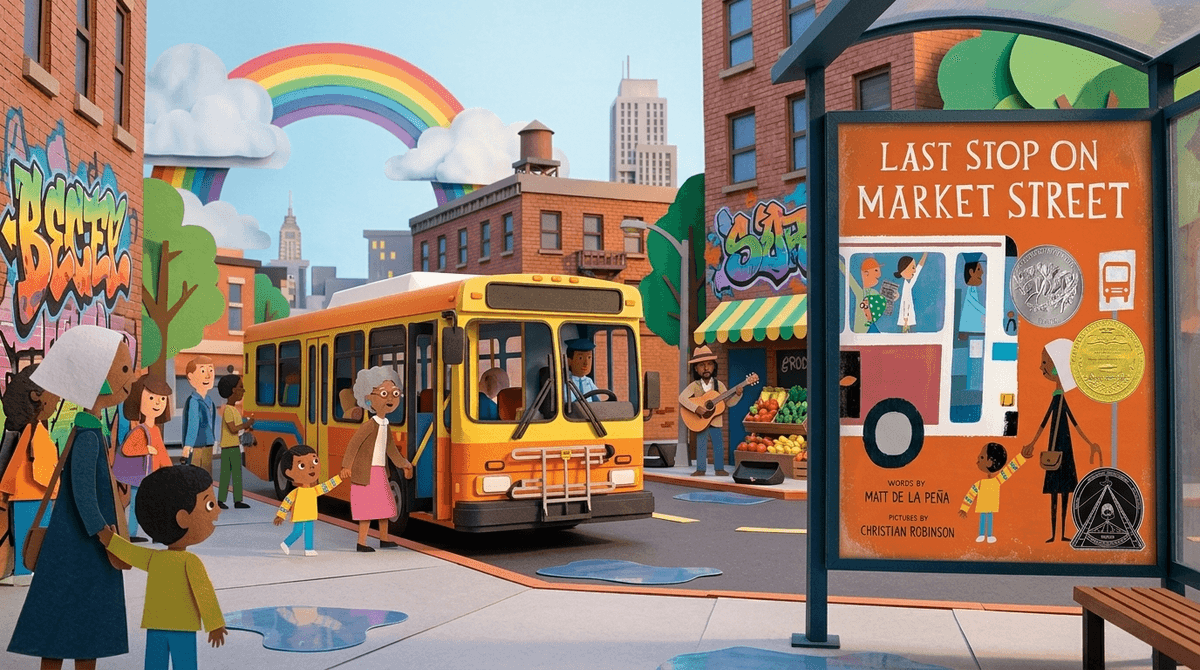
His grandmother—Nana—responds to each complaint not with frustration or lectures, but by gently redirecting his attention to the beauty and humanity around them. The blind man with the guitar. The colorful graffiti murals. The diverse faces on the bus. The rainbow after the rain.
According to Common Sense Media, it's a "tender story of Nana showing grandson city beauty via bus," and that undersells it. This book does something rare: it makes gratitude feel natural rather than preachy, and it centers urban life and volunteerism as beautiful, normal parts of childhood.
In 2026, when kids are constantly comparing what they have to what they see on screens—whether that's YouTube unboxing videos, Roblox cosmetics, or their friends' latest tech—this book hits different.
CJ's complaints are timeless, but they're also incredibly current. He wants what his friends have. He doesn't understand why his life looks different. He sees the rain as an inconvenience rather than an opportunity.
Christian Robinson's illustrations are stunning—vibrant, diverse, and full of small details that reward multiple readings. The people on the bus aren't background characters; they're individuals with their own stories, their own dignity.
The book tackles several themes without ever feeling heavy:
- Gratitude and perspective - Finding beauty in what you have rather than fixating on what you don't
- Intergenerational relationships - The wisdom grandparents bring, the patience required to teach rather than lecture
- Community and service - Volunteerism as a normal, joyful part of life
- Urban life - Cities as vibrant, diverse spaces (not just settings for crime dramas)
- Economic diversity - Acknowledging different circumstances without shame or pity
Ages 4-6: Read it straight through, focusing on the illustrations. Ask simple questions: "What does CJ see out the window?" "How does Nana help him feel better?" Kids this age will connect with CJ's complaints and appreciate Nana's gentle redirections.
Ages 6-8: Dig deeper into the themes. "Why do you think CJ and Nana go to the soup kitchen?" "What does it mean to find beauty in unexpected places?" This age can start understanding that people volunteer to help others, and that everyone has something to offer.
Ages 8+: Use it as a springboard for bigger conversations about gratitude, privilege, and community service. Older kids can appreciate the nuance—that CJ's family might not have much, but they're rich in other ways. That helping others can be as rewarding as being helped.
After reading, try these questions (but don't interrogate—let the conversation flow naturally):
- "CJ complains a lot at the beginning. Do you ever feel like that?"
- "Nana helps CJ see things differently. Who helps you see things in a new way?"
- "What's something beautiful you noticed today that you might have missed?"
- "Why do you think CJ and Nana volunteer at the soup kitchen every week?"
- "The book doesn't tell us everything. What do you think happens at the soup kitchen?"
The beauty of this book is that it doesn't provide all the answers. It invites kids (and parents) to fill in the gaps, to imagine the stories of the people on the bus, to wonder about the world beyond their own experience.
You might be wondering what a picture book about a bus ride has to do with screens and digital wellness. Everything, actually.
This book models the opposite of what screens often teach kids:
- Screens say: Compare yourself to others, want more, feel inadequate
- This book says: Look around, appreciate what you have, find beauty in the ordinary
This book encourages presence and observation:
- Screens demand constant stimulation and novelty
- This book celebrates the richness of everyday moments—watching people, listening to music, noticing details
This book centers human connection:
- Screens can isolate kids in their own bubbles
- This book shows a child engaging with his grandmother, with strangers, with his community
Reading Last Stop on Market Street won't magically cure your kid's screen addiction or make them stop asking for the latest gaming console. But it plants seeds. It models a different way of seeing the world. And it gives you language to talk about gratitude and perspective that doesn't feel like a lecture.
If your kids connect with this story, try these:
- The Wild Robot by Peter Brown - Another story about finding beauty and community in unexpected places
- Wonder by R.J. Palacio - For older kids, explores seeing beyond surface differences
- Inside Out (movie) - Helps kids understand that all emotions, even uncomfortable ones, have value
- Bluey - For younger kids, models imaginative play and finding joy in simple activities
Last Stop on Market Street won the Newbery Medal for a reason. It's a masterclass in showing rather than telling, in trusting young readers to grasp complex themes, and in celebrating the diversity and beauty of urban life.
In a world where kids are constantly told they need more—more stuff, more followers, more screen time—this book offers a radical alternative: What if what you have is already enough? What if the world around you is already full of beauty, if you just know how to look?
It's a 10-minute read that will stick with your family for years. And in 2026, when everything feels overwhelming and comparison is just a swipe away, that's a gift worth giving.
Want to explore more books that teach empathy and gratitude? Check out our guide to books about kindness and empathy or Get age-appropriate book recommendations .
.