

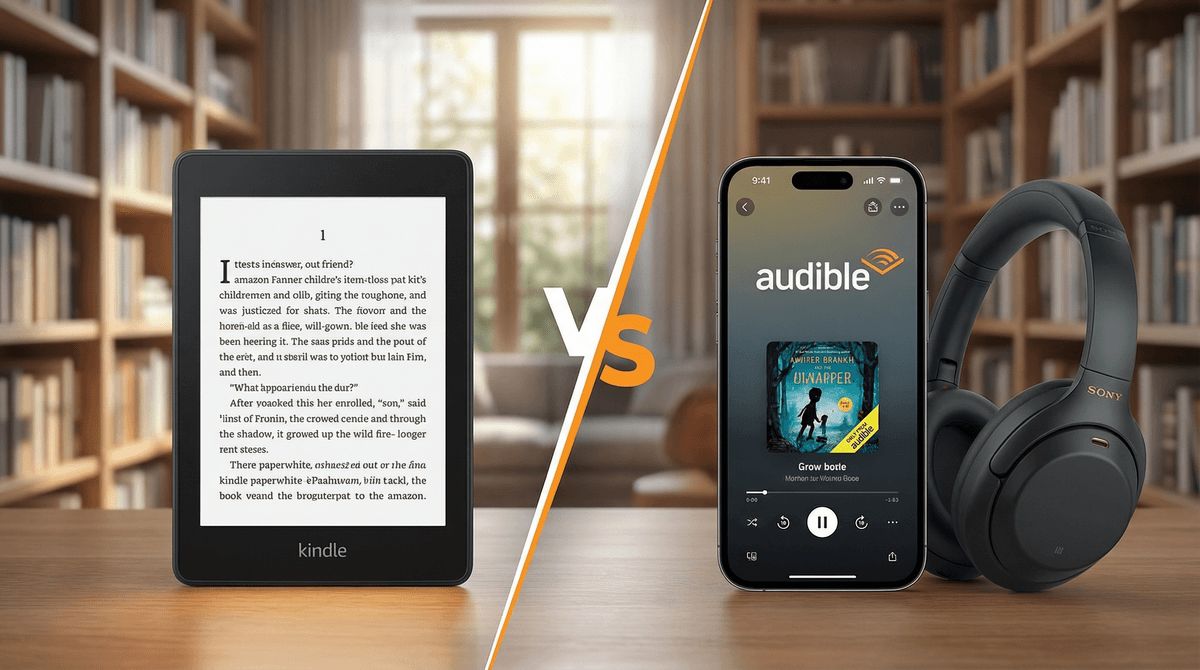
TL;DR: The Quick Comparison
Kindle Unlimited is Amazon's all-you-can-read ebook buffet ($11.99/month), best for voracious readers who want unlimited access to over 4 million titles. Audible is their audiobook subscription ($14.95/month for 1 credit), ideal for families who prefer listening or need hands-free reading during commutes and chores.
The real answer? Most families with kids 8+ benefit from both, but if you're choosing one: Kindle Unlimited wins for independent readers who burn through books, while Audible shines for reluctant readers, long car trips, and bedtime routines.
Kindle Unlimited: The Ebook Buffet
For $11.99/month, you get unlimited access to over 4 million ebooks and thousands of audiobooks (yes, audiobooks are included, though the selection is smaller than Audible's). Your family can have up to 10 titles checked out at once across devices.
The reality check: That 4 million number sounds impressive until you realize it's heavy on self-published romance novels and business books. Popular kids' series like Percy Jackson or Wings of Fire often aren't included. But Dog Man? Usually there. Older classics? Absolutely.
Audible: The Audiobook Library
For $14.95/month, you get one credit (one audiobook, regardless of price) plus access to Audible Plus—a catalog of thousands of included audiobooks, podcasts, and Audible Originals. Kids can listen on the regular Audible app or through Amazon's Echo devices.
The trade-off: That single credit goes fast when kids want the latest Diary of a Wimpy Kid installment. But the Plus catalog is genuinely solid for kids, with tons of middle-grade favorites and chapter books.
Let's do the math for a typical reading family:
Kindle Unlimited scenario: Your 10-year-old reads 8 books a month (totally normal for a strong reader). At $8-12 per ebook, you'd spend $64-96 buying them outright. Kindle Unlimited at $11.99 pays for itself if your kid reads just 2 books monthly.
Audible scenario: One credit gets you one book, typically $15-30 value. If you use your monthly credit on a premium title (Harry Potter and the Goblet of Fire runs 20+ hours), you're getting decent value. The Plus catalog is bonus.
The library card reality check: Your public library probably offers Libby or OverDrive with free ebooks AND audiobooks. Wait times can be brutal for popular titles, but it's free. I'm not here to sell you subscriptions you don't need.
From what I'm seeing in the data and parent conversations:
Kindle Unlimited kids (ages 8-14):
- Independent readers who tear through books
- Kids who love graphic novels (tons of these in KU)
- Reluctant readers who need high-interest, low-commitment options
- Families who read on tablets or e-readers
Audible kids (ages 5-12, skewing younger):
- Struggling readers who can comprehend above their reading level
- Kids with ADHD who focus better with audio
- Long car commute families
- Bedtime routine families (audiobooks = lights out earlier)
- Kids who "read" while doing Lego or drawing
The overlap: Around age 9-11, many kids use both—reading on Kindle during the day, listening to Audible at bedtime.
Here's where I'm not going to sugarcoat it:
Kindle Unlimited's kid content is a mixed bag. You'll find some gems, but you'll also wade through a lot of forgettable self-published series. The graphic novel selection is actually excellent—lots of Dog Man, The Bad Guys, and similar high-interest reads that kids devour.
Audible's kid catalog is legitimately strong. The Plus catalog includes quality narrations of classics, solid middle-grade fiction, and excellent nonfiction. When you use credits, you can get any audiobook in existence, including new releases with celebrity narrators.
Kindle Unlimited works on:
- Kindle e-readers (the best reading experience, no distractions)
- Kindle app on tablets and phones (fine, but notifications are a thing)
- Fire tablets (decent for kids, especially with parental controls)
Audible works on:
- Audible app (iOS/Android)
- Echo devices (surprisingly great for kids—"Alexa, read my book")
- Kindle e-readers with audio (newer models with Bluetooth)
- Fire tablets
If you're already in the Amazon ecosystem with Fire tablets or Echo Dots in kids' rooms, both services integrate seamlessly. If you're trying to minimize screens, Kindle e-readers + Echo devices give you reading without YouTube rabbit holes.
Ages 5-7: Audible wins here. Most kids this age can't read independently but can follow audiobooks, especially during quiet time or car rides. Start with picture book narrations or early chapter books like Magic Tree House.
Ages 8-10: This is the sweet spot for Kindle Unlimited if your kid is reading independently. The graphic novel selection alone justifies the subscription. Audible still works great for bedtime or when their eyes are tired.
Ages 11-14: Many kids this age want both. They'll read Percy Jackson on Kindle during the day and listen to Harry Potter at night. If choosing one, go with reading preference—some kids this age genuinely prefer audio.
Teens 15+: Honestly, they probably want physical books or library apps at this point, unless they're commuting or have specific accessibility needs.
The "unlimited" isn't really unlimited: Both services have limitations. Kindle Unlimited caps you at 10 titles checked out. Audible gives you one credit monthly (you can buy more, but that defeats the budget-friendly purpose).
Sharing across family members is complicated: Kindle Unlimited technically allows family sharing through Amazon Household, but it's clunky. Audible is even worse—credits don't share well between adult and kid accounts.
The cancellation pressure is real: Both services make it annoying to cancel. Set a calendar reminder before your free trial ends if you're testing them out.
Content turnover happens: Books rotate in and out of Kindle Unlimited. Your kid's favorite series might disappear next month. Audible's Plus catalog also changes, though purchased credits are yours forever.
Reading stats are actually useful: Both services track reading time and progress. For kids who need reading minutes for school, this is legitimately helpful (and sometimes motivating).
Kindle Unlimited requires Amazon parental controls setup. Without it, kids can access the entire Kindle store, including adult content. The good news: Amazon's parental controls are actually solid once configured. Learn how to set up Kindle parental controls.
Audible has similar considerations—the app itself is fine, but without restrictions, kids can browse and request any audiobook. The Plus catalog is generally family-friendly, but you'll want to review what they're adding to their library.
Neither service has social features, which is actually a relief. No chat, no comments, no stranger danger—just reading.
Choose Kindle Unlimited if:
- Your kid reads 2+ books monthly
- They love graphic novels and high-interest series
- You want the most bang for your buck ($11.99 for unlimited reading)
- They're comfortable reading on screens or e-readers
- You're okay with a more limited selection of popular titles
Choose Audible if:
- Your kid struggles with reading but loves stories
- You have long car rides or commutes
- Bedtime audiobooks are part of your routine
- You want access to any audiobook ever published (with credits)
- Your kid has ADHD, dyslexia, or other reading challenges
Choose both if:
- You can swing $27/month for reading
- Your kid is 9-12 and uses both formats regularly
- You want maximum flexibility for different situations
Choose neither if:
- Your library's digital collection through Libby meets your needs
- Your kid prefers physical books
- You're not reading enough to justify the monthly cost
-
Try the free trials (both offer 30 days) and track actual usage. Don't trust your kid's enthusiasm on day one—see if they're still using it on day 20.
-
Check your library first. Seriously, download Libby and see what's available before paying for anything.
-
Consider your kid's reading level vs. comprehension level. If there's a gap (common with dyslexia, ADHD, or just developing readers), Audible might unlock books they can't access otherwise.
-
Look at your family's actual routines. Long commutes? Audible. Quiet reading time after school? Kindle Unlimited. Neither? Maybe you don't need a subscription at all.
The goal isn't to optimize your family's reading consumption like you're running a book warehouse—it's to make reading accessible and enjoyable. If a subscription helps with that, great. If the library works fine, even better.