

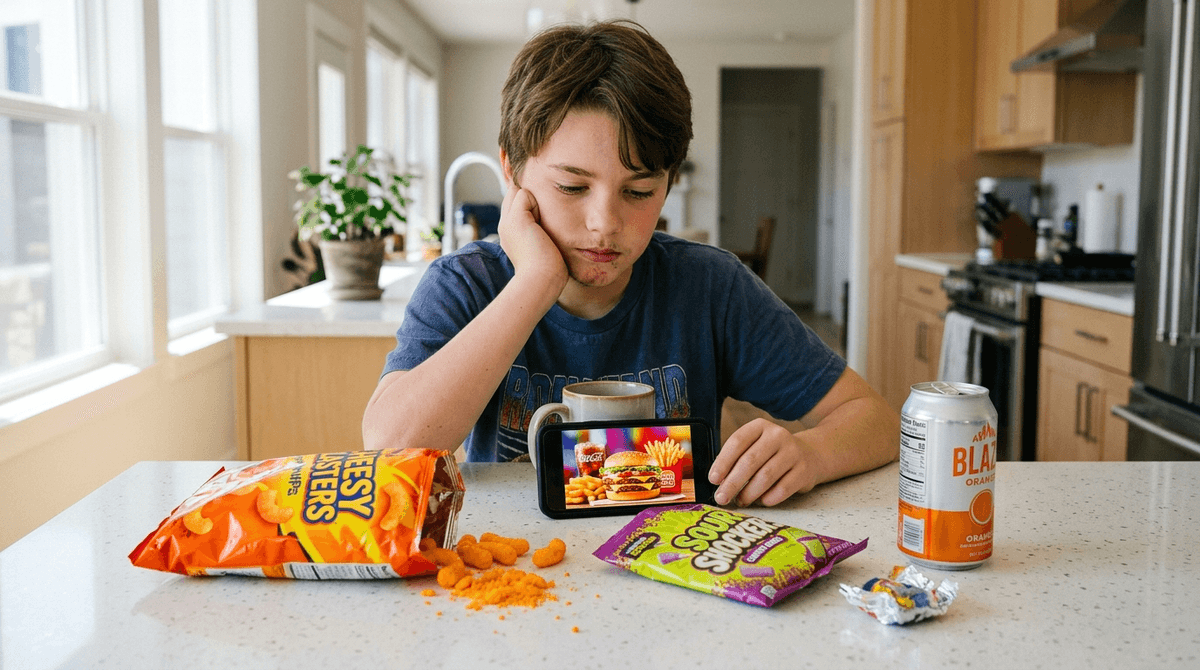

Nearly every snack, drink, and meal marketed to kids on social media fails basic international health standards. If an algorithm serves your child a food ad on TikTok or YouTube, that product is almost certainly packed with excess sugar or saturated fat.
Food brands on social media flood kids with products that blow past global health guidelines for sugar and processing. Even when these foods clear weak local food labeling laws, more than 9 out of 10 items advertised to children on platforms like YouTube and TikTok are classified as nutritionally unfit by public health authorities.
Traditional television advertising has strict guardrails, but digital platforms operate with minimal oversight. Food companies pour marketing dollars into short-form video where kids spend hours every day—and the products they push are never whole fruits or vegetables.
When a brand appears in your child's feed, assume it is ultra-processed. Recognizing that social video feeds serve as promotional showcases for junk food changes how you evaluate grocery store requests, school lunch trade-offs, and screen time rules.
Public health researchers wanted to test how well digital food advertising matches up against actual nutrition science. While countries like Brazil have updated packaging warning labels, digital marketing has largely escaped scrutiny. Researchers set out to measure the nutritional profile of every single food item featured in kids' social media marketing campaigns across Instagram, TikTok, and YouTube.
The nutritional quality of advertised food is not borderline—it is overwhelmingly poor.
- TikTok reached 100% failure. Every single food item marketed to children on TikTok failed the Pan American Health Organization (PAHO) nutritional criteria.
- YouTube was virtually as bad. Over 99% of YouTube food ads contained at least one product violating global standards, averaging nearly four unhealthy items per video post.
- Added sugar drove the failure. More than six in ten products exceeded international limits for added sugar, while nearly half blew past even the much more permissive Brazilian domestic labeling standards.
- Dairy drinks and ready-to-eat meals scored worst. Ultra-processed cheeses, chocolate drinks, and pre-packaged meals showed zero percent compliance with international health standards.
A product claiming to meet local government standards does not mean pediatricians or nutritionists want your kid eating it. Food manufacturers frequently hide behind local labeling laws that set generous thresholds for sugar and saturated fat while marketing heavily to young audiences.
Furthermore, platforms like YouTube deliver multi-product blitzes. A single 30-second clip rarely features just one snack; it often showcases three or four companion junk foods in one go, multiplying a child's exposure during a casual viewing session.
Researchers tracked 994 posts from 33 major food brands across 2023, analyzing roughly 1,500 food items. However, the study only examined official brand accounts. It didn't account for sponsored content from "kidfluencers" or organic meme trends, meaning real-world child exposure to junk food marketing is likely far higher.
The analysis also looked at advertising content, not kids' actual grocery carts or health outcomes. It proves what companies are pushing, not how much of it kids end up eating. Finally, researchers tracked "added sugars" rather than total "free sugars," which likely underestimates how sugary these products really are.
- If your child frequently asks for specific branded cereals or chocolate milks, check the nutrition panel for added sugars before agreeing; these categories fail international health standards up to 90% of the time.
- If your child watches YouTube without an ad-blocker, switch to ad-free viewing modes or curate offline playlists to cut out an average of three to four ultra-processed food pitches per ad break.
- If a packaged snack carries "no warning label" or claims to be school-approved, treat the claim skeptically; domestic packaging thresholds are far looser than the nutritional standards set by global pediatric health organizations.
Social media food advertising is not a reflection of a balanced diet; it is an unfiltered distribution channel for sugar and ultra-processed food. You cannot rely on platforms or permissive domestic labeling to protect your child's palate, so assume any snack promoted on their screen belongs in the "occasional treat" category rather than the weekly grocery haul.
Matos JP, Araújo BLSG, Ribeiro M et al. (2026). Applying Brazilian front-of-pack nutrition labeling and PAHO nutritional criteria to digital food advertising: regulatory implications for protecting children and adolescents. PloS one. doi:10.1371/journal.pone.0354180 — pubmed.ncbi.nlm.nih.gov