

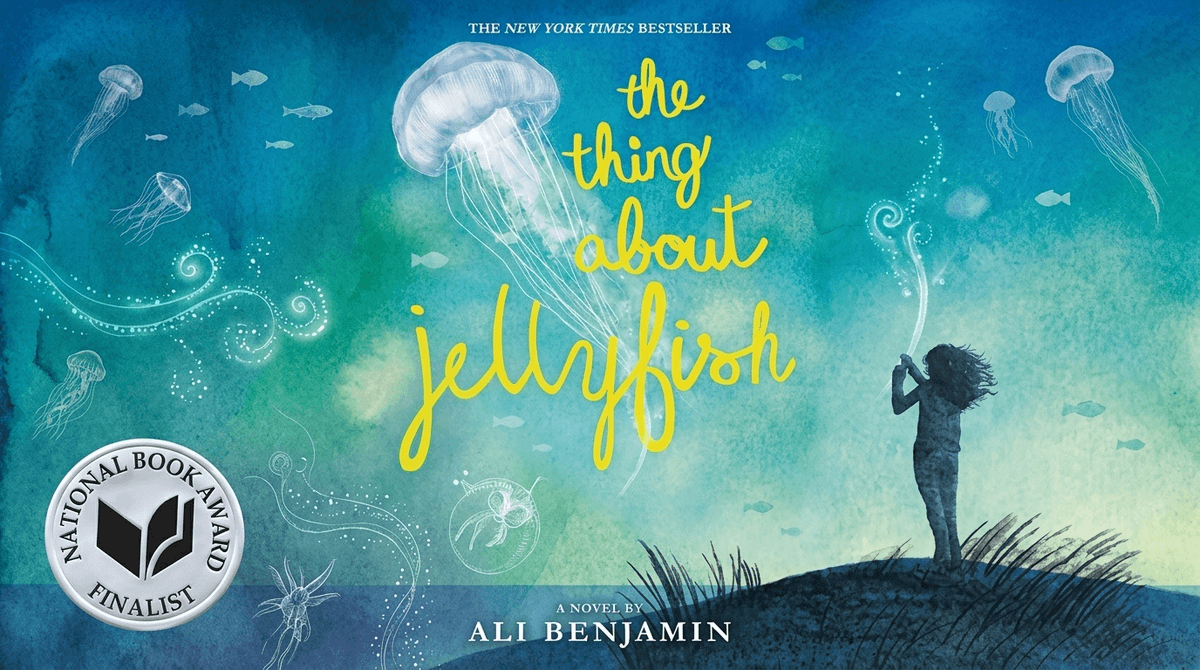
TL;DR: The Thing About Jellyfish by Ali Benjamin is a beautifully written, deeply emotional middle-grade novel, but for most 9-year-olds, it’s a "yellow light" book. It deals directly with the death of a peer, the guilt of a fractured friendship, and elective mutism. If your child is a sensitive soul or currently navigating "mean girl" or "ex-best friend" drama, this might be a lot to process alone. It’s better as a buddy-read with a parent than a solo flight for a 4th grader.
If you’re looking for something slightly more manageable but still meaningful, check out Wonder by R.J. Palacio or The Wild Robot by Peter Brown.
The Thing About Jellyfish follows twelve-year-old Suzy Swanson, who is reeling from the sudden death of her former best friend, Franny Jackson. Franny drowned while on vacation, which makes no sense to Suzy because Franny was a champion swimmer.
Suzy becomes convinced that Franny didn't just drown—she must have been stung by an Irukandji jellyfish. To cope with her grief and the "wrongness" of the world, Suzy stops talking entirely (elective mutism) and retreats into a world of scientific research, planning a solo trip across the globe to find a jellyfish expert who can prove her theory.
It’s a story about the "messiness" of life, the finality of death, and the desperate ways we try to find logic in things that are inherently illogical.
By the time kids hit 4th grade, the "magic" of early childhood is starting to wear off. They are becoming acutely aware that bad things happen, that friendships can be fragile, and that adults don't always have the answers.
Suzy’s fascination with the natural world—specifically the bizarre and dangerous beauty of jellyfish—is a huge hook for kids who love National Geographic Kids or podcasts like Wow in the World.
However, the "sadness" in this book isn't just a background vibe; it’s the engine of the plot. Unlike the adventurous peril in Percy Jackson, the sadness here is grounded, domestic, and very, very real.

When parents ask if a book is "too sad," they’re usually asking about three specific things. Here is how The Thing About Jellyfish stacks up:
1. The Death of a Peer
This isn't a grandparent passing away after a long life. This is a child who was just "there" and then isn't. For a 9-year-old, the realization that someone their own age can die is a major developmental milestone that can trigger existential anxiety. If your child has recently experienced a loss, this book will be a mirror, not a window.
2. The "Ex-Best Friend" Guilt
This is actually the part that hits 4th and 5th graders the hardest. Suzy and Franny weren't friends when Franny died. They had a "falling out" because Franny wanted to be part of the popular crowd and Suzy didn't fit in. Suzy’s last interaction with Franny was actually an attempt to "get back" at her that went wrong. The weight of unresolved conflict is a very mature theme that can be difficult for a 9-year-old to shoulder without some parental guidance.
3. Social Isolation and Bullying
Suzy’s experience in middle school is portrayed with painful honesty. She is the "weird" kid. She is lonely. She is ignored. For a 4th grader looking ahead to middle school, this can make the upcoming years look pretty bleak.
If you think your 9-year-old isn't quite ready for Suzy's journey, or if they finished it and need something to "cleanse the palate," here are some excellent alternatives:
Ages 8-12 If the draw to The Thing About Jellyfish is the "social dynamics" and "feeling like an outsider," Wonder is the gold standard. It deals with some heavy stuff, but it is ultimately much more hopeful and community-focused.
Ages 7-11 For the kid who loves the scientific observations and the "nature vs. logic" aspect of the jellyfish book, The Wild Robot is a perfect fit. It explores what it means to be "alive" and how to survive in a world that doesn't always make sense, but it does so through the lens of a robot on an island, which provides a bit of a "safety buffer" for sensitive readers.
Ages 9-12 If you want to lean into the theme of losing a friend, this is the classic. It is just as sad (maybe sadder), but it’s a foundational piece of children’s literature that handles the "aftermath" of loss in a way that feels very honest to the childhood experience.
Ages 6+ Sometimes it's easier to talk about "big feelings" through a screen before diving into a 300-page novel. Inside Out provides the vocabulary for "Sadness" and "Joy" that can help a 9-year-old articulate why Suzy's story is affecting them so much.
Check out our guide on how to talk to kids about grief in media
In the world of publishing, this is a "Middle Grade" book, usually aimed at ages 10-14.
- The 9-year-old (4th Grade): This is the "young" end of the spectrum. They will understand the words, but the emotional nuance of Suzy's regret might go over their head, or worse, sit in their stomach like a lead weight.
- The 11-year-old (6th Grade): This is the "sweet spot." They are living the "social hierarchy" drama Suzy describes and can better appreciate the scientific metaphors.
Community Data Note: Our data shows that while many 4th graders start this book because of the cool cover and "jellyfish facts," about 30% of parents of 9-year-olds report that their child stopped halfway through because it was "too boring" (which is often kid-code for "too emotionally taxing").
If your child is determined to read it, or if they’re reading it for school, here are a few ways to open the conversation:
- "Why do you think Suzy stopped talking?" This helps them explore the idea of "internalizing" grief without you having to lecture them on psychology.
- "Do you think Franny was a 'mean girl' or just a kid trying to fit in?" This is a great way to talk about the shifting sands of 4th and 5th-grade friendships.
- "Suzy uses science to explain things that don't have an easy answer. Do you ever do that?" This connects the "brainy" part of the book to the "feeling" part.
The Thing About Jellyfish is not "brain rot." It is the opposite—it is high-quality, high-protein literature. But just like you wouldn't give a 9-year-old a 20oz steak and expect them to finish it without help, you shouldn't hand them this book and walk away.
It is a beautiful, necessary book about the fact that life isn't always fair and science can't solve every problem. But for a 4th grader, it’s a "read-together" experience. If they want to read it solo, make sure you're checking in every few chapters to see how they're handling the "sting."
- If they love the science: Introduce them to Wow in the World or the National Geographic Kids website.
- If they need something lighter: Try The Wild Robot.
- If you want to dive deeper into digital wellness: Take our survey to see how your family's media habits compare to your community.