

Is My Preschooler Behind in Reading?
Let's get real: if you're Googling this at 11pm after your kid's friend started reading chapter books while yours still puts books upside down, take a breath. The preschool literacy panic is real, and it's mostly manufactured by a combination of Instagram humble-brags and well-meaning but anxiety-inducing developmental checklists.
Here's what actually matters about early reading, when to genuinely worry, and when to pour yourself a glass of wine and relax.
First, let's define "preschool" — we're talking roughly ages 3-5, before kindergarten starts. And here's the thing: preschoolers aren't supposed to be reading. Like, at all.
Yes, some do. And that's fine! But the developmental expectation is that kids learn to read in kindergarten and first grade, not before. Preschool literacy is about building the foundation for reading, not actual reading itself.
What does that foundation look like?
Ages 3-4:
- Holds books right-side up (most of the time)
- Knows books have a front and back
- Recognizes some letters, especially those in their name
- Pretends to read by telling stories from pictures
- Enjoys being read to (even if they won't sit still for long)
- Understands that print carries meaning
- Can rhyme a little bit (or at least thinks "elephant" and "banana" rhyme)
Ages 4-5:
- Recognizes many letters and their sounds
- Can write some letters, especially in their name
- Understands that words are made of sounds
- Can identify the first sound in simple words
- Retells familiar stories
- Sits through longer books
- Might recognize some sight words (their name, "stop," "mom")
Notice what's NOT on this list? Actually reading sentences. Decoding unfamiliar words. Reading independently.
You know what's messing with our heads? A few things:
Hyperlexia gets confused with typical development. Some kids (around 2-3% of children) have hyperlexia — they teach themselves to read very early, sometimes as young as 2 or 3. It's often associated with autism spectrum disorder, though not always. Point is: this is unusual, not the standard we should measure against.
Social media creates false norms. Parents post their 4-year-old reading Harry Potter, but they don't post the 47 times their kid refused to sit for a book that week. We're seeing highlight reels and thinking they're the average.
Academic push-down is real. Kindergarten used to be about play and socialization. Now it often includes expectations that used to be first or second grade. This creates pressure that trickles down to preschool, even though developmentally, it makes no sense.
Apps and programs make promises they shouldn't. ABCmouse, Homer, and similar apps can be helpful tools, but they've also convinced parents that preschoolers should be doing formal reading instruction. They're not bad apps — they're just marketed in ways that create anxiety.
Here's what research tells us matters for later reading success:
Oral language skills. The number one predictor of reading ability isn't letter knowledge — it's vocabulary and oral language comprehension. Kids who can understand complex sentences, follow multi-step directions, and have rich vocabularies do better when they start formal reading instruction.
Phonological awareness. This is the ability to hear and play with the sounds in words. Rhyming, clapping syllables, identifying first sounds — this stuff matters more than memorizing sight words.
Print motivation. Does your kid like books? Want to be read to? Show interest in signs and labels? That enthusiasm matters more than current skill level.
Letter knowledge. Yes, knowing letters helps. But knowing all 26 letters and their sounds by age 5 is plenty. Your 3-year-old doesn't need to ace a letter quiz.
What doesn't predict reading success? How early they start. Kids who learn to read at 4 and kids who learn at 6 or 7 are reading at the same level by age 11. Early reading is not an advantage in the long run.
Okay, so when should you be concerned? Here are some legitimate red flags:
By age 4:
- Doesn't show any interest in books or stories
- Can't recognize any letters
- Doesn't understand that print carries meaning
- Has very limited vocabulary for their age
- Can't follow simple two-step directions
- Doesn't engage in pretend play or storytelling
By age 5:
- Can't recognize most letters
- Doesn't understand that words are made of sounds
- Can't rhyme at all, even with support
- Struggles to learn letter sounds even with practice
- Has difficulty with basic oral language comprehension
- Shows frustration or avoidance around anything literacy-related
At any age:
- Speech that's very hard to understand
- Difficulty hearing or frequent ear infections
- Family history of dyslexia or reading difficulties
- Regression in skills they previously had
If you're seeing these red flags, talk to your pediatrician. Early intervention for actual reading difficulties is valuable. But "my kid can't read yet" at age 4 is not a red flag. It's developmentally typical.
Read together. A lot. This is the single best thing you can do. Not flashcards. Not apps. Not workbooks. Just reading picture books together, talking about the stories, and making it enjoyable. Aim for 15-20 minutes a day, but even 10 minutes counts.
Some favorites that build literacy skills without feeling like work:
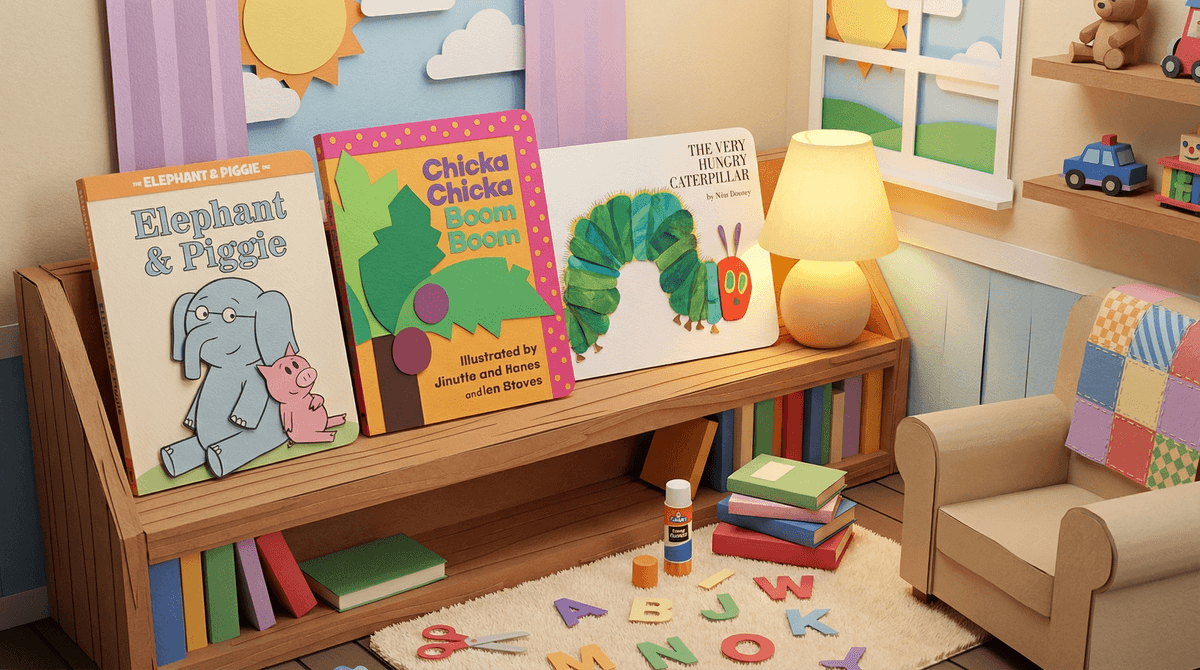
- Chicka Chicka Boom Boom (letters and rhythm)
- The Pout-Pout Fish (rhyming and emotions)
- Anything by Mo Willems — the Elephant and Piggie series is gold for early readers
Talk to your kid. Rich conversations build vocabulary and comprehension. Narrate what you're doing, ask open-ended questions, introduce new words and explain them.
Play with sounds. Sing songs, make up rhymes, play "I Spy" with first sounds ("I spy something that starts with /b/"). This builds phonological awareness without worksheets.
Let them see you read. Kids who see adults reading for pleasure become readers themselves.
Make writing fun. Let them "write" shopping lists, draw and label pictures, trace in sand or shaving cream. Fine motor skills matter for writing, and writing supports reading.
Limit the screen-based "learning." A little PBS Kids or Endless Alphabet isn't going to hurt, but apps can't replace human interaction for language development. If you're using apps, use them together and talk about what you're seeing.
Your preschooler is not behind. The goalposts have moved in weird ways that don't match child development, and that's not your kid's problem — it's a societal problem.
If your 4-year-old can't read, they're typical. If they can recognize some letters and enjoy books, they're doing great. If they're showing genuine red flags (see above), talk to your pediatrician.
But if your main concern is that another kid at daycare can read and yours can't? That's not a reading problem. That's a comparison problem. And I say this with love: let it go.
The research is clear — there's no long-term advantage to early reading. What matters is building a foundation of language, curiosity, and a love of stories. Do that, and the reading will come when they're developmentally ready.
Your job isn't to teach your preschooler to read. Your job is to read with them, talk to them, and let them be 4. They'll get there. And when they do, you'll miss the days when they wanted you to read The Very Hungry Caterpillar for the 847th time.
If you're still worried: Schedule a developmental screening with your pediatrician. They can assess whether there are genuine concerns or whether you need reassurance (spoiler: it's usually reassurance).
If you want to support literacy at home: Focus on reading together daily, having rich conversations, and playing with sounds and letters in fun, low-pressure ways.
If you're feeling pressure from preschool or other parents: Remember that you're the expert on your kid. Developmental timelines are ranges, not races. And research on early academic pressure shows it doesn't create advantages — it often creates anxiety.
You've got this. Your kid's got this. Now go read them a story and stop Googling literacy milestones at midnight.