

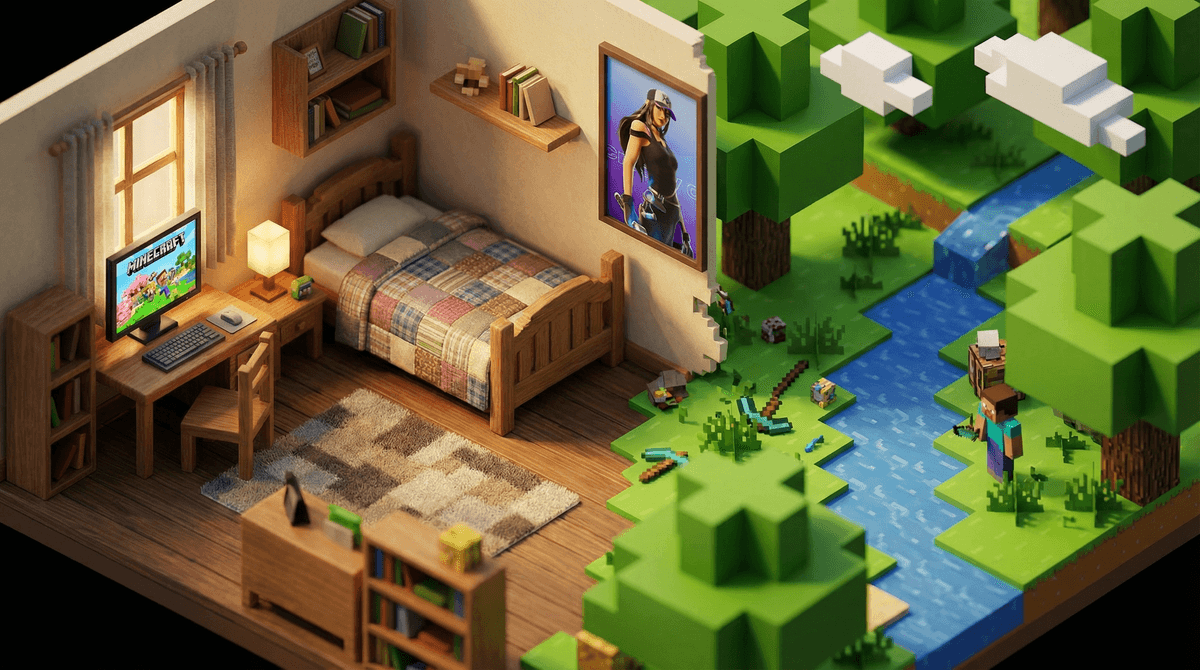
Look, if your kid is spending 3 hours in Minecraft, you're probably wondering if you should intervene or just be grateful they're not begging for Fortnite again.
The honest answer? It depends — and not in a cop-out way. Three hours of Minecraft on a Saturday while building an elaborate redstone contraption with friends is genuinely different from three hours of aimless cave-diving alone every single day after school.
The research on screen time has evolved significantly in the past few years. The old "2 hours max" rule from the American Academy of Pediatrics? That was created before Minecraft existed, when "screen time" mostly meant passive TV watching. Modern researchers are much more interested in what kids are doing and how it affects the rest of their life than arbitrary time limits.
Here's the thing parents need to understand: Minecraft legitimately does engage different parts of the brain than most games. Studies on sandbox games show they can develop spatial reasoning, planning skills, and creative problem-solving. When kids are in Creative mode designing builds or working through complex Redstone logic, they're doing something closer to digital LEGOs than Call of Duty.
But — and this is important — it's still a screen. It's still potentially displacing other activities. And not all Minecraft time is created equal.
Creative mode where kids are building, designing, and problem-solving? That's genuinely constructive time. Survival mode with friends, collaborating on projects and communicating? Also valuable. Hypixel minigames for three hours straight? That's just gaming, and while there's nothing wrong with gaming, let's not pretend it's educational.
The research suggests that the benefits of Minecraft peak somewhere around 60-90 minutes and then level off. After that, you're mostly just getting more of the same, not deeper learning or creativity.
Instead of obsessing over whether it's 2 hours or 3 hours, here's what research suggests you should actually care about:
Is it interfering with sleep? Gaming within 2 hours of bedtime consistently shows negative effects on sleep quality and duration. Three hours of Minecraft ending at 5pm? Probably fine. Three hours ending at 10pm on a school night? That's a problem.
Is it displacing physical activity? Kids need to move. If your kid is getting outside, playing sports, or being active and then playing Minecraft, that's a very different situation than coming home and immediately tunneling into screens for the rest of the day.
Is it affecting social relationships? This one's tricky because Minecraft can be social. But if your kid is only socializing through Minecraft and avoiding real-world interactions, or if they're ragequitting and screaming at their friends through the headset, that's worth addressing. On the flip side, if they're collaborating on builds with school friends and it's enhancing those relationships? That's actually pretty healthy.
Can they stop when asked? This is the big one. If you say "15 more minutes" and your kid can wrap up and transition without a meltdown, that's a green flag. If every session ends in tears, negotiation, or a full-blown tantrum, that's your body's way of telling you something's off — regardless of whether it's been 1 hour or 3.
Ages 6-8: Three hours is probably too much at this age, full stop. Their brains are still developing executive function and self-regulation. Even in Creative mode, 60-90 minutes is plenty. They need more variety in their play.
Ages 9-11: Three hours on a weekend day when they've done other activities? Reasonable. Three hours every day? That's starting to crowd out other developmental needs. Aim for 1-2 hours on school days, and be more flexible on weekends.
Ages 12+: This is where it gets more nuanced. If your middle schooler is spending Saturday afternoon building an elaborate city with friends on a realm, having a blast, and it's not affecting their other responsibilities, three hours isn't inherently harmful. But if it's becoming the only thing they want to do, every single day, that's worth a conversation.
Three hours of Minecraft isn't automatically okay or not okay. What matters is:
- Context: What else happened that day?
- Content: What are they actually doing in the game?
- Consequences: Is it affecting sleep, physical activity, schoolwork, or relationships?
- Control: Can they regulate themselves and stop when needed?
If your kid played soccer for 2 hours, did their homework, and now wants to spend 3 hours on Saturday building a Hogwarts replica with friends in Minecraft? That's probably fine. If they're coming home every day, immediately logging in, and playing until bedtime while ignoring homework and family dinner? That's a pattern worth addressing — and the problem isn't really about whether it's 2 hours or 3 hours.
Instead of setting an arbitrary time limit, try this:
-
Track a week — Just observe what's actually happening. How much are they playing? When? What else are they doing?
-
Check the basics — Are they sleeping enough? Moving their body? Doing okay in school? Maintaining friendships?
-
Look at the pattern — Is Minecraft the only thing they want to do, or one thing among many?
-
Have a conversation — Not a lecture, a real conversation. Ask what they're working on, what they like about it, what their goals are in the game.
If you want to dig deeper into whether your specific situation is healthy, Screenwise can help you think through your family's unique context . And if you're looking for alternatives to Minecraft that offer similar creative benefits, we've got you covered there too.
The goal isn't perfection. It's balance. And sometimes balance includes a 3-hour Minecraft session — as long as it's not every single day.