

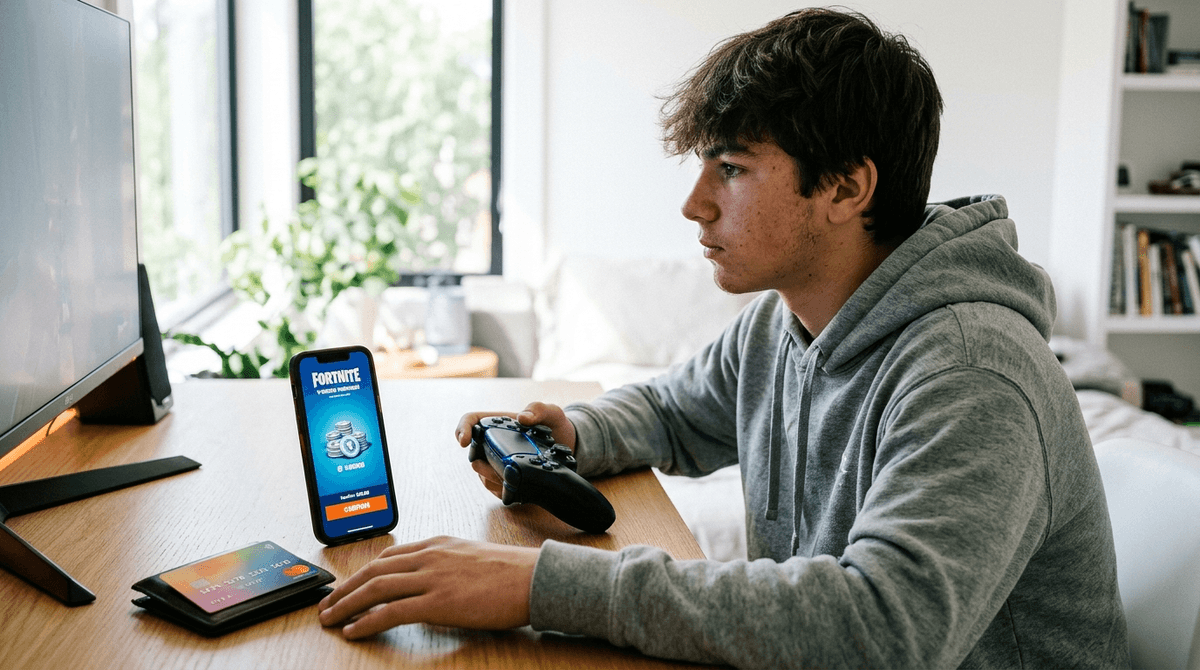

Spending real money on virtual video game items is closely tied to both gaming addiction and early symptoms of problem gambling in teenagers—especially boys. Buying digital skins or opening mystery reward packs turns out to carry risks that extend well beyond the screen.
In-game purchases link directly to compulsive gaming habits and problem gambling behaviors in young teens, with boys facing triple the gambling risk of girls.
Parents often treat in-game purchases as harmless digital allowances—a five-dollar skin here, a small weapon upgrade there. But microtransactions actively blur the line between recreational play and compulsive financial risk-taking.
If your teen is spending money inside video games, they are navigating systems engineered to mimic casino mechanics. Treating in-game purchases as casual fun overlooks how financial micro-rewards alter the way an adolescent brain engages with screen time.
Game developers have largely abandoned one-time purchase models in favor of "free-to-play" ecosystems funded by microtransactions and loot boxes. These games frequently use variable-ratio reward schedules—the exact psychological mechanism behind slot machines—to keep players hooked on the next unlock.
Researchers wanted to measure whether this monetization model was triggering real-world clinical risks in younger adolescents whose impulse-control centers are still developing.
About one in three teens surveyed bought in-game items, and more than one in five purchased loot boxes over the past year.
- Spending boosts risk: Using in-game microtransactions was associated with a 74% increase in problem gambling symptoms and a 17% increase in gaming disorder symptoms.
- Boys face much higher vulnerability: Teenage boys were nearly three times as likely as girls to display problem gambling behaviors and 21% more likely to show signs of gaming addiction.
- Loot boxes drive compulsive play: Opening randomized reward crates was tied directly to symptoms of gaming disorder.
- Mental distress compounds the problem: Teens struggling with emotional and social difficulties scored significantly higher on both gaming and gambling risk scales.
Loot boxes did not retain an independent statistical link to gambling in the researchers' final model, but microtransactions as a whole did. That distinction matters: the risk is not confined to literal mystery boxes. The broader practice of spending real money to accelerate progress or gain social status inside a game is what bridges recreational gaming and gambling behavior.
When kids ask to spend money in a game, they are often chasing emotional relief, peer validation, or escape—which explains why existing mental health struggles magnify the risk.
This study surveyed 343 secondary school students in a single region of Spain, with an average age of 14. Cultural norms and spending habits in other countries may look slightly different.
The design was cross-sectional, meaning it shows a strong correlation, not causal proof that microtransactions create gambling problems. It is plausible that teens who are already impulsive or struggling emotionally simply spend more money in games. Additionally, the data relies on self-reported surveys from teens, who may understate their spending or gaming habits.
- If your teen plays games with paid microtransactions: Remove saved credit cards from their console and phone accounts to create deliberate friction before every purchase.
- If your child asks for randomized loot boxes or card packs: Say no to mystery rewards, limiting any occasional purchases strictly to specific, predetermined cosmetic items.
- If your son shows signs of compulsive gaming alongside mood changes: Treat the screen behavior as a symptom of broader emotional or social stress rather than an isolated discipline issue.
In-game spending reshapes how teenagers evaluate digital rewards and financial risk. You do not have to ban gaming entirely, but cutting off microtransactions is one of the highest-leverage boundaries you can establish.
Peña JMD, Kjellgren R, Ferreira JA et al. (2026). Internet Gaming Disorder, Problem Gambling Symptoms and Mental Health in Spanish Adolescents: A Cross-Sectional Study on the Role of Microtransactions and Loot Boxes. Healthcare (Basel, Switzerland). doi:10.3390/healthcare14131846 — pubmed.ncbi.nlm.nih.gov