

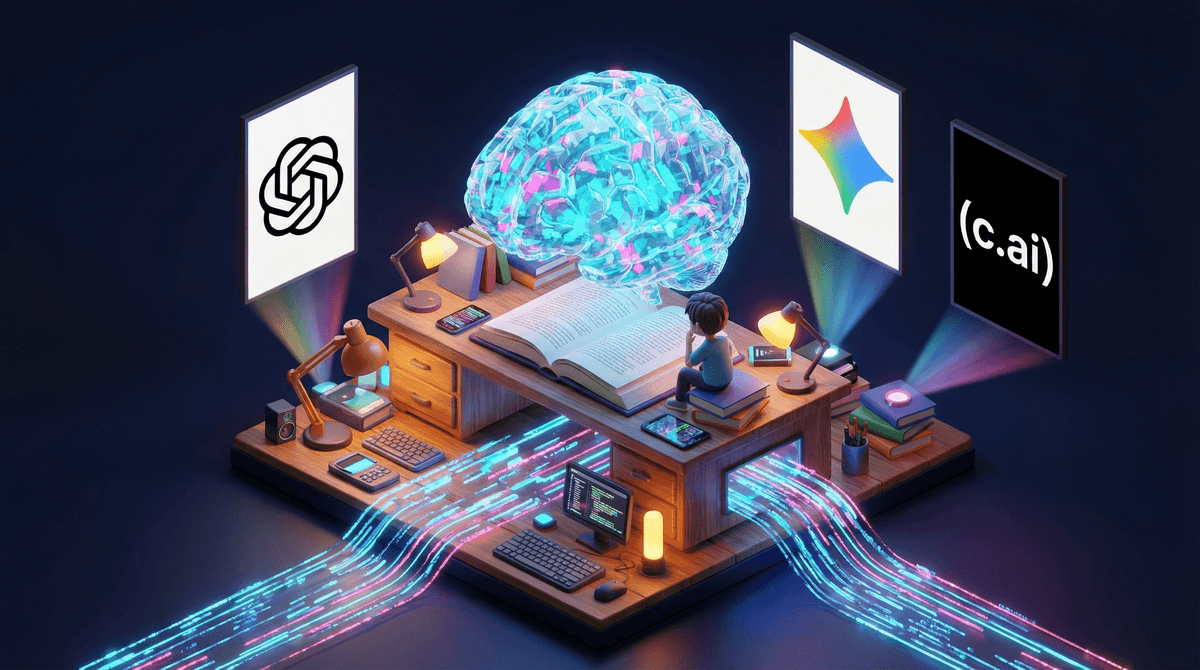
Let's start with what your kids are actually using. When we talk about AI and kids, we're mostly talking about ChatGPT, Google's Gemini, and Character.AI—tools that can write essays, answer questions, generate images, and have surprisingly human-like conversations. Your middle schooler is probably already using ChatGPT for homework help (yes, even if you haven't explicitly said it's okay). Your high schooler might be using it to brainstorm college essays or debug code. And if you've got a tween, there's a decent chance they're chatting with AI versions of their favorite fictional characters on Character.AI.
This isn't your 2010s "Hey Siri, what's the weather?" AI. These are tools that can write coherent paragraphs, solve math problems with explanations, create art, and hold conversations that feel weirdly real. And unlike most tech trends we cover, this one is moving at absolutely breakneck speed—like, "new capabilities every few weeks" speed.
Here's the thing: AI isn't going away, and your kids need to learn how to use it thoughtfully. Banning it completely is like banning calculators in the 1980s—you're just making sure your kid doesn't learn the critical thinking skills they'll actually need.
But here's what keeps educators and child development experts up at night:
The homework problem: Kids are using ChatGPT to write entire essays, and many don't see it as cheating. They see it as a tool, like Grammarly or a thesaurus. The line between "assistance" and "doing the work for you" has gotten really blurry really fast.
The accuracy problem: AI confidently spits out wrong information all the time. It "hallucinates" facts, makes up sources, and presents everything with the same authoritative tone whether it's correct or completely made up. Kids (and honestly, many adults) aren't great at spotting these errors.
The relationship problem: On apps like Character.AI, kids are having deep, personal conversations with AI chatbots. Some are using them as therapists, best friends, or even romantic partners. There have been documented cases of kids developing genuine emotional attachments to AI characters—and that raises some serious questions about healthy social development.
The privacy problem: Everything your kid types into these tools is data. It's being used to train future models. And depending on the platform, it might not be as private as you think.
Elementary (Ages 5-10): At this age, kids might encounter AI through voice assistants or educational apps, but they shouldn't have unsupervised access to ChatGPT or similar tools. If they're curious, explore it together—ask silly questions, see what it can do, and talk about how it's a computer program, not a person.
Middle School (Ages 11-13): This is when AI starts showing up in their world whether you're ready or not. They're seeing classmates use it, and they're curious. This is the age to teach them how to use it as a tool, not a crutch. Think of it like teaching them to drive in a parking lot before they hit the highway.
Some practical rules for this age:
- AI can help brainstorm or explain concepts, but can't write their assignments
- They should always fact-check what AI tells them
- No using AI chatbots for emotional support or personal conversations
- All AI use happens in shared spaces, not bedrooms
High School (Ages 14-18): Teens need to understand that AI is a workplace skill they'll need, but also that academic integrity still matters. The goal is teaching them to use AI thoughtfully—as a research assistant, a brainstorming partner, or a way to learn coding—not as a shortcut around actual learning.
Your kid's school probably has a policy now: Most schools scrambled to create AI policies in 2023-2024. Some ban it entirely, some embrace it with guidelines, most are somewhere in the middle and still figuring it out. Ask your kid's teachers what the rules are—and make sure your kid knows them.
AI detectors don't work well: Schools are using AI detection software, but it has a high false positive rate. Kids who write in certain styles (especially ESL students or very formal writers) get flagged. Meanwhile, savvy students know how to make AI-generated text undetectable. The detection arms race is messy, and your kid needs to understand that the risk isn't just getting caught—it's not learning anything.
The best defense is teaching critical thinking: Instead of trying to ban AI, teach your kids to question it. When they use ChatGPT, have them:
- Ask it the same question multiple times and compare answers
- Fact-check its sources (spoiler: they're often made up)
- Try to catch it in mistakes
- Use it to explain concepts, then explain those concepts back in their own words
Character.AI deserves special attention: This platform is wildly popular with teens and tweens, and it's designed to be addictive. Kids are having thousands of messages back and forth with AI characters. Some are harmless (chatting with Harry Potter), but others are concerning (romantic relationships with AI, using AI as a therapist for serious mental health issues). If your kid is on Character.AI, you need to talk about healthy vs. unhealthy use and set real boundaries.
Start with curiosity, not panic: "I've been reading about how kids are using AI tools like ChatGPT. Have you tried it? What do you think about it?" You'll learn way more with genuine questions than with lectures.
Use real examples: Show them how AI gets things wrong. Ask ChatGPT a question about something you know well, and fact-check it together. Make it a game to catch the AI making mistakes.
Talk about the long game: "When you use AI to write your essay, you're not learning how to organize your thoughts or make an argument. That's a skill you'll need in college, in jobs, in life. AI can help you practice that skill, but it can't build it for you."
Set clear expectations: What's okay in your house? Using AI to understand a math concept? Probably fine. Using AI to write an essay from scratch? Not okay. Having hours-long emotional conversations with an AI character? Definitely worth discussing.
AI is a tool, and like any tool, it can be used well or poorly. Your job isn't to keep your kids away from it—that ship has sailed—but to teach them to use it thoughtfully and ethically.
The kids who thrive in the AI age won't be the ones who never touch it, or the ones who use it for everything. They'll be the ones who understand what it's good for, what it's terrible at, and when to trust their own brains instead.
-
Have the conversation this week: Ask your kid if they've used ChatGPT or other AI tools, and actually listen to their answer without judgment.
-
Check your school's policy: Email your kid's teachers or check the school website. Know what the rules are.
-
Try it together: Spend 20 minutes playing with ChatGPT as a family. Ask it weird questions, try to catch it making mistakes, see what it can and can't do.
-
Set family guidelines: What's okay and what's not? Write it down. Revisit it in a few months as you all learn more.
-
If your kid is on Character.AI: Have a specific conversation about that app. It's not the same as using ChatGPT for homework help, and it needs its own set of boundaries.
The AI genie is out of the bottle. Let's make sure our kids know how to work with it, not for it.