

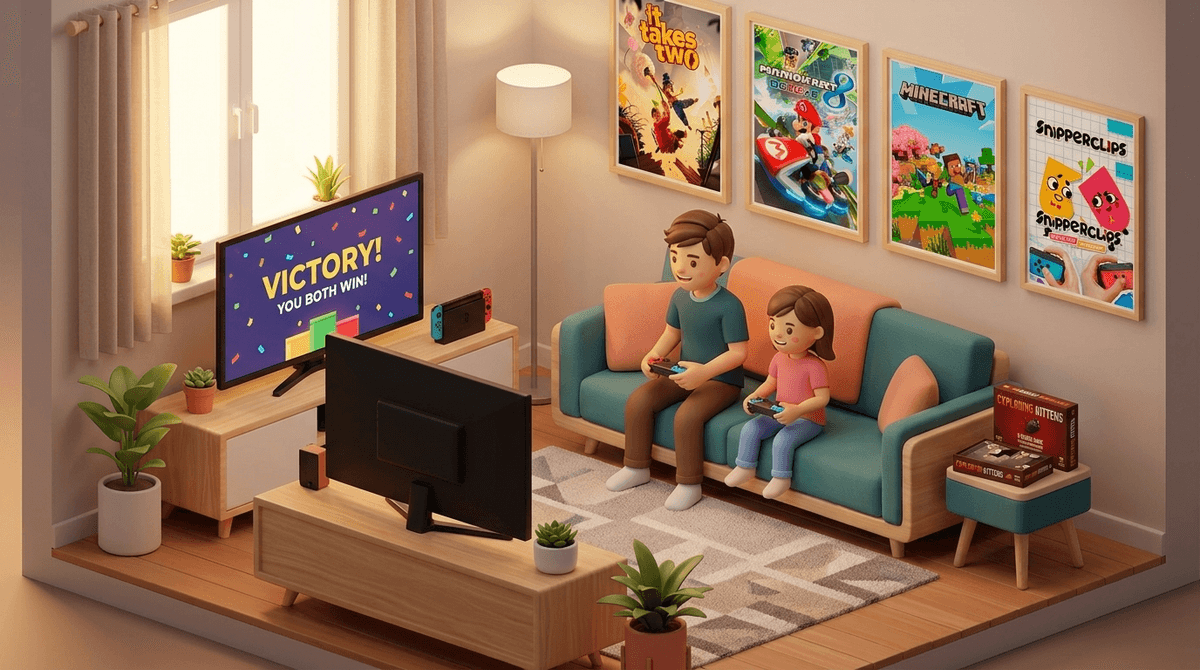
TL;DR: Sibling rivalry in gaming usually boils down to two things: access (whose turn is it?) and ability (why does my brother keep calling me a 'noob'?). You can flip the script by prioritizing cooperative "couch co-op" games over competitive ones and using built-in "assist" features to level the playing field.
Quick Picks for Peace:
- Best for Teamwork: It Takes Two (Ages 12+) or Snipperclips (Ages 6+)
- Best for Leveling the Playing Field: Mario Kart 8 Deluxe (Use "Smart Steering")
- Best for Creative Collaboration: Minecraft (Creative Mode)
- Best Analog Reset: Exploding Kittens (Ages 7+)
If you’ve ever had to pause a work call because someone downstairs screamed "THAT’S A SKILL ISSUE" at a volume that suggests a literal crime is being committed, you’re not alone. In the hierarchy of sibling fights, the "Gaming Dispute" has officially surpassed "He’s touching me" and "She got more juice" as the primary cause of household friction.
We tend to look at gaming as a solo activity or something kids do with friends online, but for siblings, the living room console is the modern-day equivalent of the back seat of a minivan. It’s a shared space with limited resources, varying skill levels, and a high potential for someone to feel "wronged."
But here’s the secret: gaming doesn't have to be the source of the rivalry. If handled right, it’s actually one of the best tools we have for teaching collaboration, emotional regulation, and how to lose without acting like a total "L-muppet."
Before we fix it, we have to understand why they’re fighting. It’s rarely about the game itself.
- The Skill Gap: This is the big one. If you have a 12-year-old and a 7-year-old, the older one is going to dominate. In a competitive game like Super Smash Bros. Ultimate, the younger kid is just a glorified punching bag. That’s not fun; it’s a recipe for a thrown controller.
- The "One More Level" Fallacy: Games are designed to keep kids engaged. When you tell a child "five more minutes," and they’re in the middle of a Roblox "Obby" (obstacle course) or a Fortnite match, they literally cannot stop without losing progress or social standing. The sibling waiting for their turn sees this as a personal insult.
- Digital Status: To kids, being "good" at a game is social currency. Calling a sibling "trash" or saying they live in "Ohio" (current kid-speak for weird/cringe) is a way of asserting dominance in the digital hierarchy.

The most effective way to stop the fighting is to move away from Player vs. Player (PvP) and move toward Cooperative (Co-op) play. In Co-op, if one person loses, everyone loses. This forces the older, more "skilled" sibling to actually help the younger one instead of dunking on them.
This is the gold standard for cooperative play. It literally cannot be played alone. The game requires two people to solve puzzles and navigate levels together. While the story is about a divorcing couple (which might be heavy or irrelevant depending on your kids), the mechanics are a masterclass in "I need you to do X so I can do Y."
- Ages: 10-12+ (due to some cartoon violence and complex themes).
- The Sibling Win: It forces communication. You can't progress if you're screaming at each other.
Nintendo is the king of the "Family Peace Treaty." Mario Kart 8 Deluxe has two features that every parent needs to know about: Smart Steering and Auto-Accelerate. You can turn these on for the younger sibling. It prevents them from driving off the track and keeps them in the race, making the "skill issue" much less of a factor.
- Ages: 4+
- The Sibling Win: The younger kid feels like they’re actually competing, and the older kid doesn’t have to wait for them to finish the lap.
If your kids are fighting over resources in Survival Mode, move them to Creative Mode. In Creative, there’s no "winning." It’s just digital Legos. Suggest a "build challenge" where they have to work together to create a specific structure, like a stadium or a replica of their school.
- Ages: 7+
- The Sibling Win: Shared ownership of a project builds a "we" mentality instead of a "me" mentality.
Check out our guide on the best cooperative games for different age gaps
The "Fairness Doctrine" is the most strictly enforced law in any household with more than one child. To avoid the constant auditing of minutes, you need a system that isn't based on your memory (because you will forget, and they will call you out on it).
- The Visual Timer: Use a physical kitchen timer or a Time Timer. Seeing the red disc disappear is much more effective than a parent yelling "five minutes" from the kitchen.
- The "Save Point" Rule: Instead of ending on a time, end on a logical breaking point. "You get two matches of Rocket League or 20 minutes, whichever comes first." This respects the game’s flow and prevents the "but I'm in the middle of something!" excuse.
- The "Coach" Role: If only one person can play at a time (like in a single-player game), give the other sibling a job. They are the "Navigator" or the "Strategist." They can look up tips on YouTube Kids or a wiki to help the player get past a hard part.
There is a fine line between healthy competitive banter and actual verbal abuse. Kids today use words like "noob," "bot," and "skill issue" as punctuation.
When to intervene:
- If the comments become personal (attacking the person, not the play).
- If one child is clearly distressed while the other is "just joking."
- If the "loser" is being shamed for their lack of ability.
How to talk about it: Explain that gaming is a hobby, not a personality trait. Use the "Would you say this to your friend at school?" test. Usually, siblings are way meaner to each other than they would ever be to a peer. Remind them that if the "toxic" behavior continues, the "console" goes into "hibernation" (aka, the top of the fridge).
Ages 5-8: The "Meltdown" Era
At this age, emotional regulation is still a work in progress. Losing feels like the end of the world.
- Strategy: Stick to games with "assist" modes or non-competitive play like Animal Crossing: New Horizons.
- Parent Tip: Praise the effort ("I loved how you helped your sister find that star") rather than the win.
Ages 9-12: The "Competitive" Era
This is where the "skill issue" talk peaks. They want to be the best and they want everyone to know it.
- Strategy: Introduce "Handicaps." In games like Super Smash Bros. Ultimate, you can manually adjust the damage levels so the younger/less skilled player has an advantage.
- Parent Tip: This is the age to talk about "GG" (Good Game) culture and being a "Good Sport."
Ages 13+: The "Separate Worlds" Era
Often, teens just want to play with their friends online.
- Strategy: If they’re sharing a console, the schedule becomes paramount. If they have separate devices, the challenge is making sure they still interact with each other in the real world.
- Parent Tip: Occasionally "force" a family game night with something like Jackbox Games where the barrier to entry is low and the humor is high.
Learn more about how to set up Nintendo Switch parental controls
Sibling rivalry in gaming isn't something you "solve" once and move on from; it’s a constant calibration. The goal isn't to have a silent living room—it's to have a living room where the noise is "Go, go, go! Jump!" instead of "I HATE YOU, YOU CHEATER!"
By choosing the right media—like Snipperclips for the little ones or It Takes Two for the older kids—and setting clear, logic-based boundaries on time, you turn the console from a battlefield into a bridge.
- Audit your library: Are 90% of your kids' games competitive? If so, it’s time to add some Co-op titles.
- The "Switch" Rule: If your kids are on a Nintendo Switch, go into the settings and learn how to use the "Parental Controls" app to set hard limits that the app enforces, so you don't have to be the bad guy.
- Go Analog: If the digital tension is too high, pull out a physical board game like Catan Junior. Sometimes a change of medium resets the sibling dynamic.