

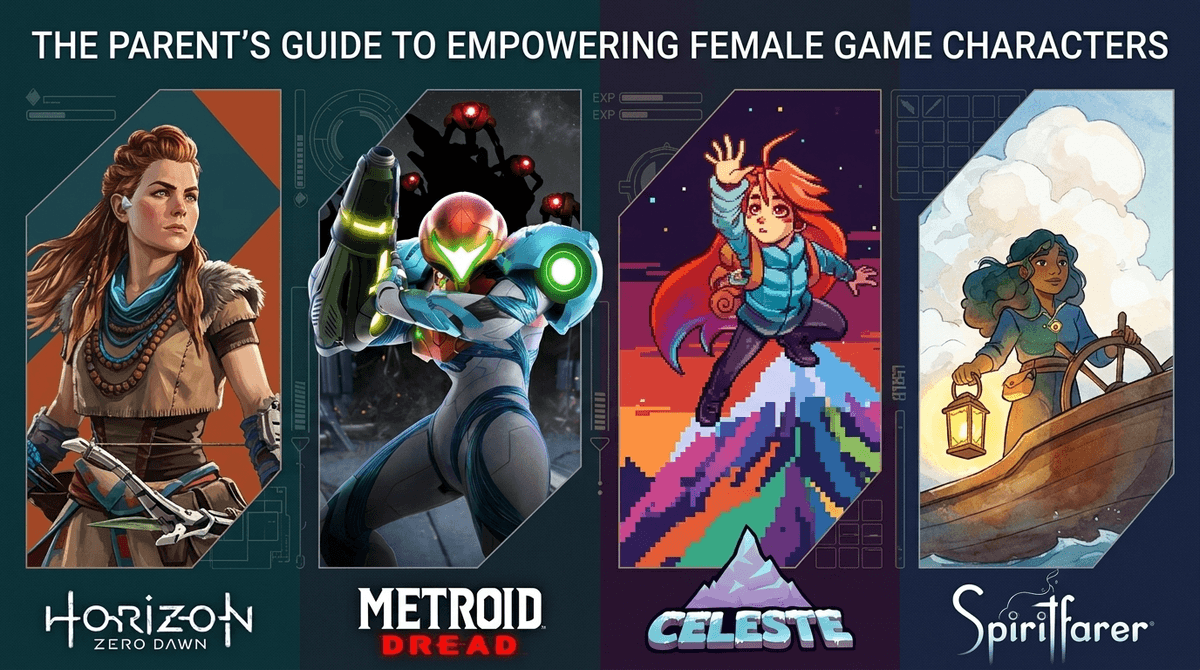
TL;DR: The Quick List If you’re looking to swap the "princess in a castle" trope for characters with actual agency, here are our top picks for games featuring powerhouse female leads:
- For the Explorer: Horizon Zero Dawn (Ages 12+) — Aloy is the gold standard for a modern hero.
- For the Thinker: Portal 2 (Ages 10+) — Chell proves you don't need to say a word to be the smartest person in the room.
- For the Resilient: Celeste (Ages 10+) — A masterclass in dealing with anxiety and persistence.
- For the Empath: Spiritfarer (Ages 10+) — Stella leads with kindness and emotional intelligence.
- For the Action Hero: Metroid Dread (Ages 10+) — Samus Aran remains the GOAT of sci-fi warriors.
Let’s be real: for decades, women in video games were either rewards to be won (looking at you, Peach) or eye candy designed for a very specific male demographic. While things have improved, we still live in a world where "gamer" is often defaulted to "boy" in the cultural zeitgeist.
When our kids—regardless of their gender—play games where a woman is the central driver of the story, it shifts the internal narrative. It’s not just about "girl power" (a phrase that feels a bit 1998, anyway). It’s about agency. It’s about seeing a character who is defined by her skills, her grit, and her choices rather than her relationship to a male hero.
Research shows that when girls see themselves reflected as capable protagonists, it positively impacts their self-esteem and their interest in STEM fields. For boys, playing as a female lead builds empathy and helps dismantle the "damsel in distress" conditioning that’s still surprisingly prevalent in digital media. Plus, honestly, some of the best-written stories in gaming right now just happen to star women.
These are the big-budget, cinematic experiences. If your kid wants a "movie-like" game, these are the ones to look at.
Aloy is arguably the most important female character of the last decade. She’s an outcast, a hunter, and a brilliant scientist. The game is set in a world where giant robotic dinosaurs roam the earth, and Aloy has to figure out why. What makes her great? She’s never sexualized, she’s allowed to be angry, and she’s incredibly capable without being a "perfect" person. Ages 12+ due to sci-fi violence and some heavy themes.
Samus Aran is the original "strong female lead." Fun fact: back in 1986, players were shocked to find out the person inside the high-tech suit of armor was a woman. In Dread, she is at her most formidable. This isn't a game about feelings; it's a game about survival, precision, and being the most dangerous thing in the room. It’s tough, but it teaches incredible persistence. Ages 10+ for some intense "chase" sequences that can be a bit stressful.
Don’t let the Pixar-style graphics fool you—this game is challenging. Kena is a Spirit Guide who helps the deceased move on. She’s a leader who uses her staff and her wits to heal a corrupted forest. It’s a beautiful story about leadership and environmental stewardship. Ages 10+ because some of those boss fights are surprisingly difficult.
Check out our guide on how to choose age-appropriate action games
Indie games often take more risks with their protagonists, giving us characters who are deeply human and relatable.
If your kid struggles with perfectionism or anxiety, they need to play Celeste. Madeline, the protagonist, is trying to climb a literal mountain while metaphorically battling her own depression and self-doubt. It’s a platformer, meaning there’s a lot of jumping and timing, but the heart of the game is Madeline’s growth. It’s one of the few games that treats mental health with real nuance. Ages 10+ (It’s hard, but there’s an "Assist Mode" to make it accessible for younger kids).
This is a "cozy game," but it’s a heavy one. You play as Stella, who takes over for Charon as the ferrymaster to the deceased. Your job is to build a boat, care for your spirit friends, and eventually say goodbye to them. Stella is a character defined by empathy and service. It’s a beautiful way to talk about loss without it being "scary." Ages 10+ due to the mature themes of death and grief.
Gris is a wordless, stunningly beautiful game about a young girl dealing with a painful experience. The world starts in black and white and slowly regains its color as she finds her voice. It’s more of an interactive art piece than a "game" in the traditional sense, but it’s a powerful experience for kids who are more artistically inclined. Ages 7+ (No violence, just atmosphere).
These games emphasize that "strong" doesn't always mean "good at fighting."
You play as Chell, a woman trapped in a testing facility run by a rogue AI. You have no weapons—only a portal gun that allows you to manipulate space. Chell is the ultimate silent protagonist; she wins by being smarter than the machine trying to kill her. It’s funny, it’s brilliant, and it’s a great way to build spatial reasoning skills. Ages 10+ for some dark humor and mild peril.
You play as Ember, a small "soul" lost in a puzzling place. While Ember’s gender isn't explicitly stated, the character is widely seen as a stand-in for anyone finding their way through the dark. It’s a game about hope and helping others find their spark. Ages 7+
When we talk about "strong" female leads, we have to acknowledge that some of the most famous ones are in games rated M for Mature.
For example, The Last of Us Part II features Ellie and Abby, two incredibly complex, strong women. However, that game is brutally violent and emotionally traumatizing. It is not for your 10-year-old. Similarly, the modern Tomb Raider reboot series is great for Lara Croft’s character development, but it’s quite gory.
What to watch for:
- The "Strong but Scantily Clad" Trap: Some games claim to have strong leads but still dress them in "armor" that is basically a bikini. If the camera seems more interested in the character's body than her face, it’s worth a conversation with your kid about the "male gaze."
- Emotional Intensity: Strong female leads are often written with more "trauma" than their male counterparts. Check if the game’s story is something your kid is ready to process.
- Community Spaces: If the game has an online component (like Overwatch 2, which has a great roster of female heroes), be aware that the gaming community can still be toxic toward girls.
You don't need to make this a lecture. Just ask a few questions while they're playing:
- "What do you like about [Character Name]? Is she good at solving problems or just good at fighting?"
- "Do you think the story would be different if the main character was a guy?"
- "I noticed she doesn't have any 'superpowers' other than her brain—how does she get out of tough spots?"
These questions help kids move from passive consumption to active observation. They start to notice when a character is well-written and when they're just a cardboard cutout.
We’ve come a long way from the days of "Save the Princess." Today’s games offer our kids the chance to inhabit the roles of scientists, warriors, guides, and survivors who happen to be women. By steering them toward games like Horizon Zero Dawn or Celeste, you’re not just giving them a fun afternoon—you’re giving them a more expansive view of what strength actually looks like.
- Audit the library: Take a look at your kid's current game collection. How many of the leads are male? How many are female? How many are "non-human"?
- Play together: Grab a controller and play Spiritfarer or Portal 2 with them. It’s the best way to see the character development firsthand.
- Explore more: Check out our full list of games with diverse protagonists
- See the best female-led games on Nintendo Switch
