

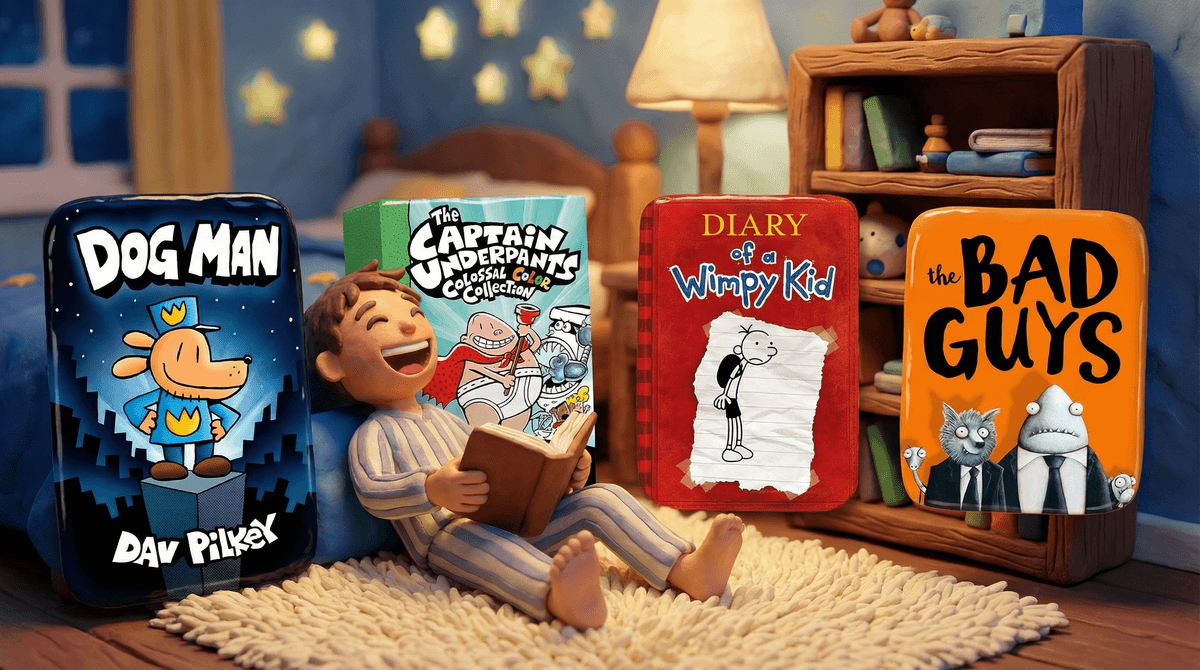
Here's something every parent of a reluctant reader needs to hear: humor is a legitimate gateway drug to literacy.
Funny books for kids aren't just "lesser" literature that we tolerate until they're ready for "real" books. They're often the books that transform a kid who groans at reading time into one who sneaks a flashlight under the covers. And honestly? In a world where we're competing with TikTok, YouTube, and Roblox for our kids' attention, a book that makes them actually laugh out loud is worth its weight in gold.
The genre is huge and diverse—from illustrated early readers like Dog Man and Captain Underpants to middle-grade novels packed with wordplay, to genuinely sophisticated humor in YA that lands with teens. What they all have in common: they meet kids where they are, respect their sense of humor (even when it's potty-based), and prove that reading can be fun.
Kids gravitate toward funny books for the same reason adults binge comedy specials after a long day—laughter feels good, and it makes hard things easier. Reading requires effort, especially for developing readers or kids with learning differences. Humor provides an emotional reward that keeps them turning pages.
There's also something validating about humor that speaks directly to a kid's experience. Books like Diary of a Wimpy Kid or Wonder (yes, it's funny despite the tears) capture the absurdity and awkwardness of childhood in ways that feel seen. And for younger kids, the gross-out humor and irreverence of series like Captain Underpants or The Bad Guys give them a safe space to explore "naughty" content that's actually harmless.
Plus, let's be real: funny books are often more accessible. They tend to have:
- Shorter chapters that feel less intimidating
- Visual elements (comics, illustrations, fake journal entries) that break up text
- Fast pacing that keeps attention
- Relatable scenarios that don't require a lot of background knowledge
If you're wondering whether you should be pushing your kid toward "better" books instead of letting them read the same silly series over and over, here's what reading research tells us: volume matters more than we think.
Kids who read a lot—even if it's "low-brow" content—develop:
- Fluency (reading speed and accuracy)
- Vocabulary (yes, even from Captain Underpants)
- Comprehension strategies
- Reading stamina (the ability to sustain attention on text)
- Intrinsic motivation to read (the big one)
A kid who devours 30 funny books will likely become a stronger reader than one who grudgingly slogs through 3 "quality" novels. And here's the thing: kids who develop a reading habit through humor often naturally graduate to other genres when they're ready. The Percy Jackson series is a perfect bridge—it's genuinely funny but also introduces mythology, complex plots, and deeper themes.
Ages 5-7: Early Readers
- Elephant & Piggie by Mo Willems - Simple, genuine humor that doesn't talk down to kids
- Narwhal and Jelly - Graphic novels with heart and silly ocean puns
- The Bad Seed - Picture book with actual wit
Ages 7-10: Building Confidence
- Dog Man - Yes, the humor is juvenile. Yes, kids are obsessed. Yes, it works.
- Captain Underpants - The OG. Potty humor with surprising heart and clever meta-humor.
- Wayside School - Absurdist humor that's actually pretty sophisticated
- The Terrible Two - For kids who love pranks and schemes
Ages 9-12: Middle Grade
- Diary of a Wimpy Kid - The format is genius for reluctant readers
- The 13-Story Treehouse (and the whole series) - Australian humor, visual chaos, pure fun
- Wonder - Don't skip this because it's "serious"—it's genuinely funny and moving
- Percy Jackson - Sarcastic narrator, mythology, adventure, and actual laugh-out-loud moments
Ages 12+: YA Humor
- The Hitchhiker's Guide to the Galaxy - British absurdism that teens love
- Turtles All the Way Down by John Green - Deals with anxiety but has sharp, witty dialogue
- Anything by Gordon Korman - Underrated author who writes genuinely funny, smart middle grade and YA
The potty humor phase is normal and temporary. If your 7-year-old is obsessed with Captain Underpants and every page with the word "poop" sends them into hysterics, that's developmentally appropriate. They're exploring taboo language in a safe way, and they'll move on. Don't shame it.
Graphic novels and hybrid books "count" as reading. If you're worried that Dog Man is too visual or not "real reading," research disagrees. The visual literacy skills kids develop from graphic novels are valuable, and these books often have more complex vocabulary than you'd expect.
Series reading is actually strategic. When kids find a funny series they love and read every single book, they're not being lazy—they're building fluency and confidence. The familiar format lets them focus on comprehension and enjoyment rather than decoding every new structure.
Your humor and their humor are different. What you find clever and what your 8-year-old finds hilarious may not overlap, and that's fine. Trust that they know what speaks to them.
In the battle for your kid's attention, funny books are secret weapons. They prove that reading isn't a chore—it's entertainment that happens to build vocabulary, empathy, comprehension, and a lifelong habit.
So yes, let them read the "silly" books. Let them reread the same series five times. Let them cackle at potty humor. Because a kid who's laughing while reading is a kid who's learning that books can be just as engaging as screens—and that's worth celebrating.
If your kid is a reluctant reader: Start with graphic novels or heavily illustrated books like Dog Man. Success breeds motivation.
If they've outgrown their current series: Try moving them to something with similar humor but slightly more complexity—like from Captain Underpants to Wayside School, or from Wimpy Kid to Percy Jackson.
If they only want to read one type of book: That's fine for now. But you can also try reading aloud together from a different genre—sometimes hearing a funny book read with expression opens them up to new styles.
If you want more specific recommendations: Find funny books for your kid's age and interests—it can get way more granular than this list.
And remember: the best book for your kid is the one they'll actually read. Even if it involves talking toilets.