

TL;DR
Fortnite is no longer just a "shooter" game; it’s a massive digital mall and social hang-out spot. While the game is free to download, the economy is built on "V-Bucks," seasonal Battle Passes, and a monthly subscription called Fortnite Crew. To keep your bank account safe, you need to understand that kids aren't just buying "power"—they're buying social status.
- The Game: Fortnite
- The Sub-Games: LEGO Fortnite, Rocket Racing, and Fortnite Festival
- The Comparison: Roblox
If you haven't looked at your kid's screen lately, Fortnite has changed. It’s not just 100 players jumping onto an island anymore. Epic Games has turned it into a "hub" similar to Roblox.
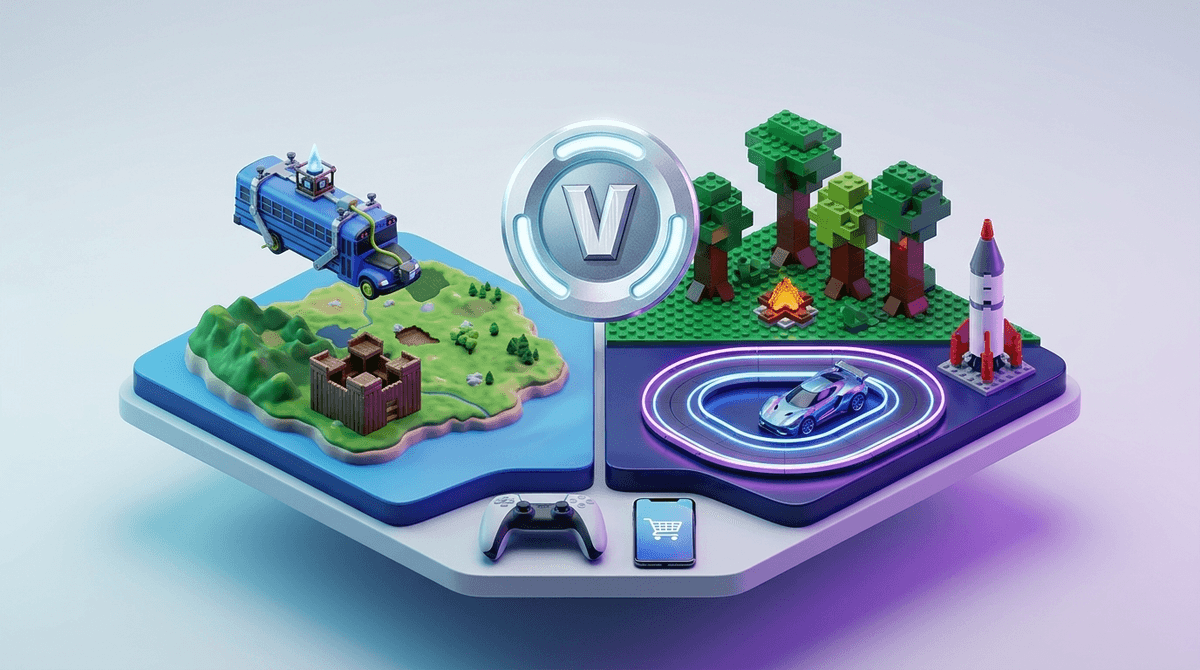
Inside the main app, your kid can play LEGO Fortnite (which is basically a survival game like Minecraft), Rocket Racing (a high-octane racer), or Fortnite Festival (a music rhythm game).
Why this matters for your wallet: Each of these "modes" has its own set of items to buy. Want a cool car for racing? That’s V-Bucks. Want a specific LEGO kit for your village? V-Bucks. Want to play a Lady Gaga song in the music mode? You guessed it—V-Bucks.
V-Bucks are the lifeblood of Fortnite. The exchange rate is roughly 1,000 V-Bucks for $8.99 USD.
The "trick" here is the same one used by Roblox with Robux: by turning "real money" into "play money," the brain stops calculating the actual cost of a digital shirt. When your kid asks for 2,800 V-Bucks, they aren't thinking "that’s $25," they’re thinking "that’s the cool Star Wars skin."
Learn more about how V-Bucks and Robux manipulate spending habits
The Battle Pass is the most common purchase in Fortnite. It costs 950 V-Bucks (about $9) and lasts for one "Season" (usually 10-12 weeks).
The Catch: You don't just "get" the items when you buy the pass. You have to play the game to "unlock" them. This creates a massive time commitment. If your kid doesn't play enough before the season ends, the items they "paid" for disappear forever. It’s a brilliant, albeit slightly predatory, way to ensure "daily active users."
The Silver Lining: If a kid completes the entire Battle Pass, they actually earn enough "free" V-Bucks within the game to buy the next season’s pass. In theory, you only ever have to buy it once—if your kid has the discipline not to spend those earned V-Bucks on other random items in the shop. (Spoiler: most kids do not have that discipline).
This is where parents often get hit with "surprise" monthly charges. Fortnite Crew is a $11.99/month subscription. It gives the player:
- The current Battle Pass.
- 1,000 V-Bucks every month.
- An exclusive "Crew Pack" (a skin/outfit that you can't get anywhere else).
If your kid is a "Fortnite-only" gamer, this is actually a decent deal compared to buying V-Bucks ala carte. However, if they rotate between Fortnite, Minecraft, and Brawl Stars, you’re likely paying for a subscription they aren't fully utilizing.
In Fortnite culture, a player who uses the free, basic character skin is called a "Default." In some middle school circles, being a "default" is a legitimate social stigma—it’s the digital equivalent of wearing "uncool" clothes to school.
When your kid asks for a skin, they aren't trying to "win" the game. None of these purchases make them shoot better or run faster. They are buying identity. They want to be the kid who has the MrBeast skin or the latest Marvel character. It’s about "the drip."
Fortnite is rated T for Teen, but our community data shows that the average age of entry is closer to 9 or 10.
Ages 7-10
At this age, the concept of "digital scarcity" and "limited time offers" is very hard to resist. They will see a countdown timer in the Item Shop and panic-buy because "it’s going away in 2 hours!"
- Strategy: No saved credit cards. Use physical V-Bucks gift cards. It creates a hard stop and a physical representation of the money being spent.
Ages 11-14
This is the peak of social pressure. They want what their friends have.
- Strategy: The "Battle Pass Only" rule. Agree that you will pay for the seasonal Battle Pass, but any extra "Item Shop" skins come out of their allowance or chore money.
Get a script on how to talk to your 10-year-old about V-Bucks
Epic Games uses several "dark patterns" (design choices meant to trick you into spending) that you should be aware of:
- The Item Shop Refresh: The shop changes every 24 hours. This creates a "buy it now or miss out forever" mentality.
- Uneven Pricing: A skin might cost 1,200 V-Bucks, but you can only buy V-Bucks in packs of 1,000 or 2,800. This always leaves the player with a "leftover" balance, tempting them to buy more to "even it out."
- Gifting: Kids can "gift" skins to friends. This sounds sweet, but it often leads to "V-Buck begging" or social trade-offs that can get messy.
Instead of "You're wasting money on pixels," try a more curious approach.
- "I see you really want that Spider-Man skin. Is that because your friends are using it, or do you just like the design?"
- "If you spend your $20 on V-Bucks today, that means we won't be buying that LEGO set we talked about this weekend. Which one is going to give you more fun for a longer time?"
Fortnite is a free game that is very expensive if left unchecked. It is designed by world-class psychologists to be a "forever game."
The goal isn't necessarily to ban spending—it's to teach your kid how to navigate a digital economy without getting fleeced. If they can learn to manage a Battle Pass budget at 11, they’ll be much better at managing a credit card at 21.
Next Steps
- Check your settings: Go into the Epic Games account settings and turn on "Require Passcode for Purchases."
- Audit the "Crew": Check your credit card statement for a recurring $11.99 charge. If your kid hasn't touched the game in three weeks, cancel it.
- Set a "Skin Ceiling": Decide as a family how many skins per month or per season is reasonable.
Learn how to set up parental controls on Fortnite Check out our review of LEGO Fortnite