

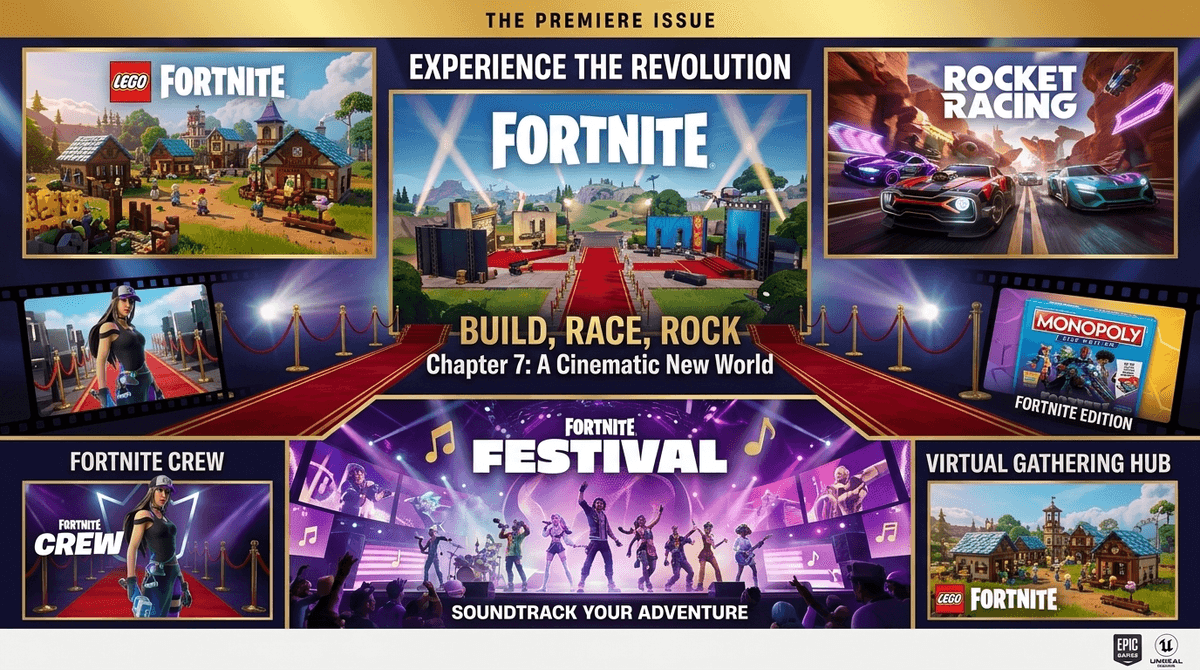
TL;DR: Fortnite has officially evolved from a "shooting game" into a digital mall, concert hall, and Hollywood backlot. Chapter 7 is all about "The Big Screen," introducing movie-set mechanics and celebrity skins that your kids are already begging for. It’s less about winning and more about "hanging out" and showing off digital fashion.
Quick Links:
- Fortnite (The Hub)
- LEGO Fortnite (The "Safe" Minecraft alternative)
- Rocket Racing (The Arcade Racer)
- Fortnite Festival (The Rhythm/Music game)
If you haven't looked at your kid's screen in a year, you might not recognize Fortnite. We are currently in Chapter 7, which is themed around "Hollywood and the Silver Screen."
The map is covered in movie studios, red carpets, and stunt-heavy locations. But the biggest shift isn't the map; it's the fact that Fortnite is now a "launcher" for multiple different games. When your kid opens it, they aren't just playing a Battle Royale. They might be playing LEGO Fortnite (survival/building), Rocket Racing (high-speed driving), or Fortnite Festival (think Guitar Hero).
It’s effectively Roblox with a much higher production budget and slightly more structured rules.
To understand why your kid is obsessed, you have to understand the vocabulary.
"Sweats" and the Skill Gap
A "Sweat" is a player who tries way too hard. They’re the ones building a five-story skyscraper the second they hear a footstep. In the Hollywood season, "sweating" has become a point of frustration for casual players. If your kid is complaining about "sweats," they’re feeling the pressure of a highly competitive environment.
Skins as Social Currency
In Chapter 7, "Skins" (the outfits characters wear) are the ultimate status symbol. With the Hollywood theme, Epic Games is leaning heavily into celebrity and movie crossovers. If your kid doesn't have the "trending" skin, they can feel like the kid at school with the "wrong" sneakers. It’s digital fashion, plain and simple.
It’s a Third Place
For most kids in 5th through 10th grade, Fortnite is their "third place"—the spot that isn't home or school where they just... exist. They might spend 20 minutes actually playing and two hours just standing in the lobby or a "Creative" map chatting about their day.
Ask our chatbot about how to set healthy boundaries for social gaming
Screenwise data shows that roughly 72% of middle school boys and an increasing 38% of middle school girls interact with the Fortnite ecosystem at least once a week.
Unlike Minecraft, which is often a solo or small-group experience, Fortnite is inherently "massively multiplayer." The peer pressure to be "online" when the squad is online is real. This is where the "one more game" argument usually starts—it's not about the game; it's about not wanting to leave the party.
Ages 7+ If you want the Fortnite experience without the "gun-heavy" vibes, this is it. It’s a survival crafting game. It’s basically Minecraft but with LEGO aesthetics. It’s collaborative, creative, and much lower stress than the Battle Royale mode.
Ages 10+ This is a rhythm game where kids play along to popular hits. Warning: The tracklist includes everything from "Baby Shark" to songs that are... definitely not for 10-year-olds. While the "explicit" versions are censored, the themes remain. It’s a great way to bond over music, but check the setlist.
Ages 6+ Pure arcade racing. No violence, just physics-defying cars. If your kid is getting frustrated by "sweats" in the main game, this is a great "cool down" mode.
Ages: Varies Widely This is the "Wild West." Users can create their own games. Some are brilliant puzzle rooms; others are "Skibidi Toilet" themed brain rot or "1v1" fight pits that can get toxic. Read our guide on navigating Fortnite Creative maps
- Ages 7-9: Stick to LEGO Fortnite in a private world. Turn off "Voice Chat" entirely. At this age, the main Battle Royale mode is often too fast-paced and the voice chat is too unpredictable.
- Ages 10-12: This is the sweet spot for the Hollywood season. They’ll want the Battle Pass. Use this as an opportunity to teach "digital budgeting."
- Ages 13+: They’re likely playing the main Battle Royale. The focus here should be on "digital citizenship"—not being the toxic "sweat" who screams into the mic when they lose.
V-Bucks are the currency of Fortnite. In Chapter 7, the "Item Shop" is more aggressive than ever.
- The Battle Pass: It costs about $10. If they play enough, they "earn" enough V-Bucks to buy the next one for free. It’s a brilliant (and slightly diabolical) way to ensure they play every single day.
- Dark Patterns: The shop uses countdown timers to create FOMO (Fear Of Missing Out). "This Hollywood skin is gone in 4 hours!" It’s high-pressure sales for 10-year-olds.
- Voice Chat: This is where the "brain rot" lives. Unless your kid is playing with real-life friends, keep "Fill" (matching with strangers) voice chat OFF.
Learn more about how V-Bucks are designed to keep kids spending
The Hollywood "Cringe" Factor
The current season features "NPCs" (non-player characters) that act like influencers and paparazzi. It's a parody of celebrity culture, but kids often take it at face value. You might hear them using terms like "Rizz" or "Main Character Energy" even more than usual.
Is it "Brain Rot"?
People love to call Fortnite brain rot, but the main Battle Royale mode actually requires intense spatial awareness, quick strategic thinking, and teamwork. It’s "mental junk food" in high doses, sure, but it’s not mindless. The "Creative" maps, however, can be pretty low-quality—think of them like the weird side of YouTube.
Instead of "Are you winning?" (which they usually aren't, because 99 people lose every game), try:
- "What's the best skin you saw today?"
- "Did you see any cool movie sets in the new Hollywood map?"
- "Are the people you're playing with being cool, or are they being sweats?"
Using their language shows you’re paying attention and reduces the "you just don't get it" barrier.
Fortnite isn't going anywhere. It’s the dominant social platform for a generation. In Chapter 7, the game is more of a "vibey" social experience than ever.
As long as you manage the spending (set a hard limit on V-Bucks) and the social exposure (keep voice chat to friends only), it’s a relatively safe, highly engaging digital playground. Just be prepared for the "one more game" plea—because in the Hollywood season, the "credits" never seem to roll.
- Check the Settings: Go into the "Parental Controls" menu in the Fortnite settings. You can set a PIN and limit play time or chat.
- Play a Round of LEGO Fortnite: It’s the easiest way to understand the mechanics without getting "sniped" by a 9-year-old from across the map.
- Talk about the "Item Shop": Explain how the timers work so they understand they're being marketed to.
Check out our full guide on setting up Fortnite Parental Controls