

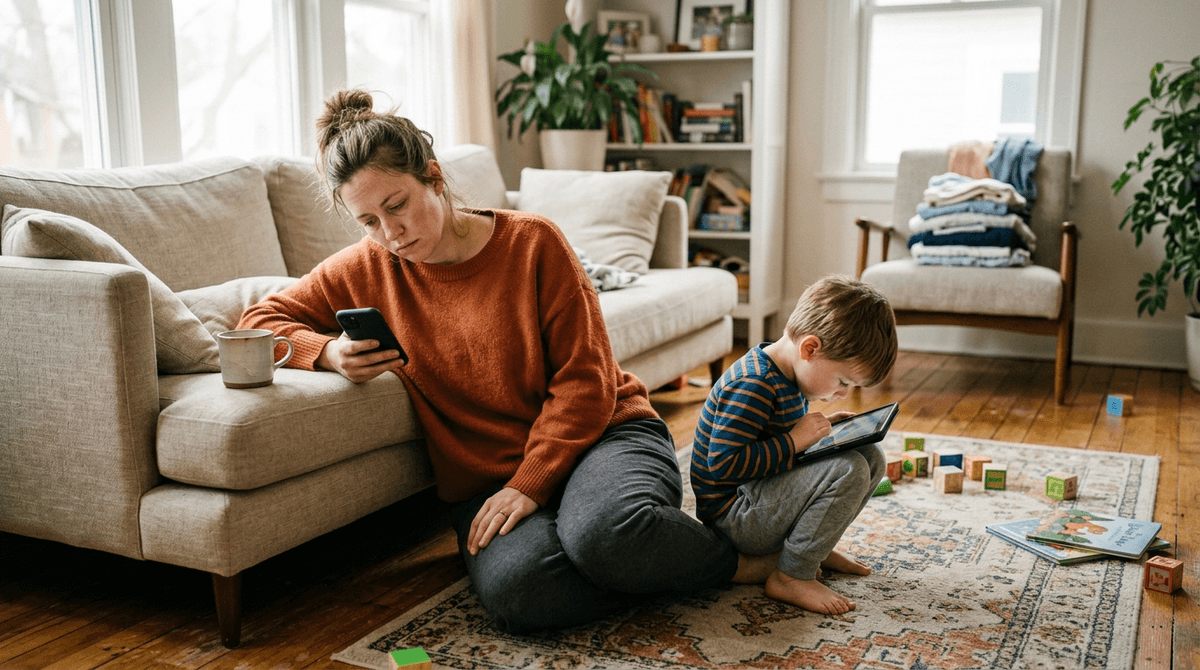

When household stress mounts, parents retreat into their phones, teaching preschoolers to do the exact same thing. Managing your kid's screen tantrums might actually mean addressing the friction simmering between the adults in the house.
Preschoolers develop problematic screen habits not simply because apps are engaging, but because shared household stress pushes parents to snub their children in favor of smartphones.
Screen battles are rarely just about tablets or television. When both parents feel drained, picking up a phone becomes an effortless escape hatch—and children as young as age three notice immediately.
If you treat a child's screen fixation strictly as a discipline problem, you miss the root cause. Curtailing digital dependency starts with lowering tension across the family unit rather than simply policing minutes on an iPad.
Most child media studies single out mothers or evaluate one parent in isolation. Researchers wanted to see how the overall household emotional climate—shared equally by both partners—influences how parents use phones and how children subsequently react.
Researchers tracked 506 families with children ages 3 to 6 across two waves to map how stress moves through a home:
- The family atmosphere outweighs individual burnout. Shared, couple-level stress drove screen issues far more than a single parent having a rough afternoon.
- Parental "phubbing" is the transmission belt. Snubbing a child to check a smartphone directly links family pressure to a preschooler's compulsive device habits.
- Kids mirror what they see. When young children feel pushed aside by a glowing screen, they adopt the same coping mechanism, seeking out digital media to self-soothe.
Being physically in the room is not the same as being present. Parents often use phones as low-friction coping mechanisms when overwhelmed, assuming a preschooler busy playing on the rug won't care.
They do care. Toddlers and preschoolers cannot articulate that they feel dismissed, so they replicate the behavior. Your phone habits send an unintentional message: when real life feels chaotic or disconnected, turn to a screen.
This study surveyed families in Shanghai, China, where early childhood educational pressures and urban parenting expectations differ from Western households.
The findings are also observational and rely on self-reported surveys. Mothers provided the ratings for child media use during the second phase of the study, meaning fathers' direct observations of their children's habits were omitted, and parents may have underreported their own screen distractions.
- If you catch yourself reflexively checking your phone during playtime… place devices in a charging basket in another room during peak evening hours to eliminate the reach-for-the-phone impulse.
- If your preschooler melts down whenever a tablet turns off… look at whether you and your partner use screens to zone out in front of them before imposing harsher usage rules.
- If family-wide stress feels unmanageable… trade off intentional solo shifts where one parent gets complete downtime while the other provides focused, phone-free engagement.
Your preschooler's screen dependency is often an echo of household pressure and adult phone distraction, not an innate behavioral flaw. Give yourself permission to feel exhausted, but address shared stress directly instead of disappearing behind a screen in front of your child.
Zhang Q, Wang J, Kong X et al. (2026). Parenting stress and children's problematic media use: An analysis based on the common fate model. Journal of family psychology : JFP : journal of the Division of Family Psychology of the American Psychological Association (Division 43). doi:10.1037/fam0001485 — pubmed.ncbi.nlm.nih.gov