

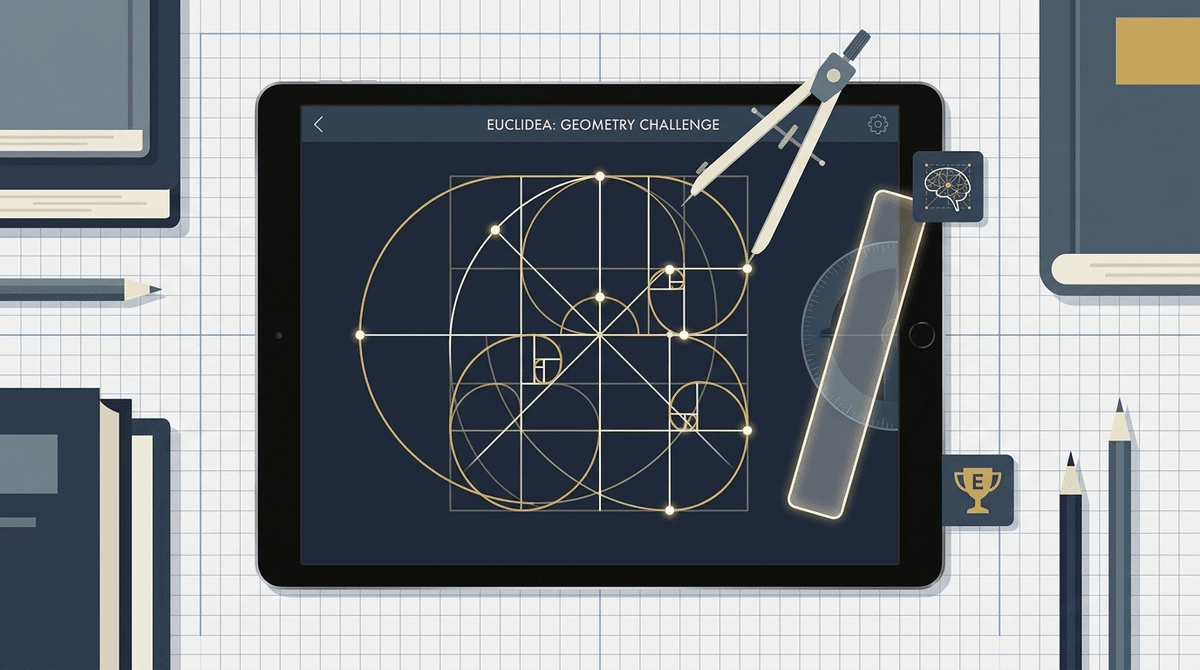
TL;DR: If you’re tired of the "educational" app category being filled with loud, flashing lights and glorified digital worksheets, Euclidea is the elegant, minimalist breath of fresh air you’ve been looking for. It’s a puzzle game based on classical Euclidean geometry (straightedge and compass constructions) that is legitimately challenging, visually beautiful, and deeply satisfying. It’s perfect for kids aged 10+ who like logic puzzles, or for teens who are currently struggling to see the "point" of their high school geometry class.
Quick Links for the Logic-Obsessed Family:
- The Gold Standard: Euclidea
- For the Younger Crowd: DragonBox Algebra 5+
- For 3D Visualization: XSection
- The Ultimate Logic Adventure: The Witness
We’ve all been there: you download a "math game" hoping it’ll help your kid with their fractions, and five minutes later they’re just clicking on a flying penguin to solve 2+2. It’s basically "chocolate-covered broccoli," and most kids see right through it.
Euclidea is different. It doesn't try to hide the math. In fact, the math is the game.
Based on the principles of Euclidean geometry (the stuff Euclid was writing about in ancient Greece), the app challenges players to build geometric shapes—angles, circles, perpendicular bisectors, inscribed hexagons—using only a digital straightedge and a compass.
It starts deceptively simple. "Draw a line through these two points." Easy. "Construct a square." Okay, a bit harder. By the time you get to the "Gamma" and "Delta" levels, you’re staring at the screen for twenty minutes trying to figure out how to find the center of a circle using only three lines. It is, quite literally, the "Dark Souls" of geometry apps.
You might be wondering why a kid would voluntarily do geometry on their iPad when they could be playing Roblox or watching MrBeast.
The secret is the "Star System."
In Euclidea, you don't just solve the puzzle. You’re rewarded for efficiency. You earn stars for:
- Solving the problem (The basic win).
- The L-Star: Solving it in the minimum number of total moves.
- The E-Star: Solving it using the minimum number of elementary Euclidean moves (the "pure" way).
This taps into the same "optimization" itch that makes games like Minecraft or Factorio so addictive. It’s not about getting the answer; it’s about finding the perfect answer. For a certain type of kid—the one who likes Rubik's cubes, chess, or complex LEGO builds—this is digital catnip.
Learn more about why "hard fun" is better for brain development than easy entertainment
We talk a lot at Screenwise about "digital wellness," which usually sounds like a fancy way of saying "put the phone down." But wellness isn't just about less screen time; it's about better screen time.
Euclidea is the ultimate antidote to "brain rot." While apps like TikTok are designed to keep users in a state of passive, low-effort consumption, Euclidea requires "System 2" thinking—the slow, deliberate, and logical part of the brain.
It teaches:
- Persistence: You will get stuck. You will fail. You will have to delete your lines and start over.
- Logical Deduction: "If I know X is the midpoint, then Y must be a right angle."
- Spatial Reasoning: Visualizing how circles and lines intersect before you even draw them.
The App Store says 4+, but let’s be real: a 4-year-old is going to have a meltdown by level three.
- Ages 5-9: They might enjoy the very early levels with a parent’s help, but the logic quickly outpaces their cognitive development. If you have a younger kid interested in math, I’d point them toward DragonBox Algebra 5+ or Prodigy first.
- Ages 10-13 (Middle School): This is the "sweet spot." They are starting to handle abstract logic, and if they can master the first few sections of Euclidea now, they will walk into 9th-grade geometry feeling like they have a literal cheat code.
- Ages 14-18 (High School): It’s a fantastic supplemental tool. If your teen is complaining that geometry is "just memorizing formulas," show them this. It proves that geometry is actually a series of puzzles to be solved, not just a list of theorems to be memorized.
Check out our guide on the best math apps for middle schoolers
1. It’s Free(ish)
You can play through the entire game for free if you are good enough. You unlock new "packs" of levels by earning enough stars in the previous pack. However, if you get stuck (and you will), you can pay a few dollars to unlock all the levels or buy "hints."
My No-BS Advice: Pay the few bucks to unlock the full version and remove the ads. It’s a one-time purchase, and it supports developers who are actually making something of value rather than just another "match-3" clone. It also removes the frustration of being "locked out" if your kid can't quite get that 3rd star on a tricky level.
2. No Social Risks
This is a major win for intentional parents: Euclidea has no social features. No chat rooms, no friends lists, no "Ohio" memes, and no strangers trying to trade "skins." It’s just your kid and the math. It’s a completely safe environment.
3. The "Frustration" Factor
Because this game is actually hard, some kids might give up quickly. This is a great opportunity for "co-playing." Sit down with them, grab a piece of paper and a pencil (sometimes it helps to sketch it out physically), and try to solve a level together.
If you tell your kid, "Hey, I downloaded a great educational geometry app for you!" they will likely roll their eyes so hard they’ll see their own brain.
Instead, try this: "I found this insanely hard puzzle game that’s supposedly impossible to beat. It’s like a logic escape room on your phone. Want to see if we can figure out the first few levels?"
Frame it as a challenge, not a lesson.
Recommended Progression
If they like Euclidea, here are the next steps to keep that logic momentum going:
- Pythagorea: By the same creators, this one focuses on geometry on a square grid. It’s slightly more intuitive but just as challenging.
- Brilliant.org: A more comprehensive (and subscription-based) platform that teaches math, science, and computer science through interactive puzzles.
- Monument Valley: While less "academic," this game uses M.C. Escher-style geometry to create mind-bending puzzles. It’s a beautiful gateway into spatial thinking.
- The Witness: For older teens and adults, this is the ultimate "show, don't tell" logic game. It’s a masterpiece of game design.
Euclidea is a rare gem in the App Store. It’s intellectually honest, aesthetically minimal, and genuinely difficult. It doesn't pander to kids with cartoon characters or "gamified" gimmicks; it trusts that the beauty of logic is enough to keep them engaged.
In a world of "brain rot" content, Euclidea is a mental workout that actually leaves your kid smarter than when they started.
Next Step: Download the app yourself first. Try to get through the "Alpha" levels. Once you feel the "Aha!" moment of solving a particularly tricky construction, you'll know exactly why this belongs on your kid's device.