

TL;DR: The Quick Watchlist
If you’re in a rush and just need to know what to put on so you can hop on a Zoom call without melting your kid’s brain, here are the gold standards for high-quality, low-stimulation content:
- The Emotional Gold Standard: Bluey
- The STEM Powerhouse: Ask the StoryBots
- The Literacy King: AlphaBlocks and Numberblocks
- The Nature Expert: Wild Kratts
- The Calm Choice: Puffin Rock or Trash Truck
Check out our guide on how to transition away from overstimulating shows
You’ve seen the term "brain rot" all over TikTok and Reddit. It’s usually used to describe the chaotic, nonsensical, and high-decibel content that seems to put kids into a literal trance. We’re talking about things like Skibidi Toilet or those weird, colorful "nursery rhyme" videos on YouTube that feature 47 different things happening on screen at once.
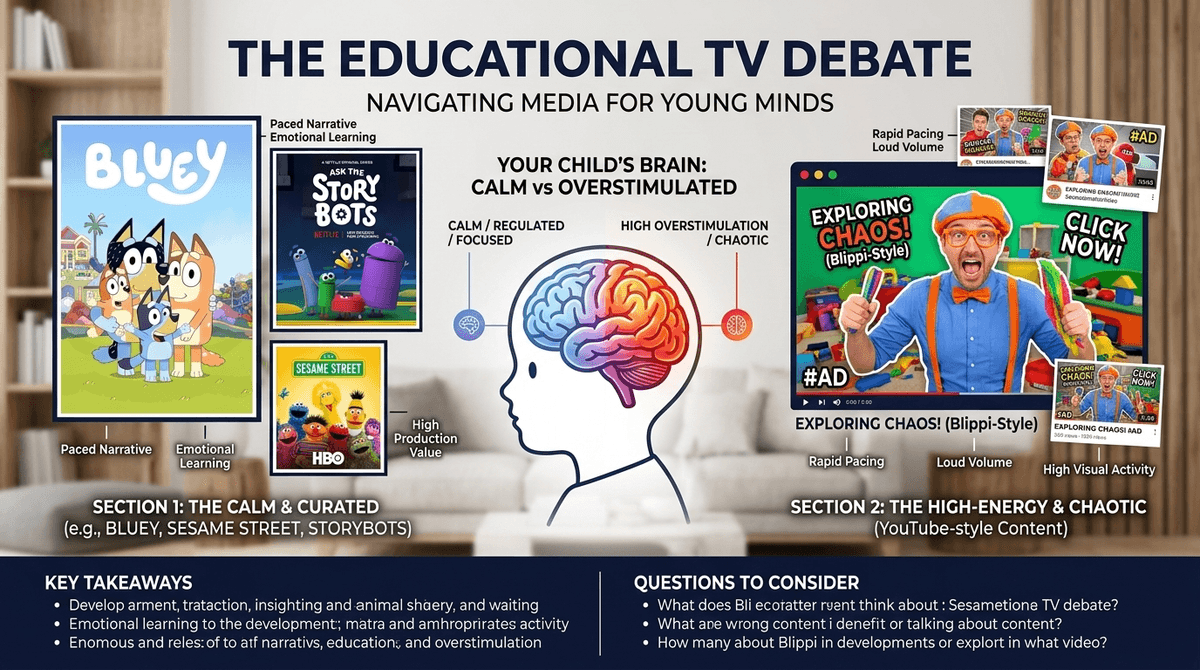
The debate isn't just about whether a show is "bad." It’s about neuro-stimulation. High-quality educational TV is paced like a conversation or a story. "Brain rot" is paced like a slot machine—constant bright flashes, loud sound effects, and zero narrative logic. When kids consume the latter, their brains are getting a massive dopamine hit every three seconds. When the TV turns off, the real world feels incredibly boring and slow by comparison, which is usually why the post-screen-time tantrum is so nuclear.
Kids are biologically wired to pay attention to novelty and movement. It’s a survival mechanism. Shows like CoComelon or certain Blippi episodes exploit this by using fast camera cuts (sometimes every 1-2 seconds).
To a three-year-old, this is hypnotic. They aren't "learning" how to be a garbage man or how to share; they are simply being overstimulated. It’s the digital equivalent of feeding them Pixy Stix for dinner—they’ll eat it, and they’ll want more, but it’s not doing anything for their development.
Not all educational TV is created equal. We like to break it down into three tiers:
1. Active Learning (The Tier 1 Stuff)
These shows ask kids to think, solve problems, or engage with the real world.
- Ask the StoryBots: This is arguably the best educational show on Netflix. It explains complex topics (how do ears hear?) without talking down to kids.
- Octonauts: It’s basically Star Trek but with marine biology. Kids actually learn the names of obscure sea creatures and their ecosystems.
- Sesame Street: The GOAT. It’s research-backed and intentionally paced to mirror how kids actually process information.
2. Social-Emotional Intelligence (The "Good Vibes" Tier)
These might not teach math, but they teach how to be a human.
- Bluey: It’s the show everyone talks about for a reason. It models imaginative play and—more importantly—models how parents can interact with their kids (even when they’re exhausted). Read our guide on why Bluey is actually for parents.
- Daniel Tiger's Neighborhood: Built on the legacy of Mister Rogers, this show gives kids actual "strategies" (little songs) to deal with big feelings like anger or disappointment.
3. Pure Entertainment / "The Peace Treaty"
This is the stuff you put on when you just need 20 minutes to cook. It’s not necessarily "educational," but it’s also not harmful.
- Trash Truck: Gentle, sweet, and slow-paced. It’s just a boy and his truck.
- Shaun the Sheep: No dialogue, great physical comedy, and high-quality animation.
This is the hill many parents are willing to die on. Blippi is a polarizing figure. On one hand, he’s taking kids to museums and indoor playgrounds. On the other hand, the persona is loud, the editing is frantic, and the "educational" value is often surface-level (e.g., just naming the color of a ball).
If your kid is obsessed, you don't have to ban it, but notice the "vibe" after they watch. Are they hyper? Are they unable to focus on a book? If so, you might want to swap Blippi for Wild Kratts or Emily's Wonder Lab, which offer more substance with a slightly more grounded energy.
Ages 0-2
The American Academy of Pediatrics says "no screens" (except video chatting), but let's be real—sometimes you just need to shower. If you’re going to do it, go for high-contrast, slow-moving content.
- Recommendation: Guess How Much I Love You or just putting on music via the Spotify app.
Ages 3-5 (Preschool)
This is the peak "brain rot" danger zone because this is where the YouTube algorithm lives. Avoid the "Surprise Egg" videos and the weird AI-generated nursery rhymes.
- Recommendation: Numberblocks (it’s shockingly good at teaching actual math concepts) and Molly of Denali.
Ages 6-9 (Early Elementary)
Kids this age start wanting "cool" stuff. They might start talking about things being "Ohio" (weird/cringe) or "Sigma." This is a great time to pivot to documentaries or competition shows.
- Recommendation: Is It Cake? or The Who Was? Show.
The biggest mistake we see intentional parents make is thinking that "educational YouTube" is the same as "educational TV." It isn't.
Even if you start your kid on a National Geographic Kids video, the "Up Next" sidebar is designed to keep them clicking. Within three videos, they can easily end up on a "toy unboxing" channel or something much weirder.
Pro-tip: If you use YouTube, use the YouTube Kids app and set it to "Approved Content Only." This turns off the search function and only lets them watch channels you have hand-selected.
The easiest way to tell if a show is "entertainment" vs. "brain rot" is the Melt Test.
- Watch your kid while they watch the show. Are they laughing? Are they asking questions? Or are they "slack-jawed" and unresponsive if you say their name?
- Turn the show off mid-episode. Do they say "Aww, okay" or do they have a total emotional collapse?
If they are "slack-jawed" and "collapsing," that show is likely overstimulating their nervous system. It’s not that the show is "evil," it’s just that it’s too much for their current developmental stage.
You don't have to be the "Screen Police." You can talk to your kids about how media makes them feel.
There is no such thing as a "perfect" media diet. Some days are StoryBots days where they learn about DNA, and some days are "I have a migraine, please just watch Minecraft videos for an hour" days.
The goal isn't to eliminate entertainment; it’s to be intentional about the quality of that entertainment. High-quality shows respect your child's intelligence and their nervous system. Low-quality shows just want their "watch time."
Choose the shows that respect your kid.
- Audit your watchlist: Take five minutes to look at what’s in your "Continue Watching" queue on Netflix or Disney+.
- Swap one show: Replace one high-stimulation show with a lower-stimulation alternative (like swapping Blippi for Trash Truck).
- Get a watchlist based on your kid's age and interests
