

Look, we all want our kids to understand money before they're 22 and wondering why their credit score is in the toilet. But sitting them down for a lecture about compound interest? That's a one-way ticket to glazed-over eyes and sudden urgent homework they forgot about.
Economics games are the secret weapon here. We're talking about games—both digital and physical—that teach financial concepts through actual play. Think Monopoly (yes, really), but also Roblox entrepreneurship, stock market simulators, and everything in between. The key is that kids are learning about supply and demand, budgeting, investment, and trade-offs while they're genuinely having fun.
And before you roll your eyes at "educational games," these aren't those clunky math apps from 2010. Many of the best economics teachers are games kids are already begging to play.
Financial literacy is basically not taught in most schools, which is wild considering we expect 18-year-olds to sign loan documents and understand credit cards. The stats are pretty grim—most adults can't explain what a 401k is, let alone teach their kids about it.
But here's the thing: kids who learn money concepts early develop better financial habits as adults. They're more likely to save, less likely to rack up debt, and generally make smarter money decisions. And games? They're a low-stakes environment where kids can fail, learn, and try again without real-world consequences.
Plus, understanding economics isn't just about personal finance. It's about understanding how the world works—why things cost what they cost, what scarcity means, how markets function. It's genuinely useful life knowledge.
For Younger Kids (Ages 5-8)
Monopoly Junior gets a lot of flak for being "too simple," but that's exactly why it works for this age. Kids learn about earning money, spending decisions, and that painful moment when you land on someone else's property and have to pay up. It's cause and effect in action.
The Game of Life introduces slightly bigger concepts—career choices, insurance, unexpected expenses. Sure, it's not realistic (nobody becomes a doctor by spinning a wheel), but it plants seeds about life having financial consequences.
Roblox (yes, I'm serious) can teach basic economics if you engage with it intentionally. Kids see how Robux works as currency, they can create and sell items, and they learn that virtual currency has real-world value when they beg you to buy more. Learn more about how Robux is in fact real money if you want to go deeper on this.
For Middle Grades (Ages 9-12)
Minecraft in survival mode is actually a masterclass in resource management. Kids learn about scarcity (diamonds are rare!), trade-offs (do I use iron for armor or tools?), and opportunity cost. If they play on multiplayer servers with economies, it gets even more sophisticated.
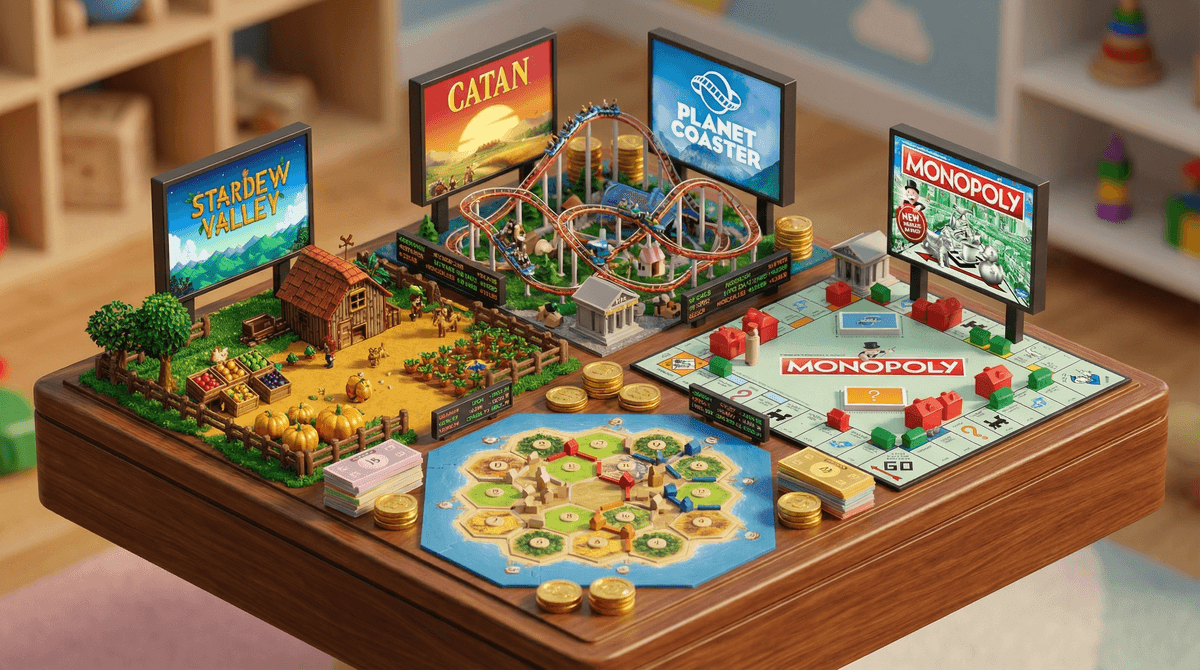
Catan is where economics gets real. Trading resources, negotiating deals, understanding supply and demand in real-time—it's all there. Plus it teaches that sometimes you need to make deals you don't love because you need wheat RIGHT NOW.
Stardew Valley is basically farming economics: the game. Kids manage a budget, decide what crops to invest in, balance short-term cash flow with long-term investments, and learn that sometimes you need to take a loss to grow. It's cozy and educational at the same time.
For Teens (Ages 13+)
Stock market simulators like Investopedia's simulator or the app [MarketWatch Virtual Stock Exchange](https://screenwiseapp.com/media/marketwatch-virtual-stock-exchange-game let teens play with fake money in the real market. They can learn about stocks, risk, diversification, and market volatility without losing actual money (though they'll still feel the sting when their portfolio tanks).
Monopoly (the real version) is genuinely complex when you play by actual rules. Property management, cash flow, strategic investment, negotiation—it's all there. Just be prepared for games that last approximately 47 hours.
Roller Coaster Tycoon or Planet Coaster** teach business management—pricing strategy, operating costs, customer satisfaction, and profit margins. Kids learn that charging $10 for a soda might seem smart until everyone leaves angry.
Not all "business" games teach good lessons. Some games glorify get-rich-quick schemes or teach that monopolistic practices are goals to aspire to. It's worth playing alongside your kids and talking through what they're learning.
Roblox deserves special mention because it's genuinely teaching entrepreneurship to some kids—there are teens making real money creating games and items. But it's also teaching other kids to spend money on virtual items they don't need. Check out this guide on Roblox economics to understand what's happening.
The best learning happens when you talk about it. Playing Monopoly silently teaches less than playing while discussing strategy, trade-offs, and why you're making certain decisions. Ask questions: "Why did you buy that property?" "What's your strategy?" "What would happen if...?"
Real-world connections matter. When your kid is managing a budget in Stardew Valley, connect it to real life: "This is kind of like how we budget for groceries each week." When they're trading in Catan, talk about how real markets work.
Ages 5-8: Focus on basic concepts—earning, spending, saving. Games should be short (under 30 minutes) and have clear cause-and-effect. Don't worry about complex strategy yet.
Ages 9-12: Introduce resource management, trade-offs, and basic investment concepts. Games can be longer and more complex. This is prime time for understanding that money is finite and choices matter.
Ages 13+: Real-world simulations become valuable. Teens can handle stock markets, business management, and complex economic systems. They're ready to understand risk, investment, and long-term financial planning.
The best economics education doesn't feel like education. It feels like playing a game, building a farm, or trading sheep for wheat. Kids absorb financial concepts when they're embedded in play, and they remember lessons learned through experience way better than lectures.
You don't need to turn every game into a teaching moment, but being intentional about which games you encourage and having conversations about what's happening makes a huge difference.
And honestly? If your kid learns that spending all their in-game currency on cosmetic items means they can't afford the thing they actually need, that's a lesson worth learning now rather than at 25 with a real credit card.
- Pick one game from the age-appropriate list above and try it with your kid this week
- During gameplay, ask questions about their decisions and strategy
- Make real-world connections when opportunities arise naturally
- Consider learning more about financial literacy apps if you want to supplement with more direct teaching tools
- Explore alternatives to purely entertainment games if you want more options
The goal isn't to turn your kid into a day trader (please don't). It's to help them understand that money is a tool, resources are limited, and choices have consequences. Games just make that lesson way more fun than a spreadsheet.