

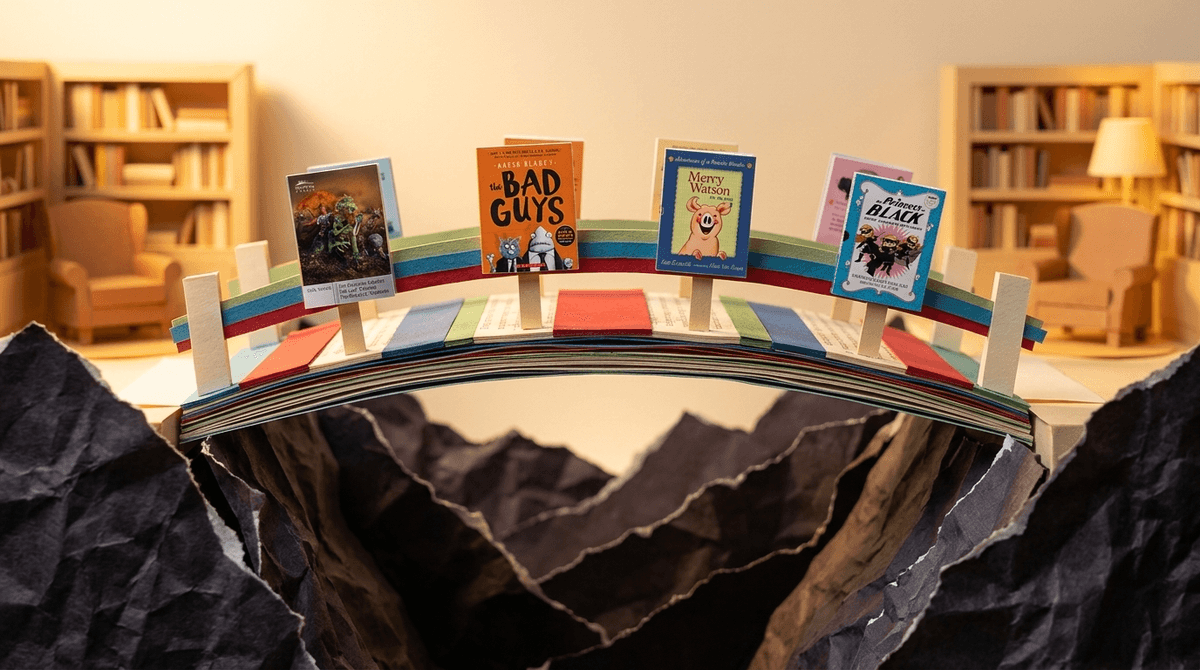
TL;DR: The Quick List for Fast Wins If you’re looking to get your kid off YouTube and into a book without a power struggle, these are the heavy hitters that actually work for the 6-9 age bracket:
- The "I love action" pick: Dragon Masters by Tracey West
- The "I miss my graphic novels" pick: The Bad Guys by Aaron Blabey
- The "I want to laugh" pick: Mercy Watson by Kate DiCamillo
- The "I love science and magic" pick: Zoey and Sassafras by Asia Citro
- The "Visual and diary style" pick: Owl Diaries by Rebecca Elliott
Get a book list based on your kid's favorite video games
We’ve all been there: your kid has finally mastered the "Cat in the Hat" stage, but the jump to a 300-page middle-grade novel feels like asking them to climb Everest in flip-flops. This is the "Valley of Despair" in literacy. It’s where reading stops being a fun puzzle and starts feeling like a chore—especially when Roblox or another round of MrBeast is only a click away.
The goal isn't to get them reading "the classics" yet. The goal is confidence. We want them to close a book, look at the spine, and think, "I did that. I’m a reader."
In the world of 2025, where "brain rot" content is optimized to keep their attention for 15 seconds at a time, these early chapter books are the perfect bridge. They use high-interest plots, short chapters, and plenty of visual support to keep the dopamine flowing without the screen.
Around 1st to 3rd grade, the cognitive load for reading shifts. Kids are moving from decoding (sounding out words) to comprehension (actually understanding the story). If the book has too much text and not enough white space, their brains literally get tired.
This is also the age where they start noticing what their friends are doing. If the "cool" kids are talking about "Skibidi Toilet" or whatever the latest "Ohio" meme is, a boring book about a talking pony isn't going to cut it. They need books that feel fast-paced, funny, or slightly edgy.
Ages 6-9 If your kid is into Minecraft or any kind of fantasy world-building, start here. These are part of the Scholastic "Branches" line, which is specifically engineered for this transition.
- The Hook: Kids are "chosen" to train dragons with special powers.
- Why it works: Every page has illustrations. The chapters are short (usually 4-6 pages). There is a lot of "leveling up" energy that mirrors video game progression. It’s pure plot, very little filler.
Ages 7-10 You might have seen the The Bad Guys movie, but the books are where the real magic happens. They are essentially a hybrid between a graphic novel and a chapter book.
- The Hook: A wolf, a shark, a snake, and a piranha try to be "good guys" but fail miserably and hilariously.
- Why it works: It’s genuinely funny. Not "parent-approved funny," but "kid-cackling-in-the-back-seat funny." For a kid who finds big blocks of text intimidating, the heavy use of speech bubbles and expressive art makes this a "fast read," which builds massive confidence.
Ages 6-9 This is the "stealth education" pick.
- The Hook: Zoey can see magical animals, and she uses the scientific method to help them when they have problems (like a sick forest monster).
- Why it works: It blends fantasy with real science. The vocabulary is slightly more challenging but supported by great illustrations. It’s perfect for the kid who is always asking "why" or playing Toca Life World.
Ages 5-8 If you want something that feels a bit more "classic" but is still high-energy, Mercy Watson is the gold standard.
- The Hook: A "porcine wonder" (a pig) who loves hot buttered toast and constantly gets into trouble.
- Why it works: The illustrations by Chris Van Dusen are full-color and gorgeous. The stories are absurd and linear, making them very easy to follow. It feels like a "real" chapter book but reads with the ease of a picture book.
Ages 5-8 Don't let the "Princess" title fool you—this is a superhero series.
- The Hook: Princess Magnolia seems like a typical royal, but when the "monster alarm" goes off, she ditches the glass slippers to fight monsters.
- Why it works: It subverts tropes in a way that kids find hilarious. It’s high-action, very visual, and the "secret identity" plot keeps them turning pages.
Check out our guide on the best graphic novels for reluctant readers
When you're browsing the library or Amazon, look for these three things. If a book has all three, it’s a winner for building confidence:
- High Image-to-Text Ratio: You want pictures on at least every other page. It provides a visual break and helps with context clues for harder words.
- Series Availability: Once a kid likes a character, they want to read every book in that series. This removes the "what do I read next?" friction.
- Large Font and Wide Margins: It sounds simple, but "white space" on a page makes the book look "easy." If a kid opens a book and sees a wall of small text, their brain often shuts down before they even start.
I’ll be blunt: some parents think Dog Man or InvestiGators "don't count" as real reading.
They are wrong.
In 2026, literacy is about more than just text; it’s about visual literacy and narrative flow. If your kid is reading Dog Man, they are learning about character arcs, dialogue, pacing, and humor. More importantly, they are associating books with pleasure rather than work.
If you want to move them toward traditional chapters, use the "Graphic Novel Sandwich" method: let them read one graphic novel, then one "hybrid" book (like The Bad Guys), then one early chapter book (like Dragon Masters).
If you want to encourage them, avoid the "did you finish your 20 minutes of reading?" lecture. Instead, try to connect the books to their digital world:
Learn more about how to compete with screen time without being the "bad guy"
We often worry that if kids aren't reading "high-quality" literature, they are wasting their time. But early reading is like physical therapy for the brain. We are building the muscles.
If they want to read a book based on [Minecraft](https://screenwiseapp.com/media/minecraft-game or a Pokemon guide, let them. The goal is the habit of reading. Once the habit is locked in and the confidence is high, you can start introducing the "heavier" stuff like The Wild Robot by Peter Brown or Wings of Fire.
The transition to chapter books is less about reading level and more about emotional safety. A kid needs to feel like they can succeed at the book in front of them.
Start with series like Dragon Masters or The Bad Guys. These books are designed to give them "quick wins." They are the "easy levels" of the reading world, and just like in a video game, you have to beat the easy levels before you can take on the boss.
- Go to the library and grab the first three books of a "Branches" series. Don't just get one. If they like it, you want the next one ready immediately.
- Try a "Buddy Read." You read one page, they read the next. It lowers the stakes and keeps the story moving faster.
- Check out Epic!. If your kid is glued to their iPad, Epic! is a digital library that has almost all of these series. Sometimes reading a "book" on a screen is the gateway drug they need.
Find early chapter book recommendations based on age and interest