

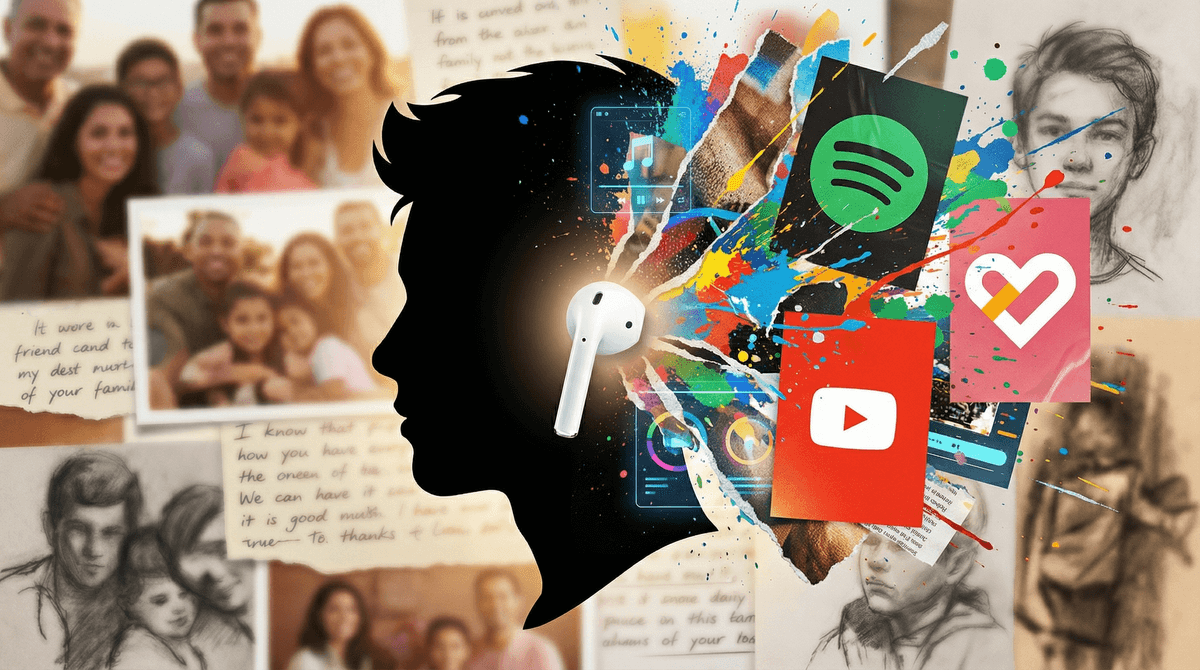
Walk into any middle school and you'll see it: earbuds have become a permanent facial feature. Kids walk around with AirPods like they're prescription eyewear, one bud dangling, always ready to tune back in. And honestly? I get it. If I were 13 and had to navigate the acoustic hellscape of a school cafeteria, I'd want an escape hatch too.
But here's the thing parents are noticing: the earbuds aren't just for the bus ride anymore. They're at dinner. They're during homework. They're creating these little sound bubbles where our kids are living increasingly separate audio lives from the rest of the household. And while part of this is normal teenage autonomy stuff, part of it is worth examining.
This isn't about whether earbuds are "good" or "bad" — they're just a tool. But like any tool, how we use them matters. And right now, we're in this weird transitional moment where the social norms around personal audio devices are still being figured out.
Let's be real about what's happening. For today's kids, earbuds represent:
Autonomy and control: In a world where adults control most of their environment (school, home, activities), earbuds give kids agency over their sensory experience. That's actually developmentally appropriate and healthy.
Social currency: Having AirPods specifically (not just any earbuds, god forbid) is a status thing. It's the 2026 version of having the right sneakers. The social pressure is real.
Legitimate noise management: Some kids genuinely use them to manage sensory overwhelm, focus on homework, or create calm in chaotic environments. For kids with ADHD or sensory processing differences, this can be genuinely helpful.
Connection to their world: Their friends are in there. Their music is in there. The YouTube video everyone's talking about is in there. To them, taking out the earbuds isn't "joining the family" — it's disconnecting from their social world.
The problem isn't that any of this is inherently wrong. The problem is when the earbuds become a wall instead of a tool.
Hearing damage is real and it's boring but it matters: The WHO estimates that over 1 billion young people are at risk of hearing loss from unsafe listening practices. And here's the kicker — noise-induced hearing loss is permanent. Those tiny hair cells in the cochlea don't grow back.
The 60/60 rule is your friend: no more than 60% volume for no more than 60 minutes at a time. Though honestly, if your kid is following the 60/60 rule, they're probably also flossing daily and getting 9 hours of sleep, so... good luck with that.
The "always on" thing: When kids are constantly plugged in, they're missing ambient sounds that actually matter — a parent calling them, a car horn, a smoke alarm, social cues from people around them. It's creating this weird situational unawareness that can be both rude and genuinely unsafe.
Family disconnection: This is the one that hurts. When everyone's in their own audio bubble, you lose those random conversations that happen in the car, the shared experience of cooking dinner together, the casual "how was your day" check-ins that don't feel forced. Those moments of boredom and ambient family time are actually where connection happens.
The social isolation spiral: For some kids, earbuds become an avoidance tool. Social anxiety? Earbuds. Awkward family dinner? Earbuds. Don't want to deal with feelings? Earbuds. When they become a constant escape mechanism, that's worth paying attention to.
Elementary (Ages 5-10): Honestly, most kids this age don't need personal earbuds for constant use. Headphones for specific activities (long car rides, their own device time, airplane travel) make sense. But the "always wearing them" thing shouldn't be normalized yet. They're still learning basic social skills and family communication patterns.
If they're using them, you're still in full control of volume limits (many kids' headphones have built-in volume limiting — use them) and when/where they're appropriate.
Middle School (Ages 11-13): This is when it gets real. Suddenly everyone has them, and your kid feels like a digital outcast without them. This is also when kids start really needing autonomy and privacy.
Reasonable middle ground: Yes to earbuds for their room, the bus, walking to school, their personal device time. No to earbuds during family meals, family activities, homework (unless they can make a genuine case for focus music), or when anyone is trying to talk to them.
High School (Ages 14-18): They're going to have them. They're going to use them constantly. Pick your battles.
But you can still have household norms: no earbuds during family dinner, one earbud out when walking in public (safety), and a general expectation that if someone's talking to them, they take them out. Not because you're a controlling monster, but because basic human courtesy still exists.
Establish earbud-free zones: Kitchen during meal prep and dinner. The car for short trips (long road trips are negotiable). Family movie night (obviously). These aren't punishment zones — they're connection zones.
Get curious about what they're listening to: Instead of just seeing earbuds as a wall, ask about the music, the podcast, the video. Sometimes kids will actually share if you're genuinely interested rather than judgey. Spotify and YouTube are their worlds — learn the geography.
Model the behavior: If you're scrolling your phone with AirPods in during dinner, guess what message that sends? Family audio-free time means everyone, not just the kids.
Talk about hearing health: Show them this article about musicians who have tinnitus . Make it real. Tinnitus is a permanent ringing in your ears that never stops. That's nightmare fuel for any teenager once they actually understand it.
Invest in good earbuds with volume limiting: If they're going to wear them constantly anyway, get ones that have actual safety features. Some earbuds can be set to maximum volume limits through parental controls.
Create "together" audio experiences: Family playlist in the car. Watching a show together (yes, The Last of Us or Stranger Things counts). Listening to a podcast together on a long drive. Show them that shared audio experiences can be good too.
Acknowledge the legitimate uses: If your kid has ADHD and genuinely focuses better with music, honor that. If they're overstimulated after school and need 20 minutes of audio decompression, that's valid. The goal isn't no earbuds ever — it's intentional use.
Real talk: I'm going to sound like a boring adult here, but this actually matters.
Noise-induced hearing loss is:
- Permanent
- Preventable
- Increasingly common in young people
- Something your kid will deeply regret in their 30s
The Apple Health app actually tracks headphone audio levels and will notify you if exposure is too loud. Android has similar features. Turn these on. Your kid will roll their eyes so hard they'll see their own brain, but do it anyway.
Signs of hearing damage include:
- Ringing in the ears after listening (tinnitus)
- Muffled hearing after removing earbuds
- Needing to increase volume constantly
- Difficulty hearing conversations in noisy environments
If you notice any of these, get their hearing checked. And maybe have a real conversation about how hearing loss actually works.
Earbuds aren't the enemy. They're actually pretty great for giving kids autonomy, managing sensory needs, and accessing the content they care about. The issue is when they become a constant barrier to family connection and awareness.
Your job isn't to ban earbuds or make your kid the social outcast who doesn't have AirPods. Your job is to teach them that like everything else in life, there's a time and a place. And that human connection — the boring, ambient, sometimes awkward kind that happens when we share the same audio space — still matters.
Set some reasonable boundaries. Protect their hearing (because they won't). Stay curious about their world. And maybe, just maybe, have a few meals a week where everyone's ears are actually available for conversation.
- Check your kid's device for volume limit settings and turn them on
- Establish one earbud-free time that happens daily (dinner is the obvious choice)
- Have an actual conversation about hearing health that doesn't sound like a lecture (good luck)
- Pay attention to whether the earbuds are a tool or an escape mechanism
- Model the behavior you want to see (yes, that means you too)
And if you're looking for ways to create more family connection that doesn't feel forced, check out our guide on family media time — because sometimes the answer isn't less screens, it's more intentional togetherness.