

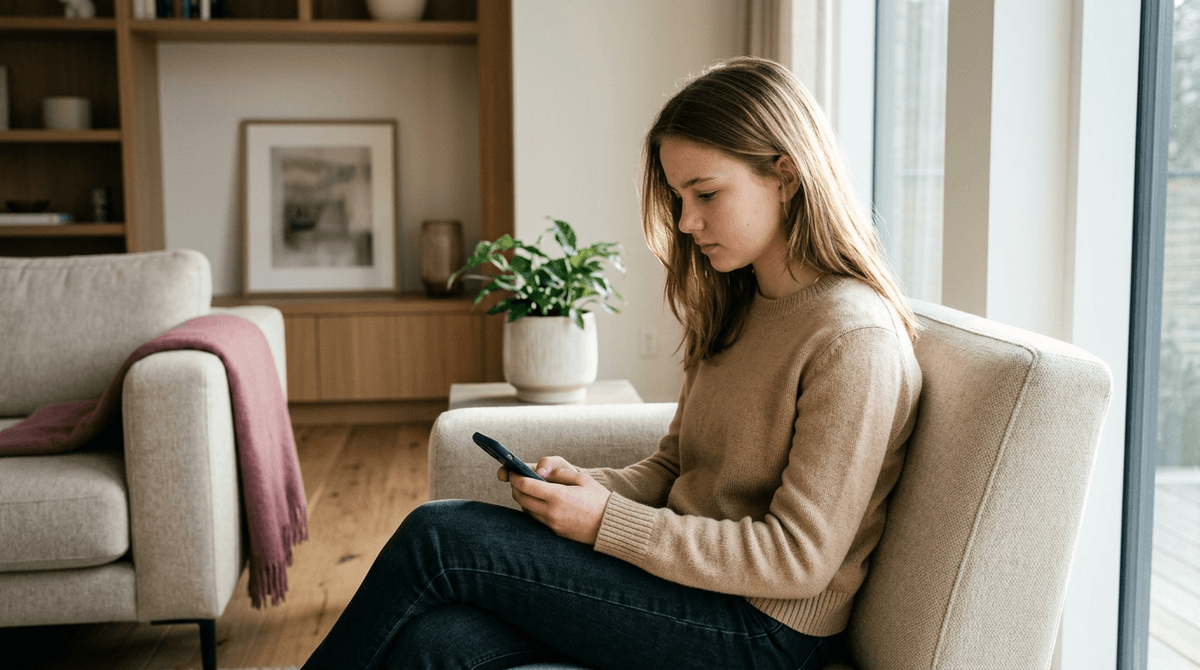

Adolescent girls who demand physical perfection from themselves end up anxious about showing their unedited faces in public. When they hide behind digital beauty filters and obsess over what their peers are doing without them, that offline anxiety skyrockets.
Digital beauty filters convert a teen girl's internal pressure for physical perfection into measurable anxiety about being seen in person, especially when paired with a heavy fear of missing out.
Face filters are rarely just lighthearted visual tools. When teens routinely rely on digital smoothing, slimming, and feature reshaping, they create an impossible standard that their offline faces cannot match, making real-world social interactions feel dangerous.
If a teenager seems confident online but increasingly hesitant to attend in-person hangouts, school events, or sports practices, the issue might not be general shyness—it may be the stressful gap between their filtered posts and reality.
Researchers wanted to track how internal psychological pressure translates into social avoidance over time. While past snapshot studies proved that self-conscious teens enjoy using filters, this study tracked teenagers over time to see if image-editing habits actively manufacture real-world social anxiety.
Tracking high school girls over time revealed a clear domino effect from online self-editing to real-world distress:
- Perfectionism fuels filter reliance. Girls who feel intense pressure to look flawless are far more likely to routinely alter their faces digitally before posting or sending photos.
- Filters build in-person dread. Frequent filter use directly increases anxiety about being seen face-to-face, as teens worry others will judge the gap between their edited posts and raw appearance.
- FoMO acts as an amplifier. The shift from perfectionism to filter use—and from filter use to social anxiety—is significantly stronger in girls who constantly worry that their peers are hanging out without them.
Filters offer immediate, short-term relief from appearance anxiety, but that relief operates like a trap. By masking perceived flaws online, teens prevent themselves from learning that their real face is entirely acceptable to their peers. This safety behavior guarantees that stepping into a brightly lit classroom without a digital filter feels increasingly terrifying over time.
The study followed 443 female high school students in Tehran, Iran. While appearance pressure on teenage girls is widespread, cultural differences around social media usage mean these results may apply somewhat differently to boys or to Western teenagers. Additionally, the data relied on self-reported surveys rather than direct observation of screen time.
- If your daughter relies heavily on beautifying filters in apps like Snapchat or TikTok, sit down with her to discuss how smoothed skin and reshaped features create an unmaintainable real-world expectation.
- If your teen resists attending offline social events after posting heavily edited photos, set firm house boundaries around image-tuning apps to lower the pressure of being seen in person.
- If your teen struggles with a high fear of missing out, prioritize structured, face-to-face weekend activities to weaken the compulsion to check social feeds constantly.
Beauty filters aren't just fun camera tools—they act as an anxiety engine for kids struggling with body perfectionism. Stripping away artificial face-tuning and reducing feed-checking gives teens the breathing room they need to accept themselves in real life.
Abdollahi A, Dehghanidowlatabadi S, Noor Sri Juwaneeta Jamaludin A et al. (2026). The Longitudinal Pathway from Body Appearance Perfectionism to Social Appearance Anxiety: The Mediating Role of Digital Filter Use and Moderating Role of Fear of Missing Out. The Journal of genetic psychology. doi:10.1080/00221325.2026.2680991 — pubmed.ncbi.nlm.nih.gov