

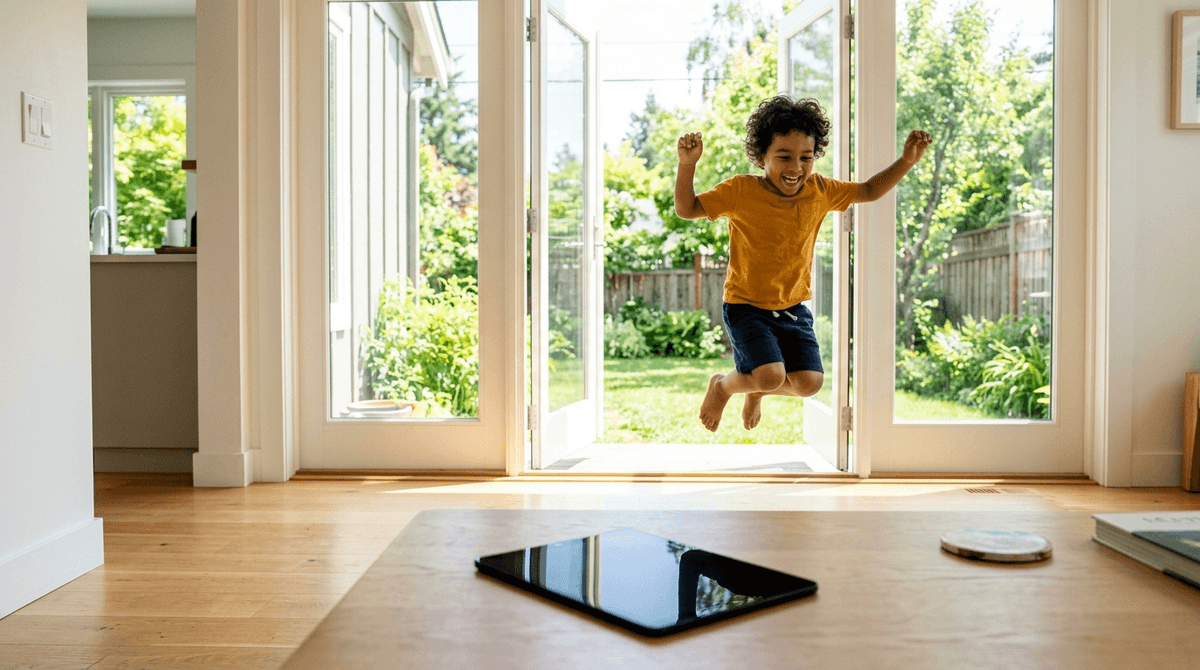

Toddlers and preschoolers are noticeably less irritable on days they get more physical activity, while heavy screen time reliably drives crankiness up.
Movement acts as a daily mood stabilizer for young kids: active toddlers are consistently less irritable, and bumping up physical play pays off on the exact same day.
Every parent knows the late-afternoon meltdown zone. The default impulse is often handing over an iPad to buy twenty minutes of quiet, but that trade usually backfires.
This data shows that physical activity isn't just an investment in long-term health; it changes your child’s emotional baseline today. Swapping half an hour of passive screen watching for thirty minutes of gross-motor play directly cuts down on whining, defiance, and sudden tantrums.
Researchers wanted to move beyond the tired question of whether "active kids" simply have easier temperaments from birth. By tracking how individual children's moods swung day-to-day based on their daily movement, they isolated the immediate effect of physical exertion versus digital media use.
The study tracked over 1,200 children across Australia at ages 2 and 4 using detailed 24-hour time-use diaries.
- Active days equal better days. Even naturally fussy children showed sharp drops in irritability on days they moved more than their personal average.
- Screens track with tantrums. Higher screen use consistently ran alongside worse irritability across both age groups.
- The swap works mathematically. When researchers modeled trading 30 minutes of sedentary screen time for 30 minutes of physical play, predicted irritability scores reliably dropped.
A child sitting in front of a cartoon looks calm, but their nervous system isn't discharging stress. Toddlers experience dysregulation physically. Sitting still while absorbing fast-paced media suppresses movement without releasing tension, leaving them primed for an explosive reaction the second the device turns off.
The findings are observational. Researchers tracked habits and moods together, so this does not prove that a tablet directly causes a tantrum—exhausted parents might simply lean harder on screens when a child is already mid-meltdown. Additionally, parents recorded the time diaries and mood ratings themselves, meaning their own stress levels could have influenced how irritable their children seemed.
- If your preschooler is spiraling into a 4:30 p.m. meltdown… change their physical state with ten minutes of outdoor chase or an indoor dance party rather than offering a show.
- If you need to pull your child away from a tablet… pair the screen shut-down immediately with a physical destination, like walking to the mailbox or jumping on a floor pillow, to bleed off transition angst.
- If bad weather traps you inside all day… clear floor space for roughhousing or an obstacle course, because quiet indoor sedentary play will not deliver the same emotional reset.
Physical play isn't a bonus chore to check off—it is your fastest, most effective tool to defuse a cranky child before bedtime.
Bourke M, Phillips SM (2026). Within- and between-person associations between 24-hr movement behaviors and irritability in early childhood. Developmental psychology. doi:10.1037/dev0002249 — pubmed.ncbi.nlm.nih.gov