

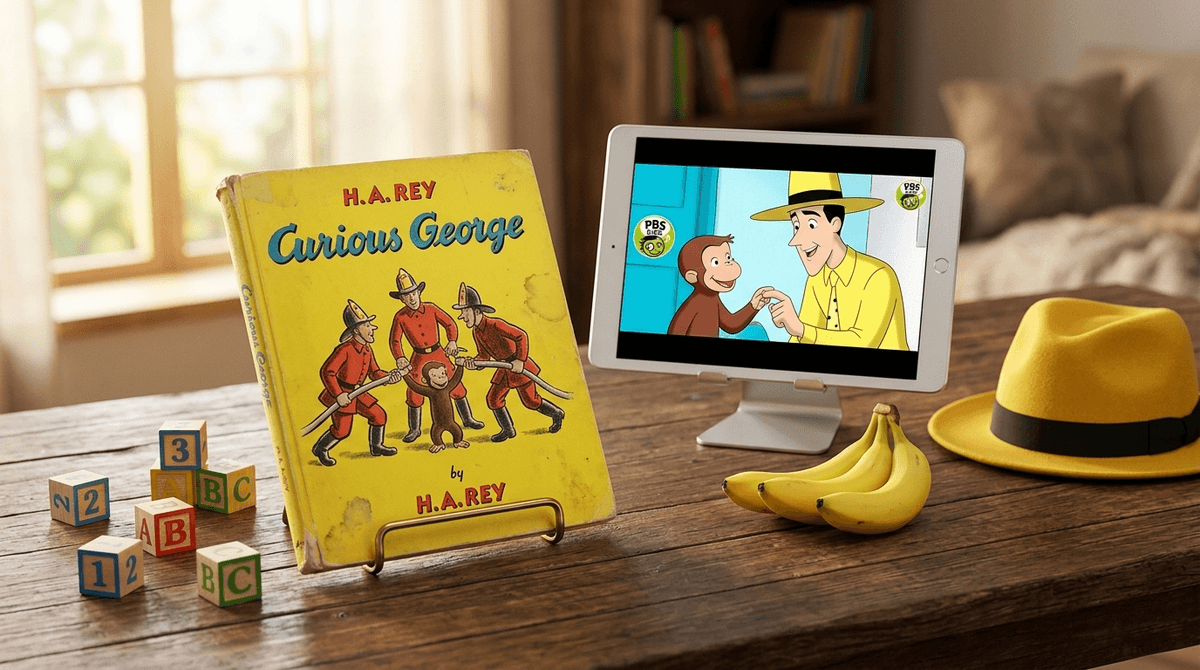
TL;DR: Curious George is the ultimate "chaotic good" toddler proxy. The vintage books are charming but occasionally sketchy by 2025 safety standards, while the Curious George show on PBS is a STEM-heavy masterpiece of gentle parenting. It’s a "Green Light" franchise for ages 2–6, provided you can handle the Man with the Yellow Hat’s questionable supervision skills.
Quick Links:
- The OG: Curious George by H.A. Rey
- The Best Screen Version: Curious George (PBS Kids)
- The Movie: Curious George (2006)
- The Digital Hub: PBS Kids Website
If you grew up with a pulse, you know George. He’s the little monkey (technically an ape, but let’s not be those people) who was brought from Africa by the Man with the Yellow Hat to live in the "big city."
Created by Margret and H.A. Rey—who, fun fact, literally fled Nazi-occupied Paris on bicycles with the original George manuscript strapped to their backs—the series has evolved from a few classic picture books into a multi-media empire.
Today, George isn't just a book character; he’s the face of early childhood STEM education. There’s a massive difference between the 1941 Curious George book and the 2020s Curious George show. The old-school George was a bit of a menace who occasionally ended up in jail or the hospital; the modern George is basically a furry little engineer who helps kids understand 3D shapes and simple machines.
George is a mirror for every toddler and preschooler. He has zero impulse control, a massive heart, and a brain that asks "What happens if I turn this lever?" before his internal "Is this a bad idea?" filter can kick in.
Kids love George because he gets to do the things they aren't allowed to do—like painting a room with a garden hose or letting all the animals out of the shelter—but he never gets "in trouble" in a punitive way. The Man with the Yellow Hat is the ultimate "gentle parent." He doesn't yell; he just sighs, buys more bananas, and helps George fix the mess. It’s pure wish fulfillment for the under-5 crowd.
Not all George content is created equal. Here is the breakdown of what’s worth your time and what’s just digital noise.
The original seven books by the Reys are classics for a reason. The illustrations are iconic and the pacing is perfect for a bedtime story. However, if you're reading these to a 3-year-old today, be prepared for some "Wait, what?" moments. In the first book, George is literally kidnapped in a bag, and in Curious George Takes a Job, he ends up huffing ether and passing out. It’s a vibe, but maybe not the one you want right before nap time.
This is the gold standard. Narrated by William H. Macy (early seasons) and Rino Romano, this show is genuinely smart. Every episode focuses on a math or science concept—measuring, mapping, states of matter—without being "educational" in that annoying, soul-crushing way. It’s calm, the music is great, and it’s one of the few shows that won't make you want to throw your TV out the window after the third loop. Check out our guide to the best educational shows for preschoolers
If you haven't heard the Jack Johnson soundtrack for this movie, go listen to it now. It’s the ultimate "chill parent" playlist. The movie itself features Will Ferrell as the Man with the Yellow Hat (given the name "Ted" here). It’s a sweet, low-stakes movie that is perfect for a first-ever family movie night. No scary villains, no high-stress chase scenes—just a monkey and a guy in a bright suit.
If your kid is asking for "George games," skip the random shovelware in the App Store and go straight to the PBS Kids Website. The George games there are browser-based, free, and actually focus on the STEM skills from the show. They’re great for "supervised digital playtime" where you’re teaching them how to use a mouse or a touchscreen.
- Ages 2-3: Stick to the Curious George board books and the Curious George show. This age group loves the physical comedy of George falling over or making a mess.
- Ages 4-6: This is the sweet spot for the STEM concepts. Talk about how George solves problems. When he tries to make a bridge for his toy boat, ask your kid, "What would you use to build that?"
- Ages 7+: Most kids start to outgrow George by 1st grade. If they’re still into animals and mischief, you might want to transition them to The Bad Guys or Dog Man.
Learn more about transitioning from picture books to early graphic novels
Let’s talk about the elephant (or monkey) in the room.
1. The "Kidnapping" Origin: In the 1941 book, the Man with the Yellow Hat sees George in the jungle, decides he wants him, puts him in a bag, and takes him on a ship to the city. In 2026, that’s... problematic. It’s a colonialist narrative that hasn't aged well. Most parents just skip the first few pages or frame it as "George went on an adventure with his friend," but if you're a family that values historical context, it's a conversation starter about how we treat animals and people.
2. Safety Mimicry: George does things that would get a human child killed. He flies away on a bunch of balloons, climbs onto high-voltage wires, and messes with heavy machinery. If you have a "runner" or a kid with zero fear, you need to be explicit: "George is a monkey, and monkeys are great climbers. Humans cannot do what George does."
3. The Digital Rabbit Hole: Because George is "safe," it’s easy to let kids binge the show on YouTube. Don't do this. YouTube’s algorithm can quickly pivot from official George clips to weird, bootleg "Elsagate" style content or "learning colors" videos that are basically brain rot. Stick to the PBS Kids app or a dedicated streaming service.
George is a fantastic tool for teaching Emotional Intelligence (EQ). Because George doesn't speak, kids have to read his body language and facial expressions to understand how he’s feeling.
- On Impulse Control: "George really wanted to see what was inside that package, didn't he? Have you ever felt like you just had to open something even though you knew you should wait?"
- On Problem Solving: "George made a huge mess with that flour. How did he fix it? Who did he ask for help?"
- On Forgiveness: "The Man with the Yellow Hat wasn't even mad. He helped George. Why do you think he did that?"
Curious George is one of the few "legacy" brands that has actually gotten better with age. While the original books require a little bit of "vintage filter" from parents, the modern iterations are stellar examples of how to engage a child's curiosity without overstimulating them.
It’s not Bluey—it’s not going to make you weep about your own childhood—but it’s a solid, dependable "B+" in the parenting toolkit. It encourages kids to ask "Why?" and "How?", which is exactly what we want in a world that’s becoming increasingly automated.
Next Steps:
- Check out the Curious George (PBS Kids) if you need 20 minutes to fold laundry in peace.
- Grab a copy of Curious George Flies a Kite for a great example of early-reader sequencing.
- Take the Screenwise Survey to see how your family's media diet compares to other intentional parents in your community.