

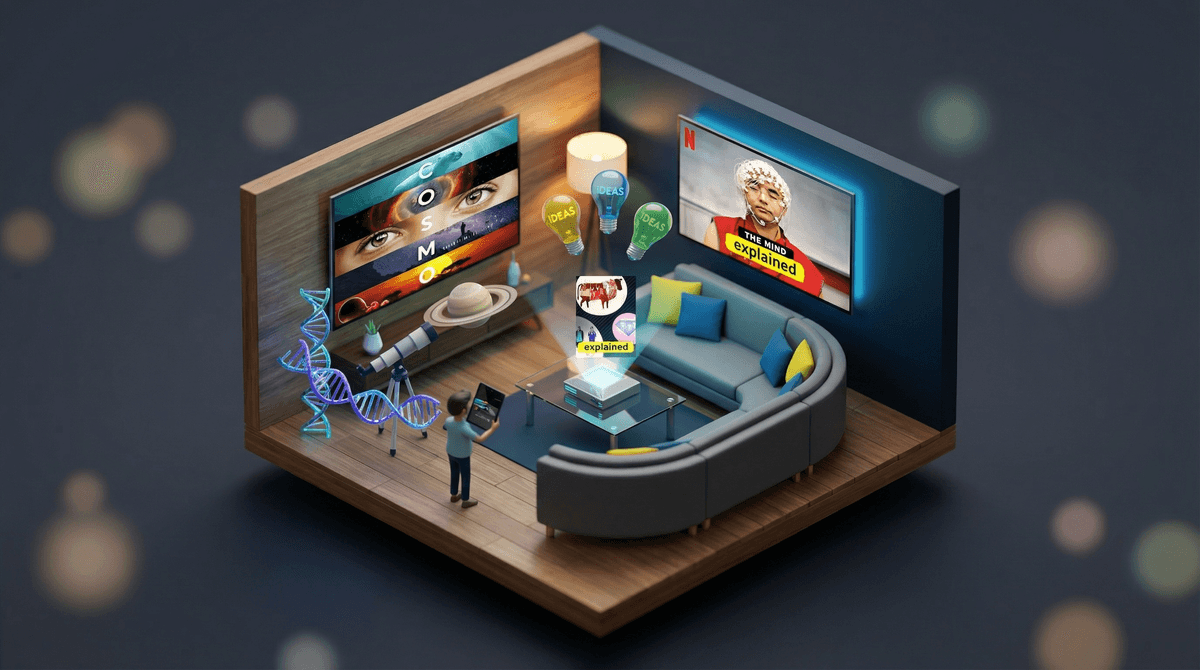
Curiosity is a Netflix docuseries that does something pretty rare in the streaming world: it makes learning genuinely entertaining without dumbing anything down. Each episode tackles a single question—like "Why do we dream?" or "Can we live forever?"—and explores it through a mix of science, expert interviews, and surprisingly high-quality visuals. Think of it as the sophisticated older sibling of those "fun facts" YouTube videos your kids binge, except actually substantive.
The series is hosted by different experts and celebrities depending on the episode (you'll see everyone from Emma Stone to Kareem Abdul-Jabbar), which keeps things fresh. Episodes run about 20 minutes, making them perfect for that post-homework, pre-dinner window when you need something that won't turn their brains to mush but also won't trigger the "this is educational so I hate it" reflex.
Here's the thing about Curiosity: it respects its audience. The show doesn't talk down to viewers or oversimplify complex topics into meaninglessness. When an episode explores whether robots will take over the world, it actually discusses AI ethics, job displacement, and the difference between narrow and general intelligence. Your 10-year-old might not grasp every nuance, but they'll walk away with real concepts to chew on.
The production quality matters too. This isn't some educational channel with stock footage and a monotone narrator. The visuals are legitimately cool—think stylized animations, clever demonstrations, and field reporting that makes science feel like an adventure rather than a textbook chapter.
And critically: episodes are self-contained. You're not committing to a 47-episode arc. Your kid can watch one episode about whether aliens exist and then bail. Or they might get hooked and watch three more. Either way, you're not stuck managing another endless series.
Ages 8-12: This is the sweet spot. Kids in this range are developing the cognitive ability to handle abstract concepts and "what if" thinking. The episodes will spark questions—lots of them—which is exactly the point. Some topics (like the episode on mortality) might be heavy depending on your kid's temperament, so maybe preview those first.
Ages 13+: Absolutely appropriate, though some teens might initially resist because it's "educational." The trick here is leading with the most intriguing episode titles. "Can we live forever?" hits different than "Let's watch a science show."
Under 8: Probably too advanced for solo viewing, but could work as a family watch if you're willing to pause frequently and translate concepts. The attention span required is also a factor—20 minutes is long when you're six.
This isn't passive entertainment. If you just want something to occupy your kid while you make dinner, fine—Curiosity will do that without rotting their brain. But the real value comes from the conversations afterward. When your kid asks "Wait, so ARE we alone in the universe?" at bedtime, that's the show working as intended.
Some episodes touch on existential topics. Death, the nature of consciousness, whether we're living in a simulation—this show goes there. For some kids, that's thrilling. For others, it might trigger anxiety. You know your kid. The episode descriptions are pretty clear about what's covered, so scan ahead.
The science is legitimate. Unlike some "edutainment" that sacrifices accuracy for entertainment, Curiosity brings in actual researchers and presents real scientific thinking. When they discuss controversial topics, they acknowledge the debate rather than presenting one view as fact. This is good modeling for critical thinking.
It's not a substitute for school, but it's a hell of a supplement. Think of this as the kind of learning that makes school concepts click. When your kid studies the water cycle and remembers that Curiosity episode about weather, suddenly geography class gets more interesting.
Here's how to level up from "just another show" to actual learning:
Watch together occasionally. You don't need to co-view every episode, but picking one or two to watch as a family sends the message that this stuff matters. Plus, you might actually learn something. (The episode on memory genuinely changed how I think about why I can never remember where I put my keys.)
Keep the conversation going. When your kid brings up something from an episode, engage with it. "I don't know, what do YOU think?" is powerful. You're modeling curiosity itself , which is worth more than having all the answers.
Connect it to other media. If your kid loved the space episode, maybe that's your opening to suggest Cosmos or check out some space-themed books. Use Curiosity as a gateway drug to deeper learning.
Don't force it. If your kid watches one episode and isn't into it, that's fine. Not every kid is wired for this format, and that's not a referendum on their intelligence or your parenting.
In the endless battle to find screen time that isn't completely mindless, Curiosity is a genuine win. It's not perfect—some episodes are stronger than others, and the celebrity hosts can feel a bit gimmicky—but it's doing something valuable: showing kids that learning about the world can be as compelling as whatever's trending on TikTok.
Will it turn your Fortnite-obsessed kid into a junior scientist? Probably not. But it might plant seeds. It might give them language for big questions. It might make them think differently about the world for 20 minutes. And honestly? In 2026, that counts as a parenting win.
Start with whichever episode title makes your kid's eyes light up. "Why do we dream?" and "Will robots take over the world?" tend to be crowd-pleasers. Watch one together, see what questions come up, and go from there. And if you want to explore more science content that doesn't make you want to claw your eyes out, check out Brains On! for audio learning or Octonauts for younger kids who aren't quite ready for Curiosity's complexity.
The goal isn't to eliminate fun screen time—it's to expand what "fun" can include. Curiosity does exactly that.