

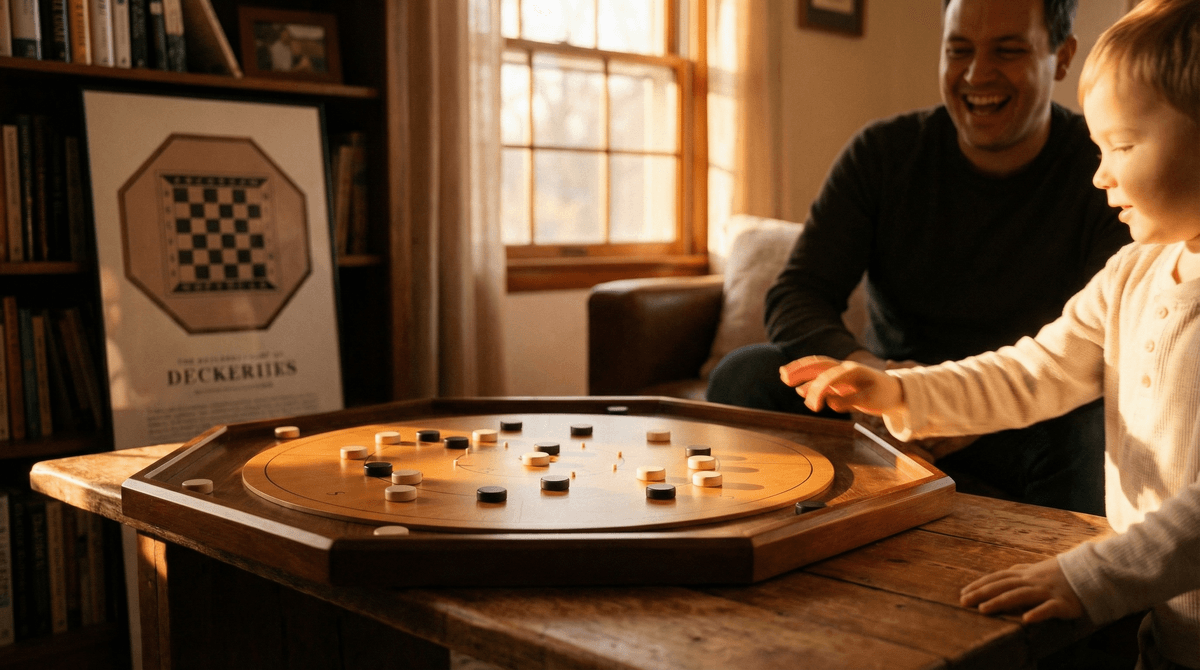
If you've never heard of Crokinole, you're not alone—but you're also missing out on one of the most genuinely fun tabletop games that doesn't involve tiny plastic pieces you'll find embedded in your foot at 2am.
Crokinole (pronounced "CROW-kin-ole") is a dexterity board game that's been around since the 1870s, originating in Ontario, Canada. Picture a circular wooden board, about 26 inches across, with a hole in the center and concentric scoring rings. Players take turns flicking wooden discs across the board, trying to land them in the high-scoring center hole or knock their opponent's discs off the board entirely. It's like shuffleboard meets curling meets air hockey, but somehow more addictive than all three combined.
The rules are simple enough that a 6-year-old can grasp them in five minutes, but the strategy and skill ceiling are high enough that adults will genuinely want to keep playing. And here's the kicker: you're all sitting around the same physical object, making eye contact, trash-talking, and groaning in unison when someone nails an impossible shot.
In an era where "family game night" often means everyone playing different games on different devices in the same room, Crokinole is experiencing a legitimate renaissance. Sales have surged in recent years, and it's not hard to see why.
First, there's the analog appeal. Parents who are exhausted from managing screen time limits, negotiating Robux purchases, and explaining why we can't just "pause" an online game are craving activities that don't require Wi-Fi, updates, or in-app purchases. Crokinole delivers pure, unplugged fun with zero notifications.
Second, it's genuinely skill-based in a way that feels satisfying. Unlike many family board games where luck dominates (looking at you, Candy Land), Crokinole rewards practice and precision. Kids can see themselves improve over time, which hits that same progression dopamine that games like Fortnite provide—but without the battle pass.
Third, the physical craftsmanship matters. A quality Crokinole board is a beautiful object—smooth hardwood, often handcrafted, with a satisfying weight and finish. In a world of disposable plastic toys and digital ephemera, owning something substantial and heirloom-quality resonates with families trying to be more intentional about their purchases.
Ages 6-8: Kids in this range can absolutely play, though they'll need some hand-over-hand guidance on flicking technique at first. The basic "get your disc closest to the center" concept is intuitive. You might simplify scoring or play cooperatively at first. The fine motor skill practice is actually fantastic for this age group.
Ages 9-12: This is the sweet spot. Kids have the dexterity to execute shots with real precision, can handle the full scoring system, and are competitive enough to stay engaged through multiple rounds. They'll also start developing actual strategy about shot placement and defensive play.
Ages 13+: Teens will often surprise you by getting genuinely into it, especially if you frame it as a skill challenge rather than "family fun time." The same kids who spend hours practicing edits in Rocket League will appreciate the muscle memory and precision required for a good crokinole shot.
Adults: Look, this game is legitimately fun for adults. You will want to play even when the kids aren't around. There are actual Crokinole tournaments. Embrace it.
The investment is real: A quality Crokinole board runs $150-400+. Cheaper versions exist, but the playing surface quality matters significantly for disc glide. This isn't a $20 impulse buy. That said, it's a one-time purchase with zero ongoing costs, which means over its lifetime it's cheaper than a year of Roblox Premium.
Space requirements: You need a table or floor space that can accommodate the 26-inch board plus room for players to sit around it. It's not huge, but it's not pocket-sized either. The board also needs to be level for fair play.
It's loud: The satisfying click-clack of wooden discs hitting each other is part of the charm, but it's not a quiet game. If you have downstairs neighbors or a sleeping baby, timing matters.
Dust is the enemy: The board needs to be kept clean and occasionally waxed for optimal disc glide. It's low maintenance, but not zero maintenance.
The learning curve is forgiving: Unlike complex strategy games that take hours to learn (looking at you, Catan), you can teach someone Crokinole in under 10 minutes and be playing actual competitive games within 20 minutes.
Crokinole isn't going to single-handedly solve your family's screen time challenges. Your kids will still want to play Minecraft, and that's fine. But if you're looking for something that creates genuine face-to-face interaction, develops real physical skills, and provides entertainment that doesn't depreciate the moment a new update drops, Crokinole delivers.
It's also one of those rare activities where the skill gap between parent and child can actually narrow over time—your 10-year-old practicing daily might legitimately beat you within a few weeks, which is both humbling and kind of wonderful.
Is it the right fit for every family? No. If you're tight on space, budget, or have very young kids who put everything in their mouths, maybe wait. But for families actively trying to cultivate analog alternatives to digital entertainment, Crokinole is one of the best investments you can make.
Ready to try it? Look for boards from reputable makers like Crokinole Canada, Tracey Boards, or Hilinski. Read reviews carefully—board quality varies significantly.
Want to try before buying? Check if your local board game café has one available. Many do, and it's a great way to see if your family actually enjoys it before dropping $200+.
Looking for other analog alternatives? Check out our guide to screen-free family activities or explore other engaging board games for families.