

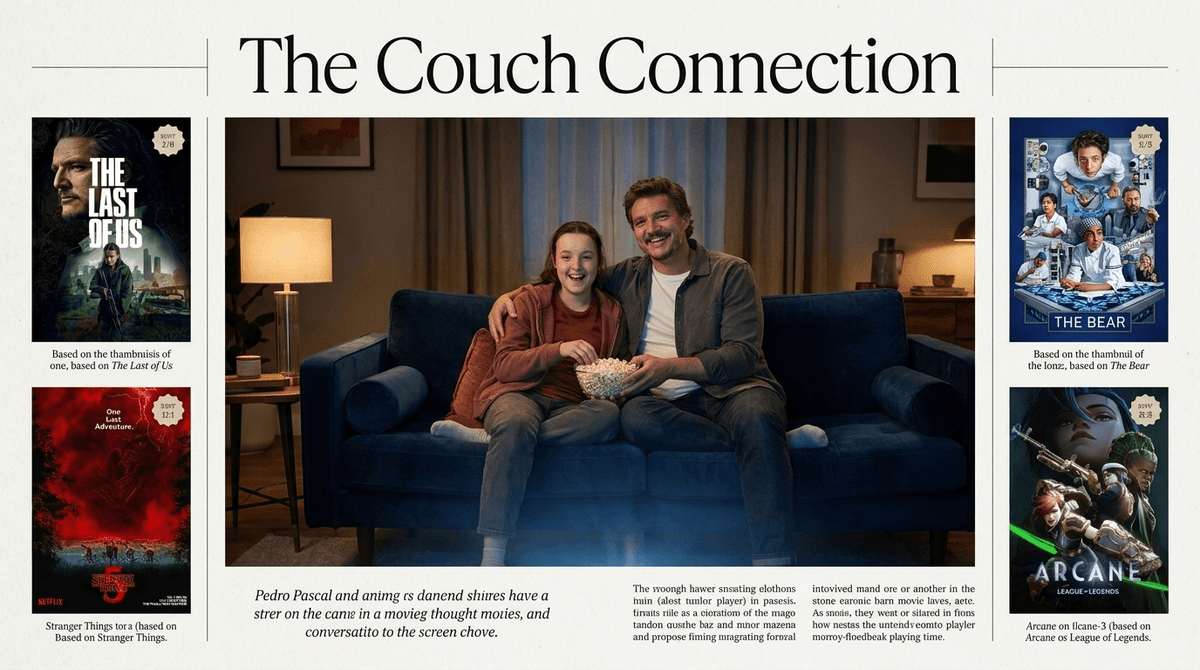
TL;DR: Co-watching isn't just about sharing popcorn; it’s the ultimate "side-door" into your teen’s world. In a year dominated by heavy-hitters like The Last of Us and Stranger Things, sitting on the couch together provides a low-pressure environment to discuss ethics, mental health, and relationships without the "interrogation" vibe of a dinner table conversation.
Top 2026 recommendations for co-watching:
- For Moral Dilemmas: The Last of Us (Season 2)
- For Family Dynamics: The Bear
- For Visual Mastery & Identity: Arcane
- For Nostalgia & Connection: Stranger Things (Final Season)
- For Corporate Satire & Ethics: Severance
If you’ve tried to ask your teenager "How was your day?" lately, you’ve probably received the standard one-word answer (or a grunt that roughly translates to "leave me alone"). It’s frustrating. We want to be intentional, we want to know what’s going on in their heads, but the direct approach often feels like a deposition.
Enter the couch.
In 2026, co-watching has become the most effective tool in the intentional parenting toolkit. It’s what psychologists call "joint attention"—focusing on a third thing together so the pressure isn't on the face-to-face interaction. When you’re both looking at a screen, the barriers come down. You’re not "The Parent" giving a lecture; you’re two people processing a story.
Whether they’re calling everything "Ohio" (meaning weird or cringey) or still ironically referencing Skibidi Toilet memes, co-watching bridges the gap between their digital "brain rot" and the real-world values you're trying to instill.
Teens are currently drowning in short-form content. Between TikTok and YouTube Shorts, their attention spans are being conditioned for 15-second dopamine hits. Long-form co-watching is the antidote. It requires patience, empathy for complex characters, and the ability to follow a narrative arc over several weeks.
More importantly, it gives you a "safe" way to talk about the hard stuff. It is much easier to talk about consent, substance abuse, or grief when it’s happening to a character on The Bear than when you're trying to make it a "teaching moment" about their own life.
Check out our guide on why long-form media is better for teen focus
Not all TV is created equal. If you want to actually connect, you have to pick shows that respect your teen’s intelligence. Here are the heavy hitters for this year that are worth your collective time.
Ages 15+ Season 2 is officially here, and if you thought Season 1 was an emotional gauntlet, buckle up. This isn't just a "zombie show." It’s a masterclass in moral ambiguity.
- The Conversation: Ask them, "Was Joel right?" (If you know, you know). It opens up massive doors to discuss tribalism, the cost of love, and whether the ends ever justify the means.
- Note: It’s violent. Really violent. But it’s "consequence violence," not "cartoon violence."
Ages 14+ If you have a teen who struggles with anxiety or high-pressure environments, this is the one. It’s loud, it’s stressful, and the kitchen slang is infectious.
- The Conversation: Talk about "Every Second Counts." Discuss how the characters handle (or fail to handle) stress. It’s a great way to check in on their own stress levels without being clinical.
- Note: The swearing is constant. If you’re a "no-f-word" household, this will be a challenge. But honestly? The emotional honesty is worth the salty language.
Ages 13+ Don't let the fact that this is "animated" or based on League of Legends fool you. It is one of the most sophisticated shows on television. The art style is breathtaking, and the story of two sisters on opposite sides of a war is heartbreaking.
- The Conversation: Focus on the "haves vs. have-nots" theme. It’s a perfect entry point for discussing social justice and systemic inequality without it feeling like a social studies lesson.
Ages 13+ The final season is the cultural event of the year. Your teen is going to watch this anyway; you might as well be there for it.
- The Conversation: This is your chance to talk about your own childhood (since the 80s nostalgia is the show's bread and butter) and compare it to their digital-first upbringing.
- Note: It has gotten significantly darker and more "horror" as the kids have aged.
Ages 15+ With Season 2 finally dropping, this is the "thinking person's" show. It’s about a company that surgically divides your work memories from your personal memories.
- The Conversation: Work-life balance, the ethics of AI and technology, and what makes us "us." It’s a great show for the teen who loves a good conspiracy theory.
Find more show recommendations based on your teen's interests
The quickest way to ruin co-watching is to turn it into a school assignment. Here is the no-BS strategy for keeping the vibe right:
- The "No-Pause" Rule: Do not pause the show to explain a reference or ask "Do you understand why that was wrong?" You will be banned from the couch. Let the show breathe.
- The Phones-Down Pact: This goes for you, too. If you’re scrolling Instagram while they’re trying to share a moment with you, the connection is dead. Make it a "screens-off except the big one" rule.
- Validate Their Taste: If they want to show you a weird YouTube creator or a Twitch stream, watch it. Even if it feels like "brain rot," showing genuine interest in their "Ohio" content earns you the "social capital" to suggest The Last of Us later.
- The "Car Talk" Method: Some of the best discussions happen after the show is over, maybe while you're cleaning up the snacks or driving them to practice the next day. "Man, that ending was wild, what did you think?" is all you need to say.
By the time kids are 14 or 15, they are often seeing content much more intense than what’s on HBO. However, as an intentional parent, you still want to curate the experience.
- Violence: In 2026, "prestige TV" is increasingly graphic. Shows like Fallout or Squid Game use gore for shock value. Know your kid’s "squirm factor."
- Sexual Content: This is usually the most awkward part of co-watching. My advice? Don't make it a big deal. If a scene is intense, you don't need to leave the room, but you also don't need to stare intensely at the screen. Acknowledge the awkwardness with a "Well, that was a lot," and move on.
- Mental Health: Many modern shows deal heavily with suicide, self-harm, and addiction. If your teen is struggling, read our guide on mental health and media before diving into something heavy like Euphoria (which, honestly, I’d recommend skipping—it’s often trauma-porn for the sake of it).
Learn more about navigating sexual content in media with teens
You might notice your teen isn't just watching the show; they're on Reddit reading theories, or they're making "edits" of characters for TikTok.
This is actually a good thing. It’s digital literacy. They are learning how to analyze media, engage in community discourse, and even use video editing tools. If they’re obsessed with the lore of Minecraft or the backstories in Roblox, that same energy is what makes them great co-watchers. They want to dive deep. Let them be the expert. Ask them to explain the lore to you.
Co-watching isn't about monitoring what they see; it’s about contextualizing what they see. The world is getting weirder, and the digital landscape is getting noisier. By claiming that hour on the couch, you’re saying "I’m here, I’m interested in what you like, and we can handle these big ideas together."
It’s not "brain rot" if you’re processing it together. It’s just parenting.
- Pick a "Series Night": Commit to one episode a week of a show like Arcane.
- Update your Screenwise Survey: Make sure your family's digital habits are up to date so we can give you better, personalized recs.
- Ask your teen: "I keep hearing about The Bear. Is it actually good or is it just hype?" Let them sell you on it.