

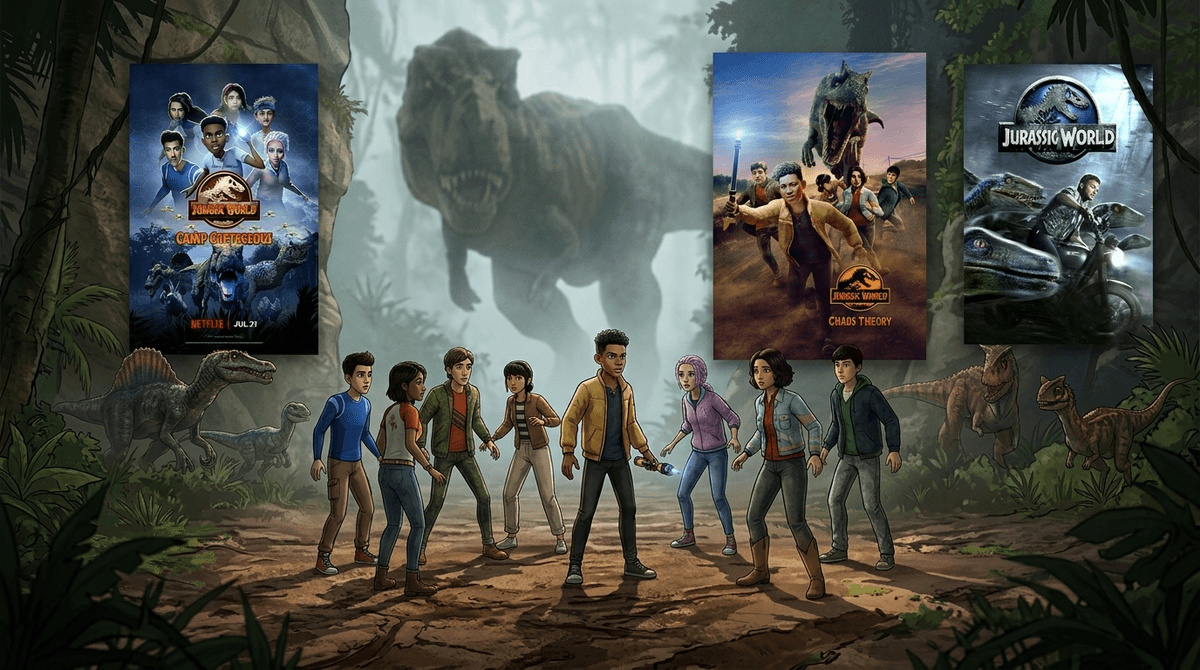
First things first: unless your kid is looking for a cooking competition about crabs, they are probably looking for Jurassic World: Camp Cretaceous. It is a common mix-up, but the "crustacean" version doesn't exist. The real show is a high-octane, surprisingly intense survival thriller that happens to be animated. It is not "baby's first dinosaur show," and it definitely isn't background noise.
Jurassic World: Camp Cretaceous is a five-season survival series on Netflix that follows six teenagers stranded on Isla Nublar. While the animation style looks "kiddy," the stakes are legitimately high—think constant peril, jump scares, and heavy themes of abandonment. It’s a top-tier pick for kids aged 8 to 12 who can handle suspense, but it might be a bit much for the preschool set who just want to see a friendly Brachiosaurus. For the full breakdown of what hits for every age, check out our best shows for kids list.
The biggest thing to know about Camp Cretaceous is that it respects its audience’s intelligence. It doesn't shy away from the fact that dinosaurs are apex predators. About 40% of Screenwise families are using the "Kids" profile on Netflix, where this show is a heavy hitter, but "Kids" is a broad label.
In this show, characters get chased, trapped, and nearly eaten in almost every episode. There is no "reset button" at the end of twenty minutes; the trauma and the dirt stay with the characters. If your kid is sensitive to "perpetual jeopardy"—that feeling where the characters never get a moment to breathe—you might want to co-watch the first couple of episodes. It’s less about blood (there is virtually none) and more about the relentless tension.
Most kids' shows have "the smart one," "the jock," and "the influencer." Camp Cretaceous starts there but quickly complicates things. Over five seasons, these kids have to deal with real-world issues: social anxiety, parental disappointment, and the ethics of animal conservation.
The "influencer" character, Brooklynn, actually has to deal with the reality of her phone being dead and her "followers" not being there to save her. It’s a great entry point for a conversation about what "community" actually looks like when the Wi-Fi goes out. If your kid loves the character-driven side of this, they’ll probably also dig The Dragon Prince or Avatar: The Last Airbender.
Once your kid finishes the five seasons of the original show, they will inevitably jump into the sequel series, Chaos Theory. This one jumps forward in time. The kids are now young adults, and the tone shifts even further into "conspiracy thriller" territory.
From the first two seasons, it’s clear the creators are leaning into the "Jurassic" legacy. It feels more like the original Jurassic Park than a Saturday morning cartoon. If your kid is moving into our digital guide for middle school, Chaos Theory is exactly the kind of "bridge" content that keeps them engaged without feeling like they're watching "baby stuff."
The "Next Episode" button is the real predator here. Because the show relies so heavily on cliffhangers, it is incredibly hard for a kid to watch "just one." If you’re trying to manage screen time, the move is to set the limit by the clock, not the episode count. Tell them they have 45 minutes, which covers about one and a half episodes, and they’ll have to stop mid-story. It sounds cruel, but it prevents the "one more" spiral that happens when an episode ends with a T-Rex roar.
- The "Survival" Skillset: Ask them which of the six kids they’d want in their group if they were stranded. It’s a fun way to see what traits they value—is it the book-smarts of Darius or the pragmatism of Yasmina?
- The Ethics of Dinos: The show eventually gets into "biomedical ethics" (fancy talk for "should we be making these things?"). Ask them if they think the dinosaurs deserve to be protected, even if they’re dangerous.
- The Evolution of Ben: One character, Ben, goes through a massive transformation from "scared of everything" to "survivalist." Ask your kid what they think caused that change.
Q: Is Camp Cretaceous too scary for a 6-year-old?
Probably. Unless your 6-year-old is a seasoned pro with "scary" media, the constant threat of being eaten and the dark, atmospheric scenes can be a lot. It’s better suited for 8+ where they can distinguish between "suspenseful fun" and "nightmare fuel."
Q: How much violence is actually in the show?
There is zero gore. You won't see blood or viscera. However, you will see dinosaurs attacking vehicles, people falling from great heights, and plenty of "near-miss" chomps. The violence is more about the threat of harm than the harm itself.
Q: Do you need to have seen the Jurassic World movies first?
Not really. The show takes place concurrently with the 2015 Jurassic World movie, but it stands on its own. It actually does a better job of explaining the "science" and the park layout than the movies do.
Jurassic World: Camp Cretaceous is one of the rare "kids' shows" that actually earns its place on the big screen. It’s well-written, genuinely thrilling, and manages to make you care about a bunch of CGI teenagers. If your kid is a dino-obsessive, this is the gold standard. Just be prepared for them to ask for a trip to a theme park immediately afterward.
