

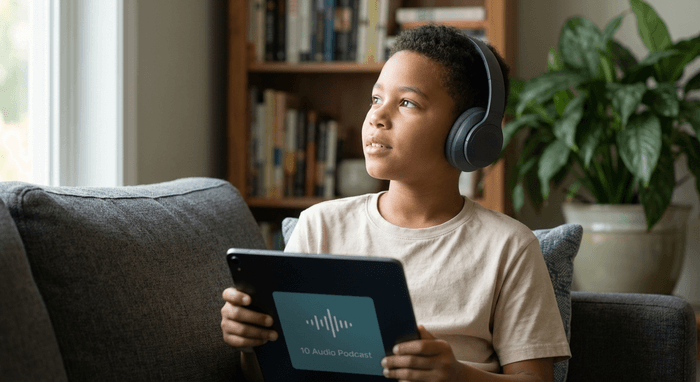
TL;DR: If you are currently in the "But why?" stage of parenting—which, let’s be honest, starts at age 3 and doesn't seem to end until they're teenagers—But Why: A Podcast for Curious Kids is your new best friend. It’s a screen-free way to handle the constant barrage of questions about everything from why the sky is blue to how the government works, without you having to frantically Google things while driving.
Quick Links:
- But Why: A Podcast for Curious Kids
- Wow in the World (The high-energy alternative)
- Brains On! (For the science-obsessed)
- Greeking Out (For the Rick Riordan fans)
Produced by Vermont Public and distributed by NPR, this isn't just another "educational" show that feels like a lecture. The format is brilliant: kids from all over the world record themselves asking a question, and the host, Jane Lindholm, finds an actual expert to answer it.
It’s the ultimate "ask a professional" setup. Instead of you trying to explain the physics of a black hole while simultaneously trying to find a parking spot at Target, a literal astrophysicist does it in a way an eight-year-old can actually wrap their head around.
The topics range from the silly ("Why do we have eyebrows?") to the incredibly complex ("What is racism?" or "How do babies get made?"). It’s handled with a level of respect for the child’s intelligence that you don't always see in kids' media. There’s no talking down, no annoying "kid-voice" acting, and zero Skibidi Toilet energy.
Kids love being taken seriously. When they hear another kid’s voice—complete with the stumbles and the "umms"—asking the exact same weird question they’ve had in their head, it builds an immediate connection.
It also hits that sweet spot of curiosity. Elementary-age kids are starting to realize the world is a massive, complicated place. They’re moving past the "I like trucks" phase and into the "How does the engine actually move the wheels?" phase. This podcast gives them the keys to the kingdom.
Plus, it’s a great "liminal space" activity. It’s perfect for:
- The 20-minute school commute.
- That weird hour between school and soccer practice.
- Folding laundry (if you’ve managed to trick your kids into helping with that).
We talk a lot about "brain rot" and the "zombie stare" kids get when they’ve been on YouTube for too long. Podcasts are the perfect antidote.
Listening to a podcast requires active imagination. They have to visualize the "giant squid" or the "inside of a volcano" that the expert is describing. It’s a low-stimulation, high-engagement medium. It doesn't trigger the same dopamine-loop addiction that Roblox or TikTok does, yet it keeps them quiet and occupied.
Check out our guide on the best podcasts for different age groups
If you’re just starting out, don't feel like you have to go in chronological order. Pick a topic your kid is already obsessed with.
The "I Love Gross Stuff" Starter Pack
- Why Do We Poop and Fart? (The classic. Every kid wants to know.)
- Why Do We Have Slime in Our Noses?
- Why Do We Have To Brush Our Teeth? (Actually helpful for the bedtime battle.)
The "Deep Thinker" Starter Pack
- Why Do People Have Different Skin Colors?
- What Is Death? (Warning: Be ready for a follow-up conversation after this one.)
- Why Is It Hard To Share?
The "Nature & Science" Starter Pack
- How Do Clouds Stay in the Sky?
- Are Dinosaurs Really Extinct?
- Why Is the Ocean Salty?
The Sweet Spot: Ages 5–10.
- Ages 4-6: They might need you to sit with them and occasionally hit "pause" to explain a bigger word, but the shorter episodes are great for their attention spans.
- Ages 7-10: This is the prime demographic. They can listen independently, and they’ll often come back to you with "Did you know...?" facts that will actually impress you.
- Ages 11+: They might start to find the "kid-centric" framing a little young, but the science episodes still hold up. At this age, you might want to transition them to something like Science Vs (with some parental vetting) or Radiolab.
Podcasts are generally one of the "safest" forms of media because there’s no user-generated content, no chat rooms, and no "dark patterns" trying to get them to buy virtual currency.
However, But Why doesn't shy away from the real world. During the height of the pandemic, or when major global events happen (like the war in Ukraine), they often do "special" episodes to help kids process the news.
Pro-tip: Take a quick look at the episode title before you hit play in the car. If your kid is particularly sensitive or you aren't ready to discuss "Where do babies come from?" while navigating a 4-way stop, maybe save that one for later.
Get guidance on handling "the talk" when it comes up in media
The best thing about But Why is that it models how to ask questions. You can use it as a jumping-off point for your own family's "digital inquiry."
- Ask: "What was the most surprising thing you heard in that episode?"
- Challenge: "If you were going to record a question for Jane, what would it be?" (You can actually go to their website and submit a recording—it's a great "productive" tech activity!)
- Connect: If they loved the episode on space, maybe that's your cue to download SkyView and look at the stars tonight.
If your kid burns through the entire catalog of But Why, here are some other heavy hitters in the "intentional parent" podcast world:
- This is the "high-energy" cousin. Guy Raz and Mindy Thomas are hilarious, but it’s much more "wacky" and scripted. It’s great for kids who need a bit more entertainment value to stay focused.
- If your kid is obsessed with Percy Jackson, this is a non-negotiable. It’s Greek mythology told in a very kid-friendly, funny way.
- An ethics podcast for kids. It asks questions like "Is it ever okay to lie?" or "Should we stop having pets?" It’s brilliant for developing critical thinking.
- Very similar to But Why but with a heavier focus on pure science and a rotating cast of kid co-hosts.
But Why: A Podcast for Curious Kids is a rare 10/10 in the world of kids' media. It’s educational without being boring, it’s respectful of children’s curiosity, and it gives parents a much-needed break from being the "fount of all knowledge."
In a world of YouTube Kids rabbit holes and mindless iPad games, this is the kind of digital content that actually makes your kid’s world feel bigger, not smaller.
- Subscribe on Spotify or Apple Podcasts.
- Pick an episode for your next car ride (start with the Poop/Fart one, trust me).
- Check your Screenwise dashboard to see how your kid’s audio-to-video ratio is looking this week.
Learn more about the benefits of audio-only media for child development