

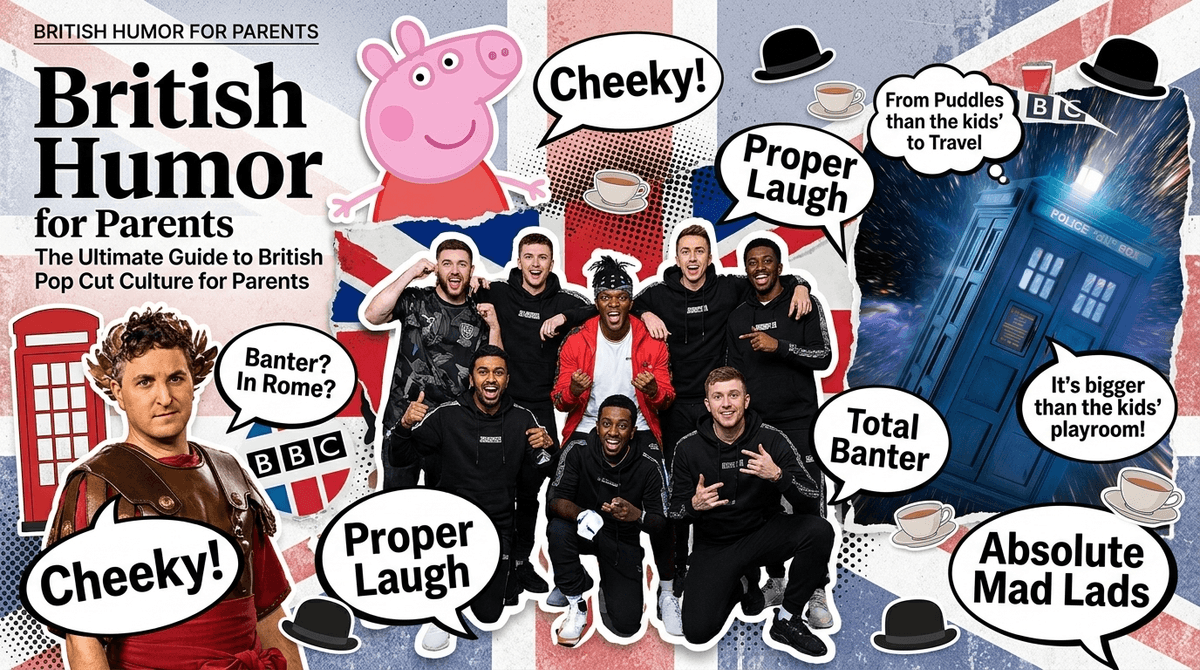
TL;DR
If your child is suddenly calling things "rubbish," acting "cheeky," or developing a dry, sarcastic wit that feels a bit beyond their years, you’re likely witnessing the "British Invasion 2.0." From the subtle "savage" behavior in Peppa Pig to the high-energy "banter" of The Sidemen, UK media is shaping how kids communicate. The goal isn't to ban the accent, but to help them understand the difference between clever satire and being a jerk.
Quick Links:
- The Gateway: Peppa Pig (Ages 3+)
- The Educational Gold Mine: Horrible Histories (Ages 7+)
- The Gaming Legend: DanTDM (Ages 7+)
- The Teen Obsession: The Sidemen (Ages 13+)
British humor is built on a foundation of irony, self-deprecation, and "the banter." Unlike a lot of American kids' media, which tends to be earnest, loud, and focused on "winning," British content often celebrates the underdog, the awkward, and the slightly cynical.
In the UK, if someone makes fun of you, it’s often a sign of affection. This is "banter." The problem is that American kids—especially those in the Roblox and Minecraft age brackets—often pick up the "roasting" part of the humor without the underlying cultural context of connection. They get the sarcasm, but they miss the warmth.
Learn more about the 'Peppa Effect' and why kids are mimicking British accents
It starts with Peppa Pig. For years, parents have noted the "Peppa Effect"—kids developing slight British accents. But more recently, the conversation has shifted toward Peppa’s attitude.
Peppa is, for lack of a better word, sassy. She frequently fat-shames her father ("Silly Daddy!") and can be quite exclusionary with her friends. In the UK, this is seen as a reflection of how kids actually relate to one another—it's a bit more "real" and a bit more biting. To an intentional parent, it can look like your four-year-old is becoming a tiny, sarcastic tyrant.
If you're finding Peppa a bit too much, many families are pivoting to Bluey. While Australian, Bluey shares that dry Commonwealth wit but anchors it in much stronger emotional intelligence.
Check out our guide on whether Peppa Pig is too sassy for your toddler
If you have a middle schooler or a teen, you’ve heard of The Sidemen. This group of seven UK creators (including KSI) is essentially the British version of a massive content house, but with a lot more "roasting."
The Sidemen are masters of the "diss track" and high-stakes challenges. Their content is often hilarious and genuinely well-produced, but it sits firmly in "lad culture." This involves a lot of shouting, making fun of each other's appearances, and a level of sarcasm that can easily translate into schoolyard bullying if a kid doesn't realize these guys are actually best friends in real life.
Contrast this with someone like DanTDM, the "OG" British YouTuber. Dan has managed to maintain a massive following for over a decade by being wholesome, dryly funny, and consistently age-appropriate. He’s the gold standard for British gaming content.
See a parent review of The Sidemen
If you want to keep up at the dinner table, you need to know what these words mean in the context of UK creator culture:
- Cheeky: Pushing the boundaries in a way that’s supposed to be cute or funny (e.g., "a cheeky Nando's" or a "cheeky prank").
- Innit: Short for "isn't it." Used as a universal punctuation mark at the end of a sentence.
- Bruv/Mate: Friend. (Though "bruv" is often used more aggressively in gaming lobbies).
- Mid: Mediocre. (This started in the UK/US drill music scenes and took over the world).
- Clapped: Ugly or broken. (If your kid says their Roblox avatar looks "clapped," they aren't happy).
- Rubbish: Trash. Used for things that are bad or for lies ("That’s absolute rubbish").
Read our full guide on understanding British slang for parents
Not all British exports are just guys screaming in a warehouse. Some of the best media for kids right now comes from the UK and leans into that specific cultural wit without being toxic.
For the Littles (Ages 3-6)
- Pure physical comedy. It’s brilliant because there’s no dialogue, just expert timing and the kind of dry humor that even parents will enjoy. It’s the antithesis of the "loud" preschool show.
- The classic. It introduces kids to the concept of the "straight man" (Gromit) and the "bumbling eccentric" (Wallace). It’s cozy, clever, and very British.
For the Middle Years (Ages 7-12)
- This is quite possibly the best educational show ever made. It uses Monty Python-style sketches to teach history (the "terrible Tudors," the "vile Vikings"). It’s gross, it’s cynical, and it’s incredibly smart.
- A rite of passage. It teaches that being "clever" is a superpower. The humor is often fast-paced and relies on wordplay.
For Teens (Ages 13+)
- While there is a "Junior Taskmaster," the original (available on YouTube) is a masterclass in British wit. Comedians are given absurd tasks, and the humor comes from their failure and the judge's biting critiques. It’s a great way to show kids how to be funny without being "mean."
-
Warning: High Maturity. But for older teens, this show captures the awkwardness of British adolescence better than almost anything else. It’s frank, funny, and deeply empathetic.
Sex Education (Netflix)
The biggest hurdle with British humor is intent.
In American culture, we tend to take things literally. If a kid says, "You're rubbish at this game," an American parent might see that as a direct insult. In a UK gaming lobby, that might just be the "entry fee" for the conversation.
However, we need to teach our kids that context is everything.
- The Relationship Test: Are you close enough with this person to "banter" with them? If not, you're just being rude.
- The Punching Up Rule: British humor is best when it's self-deprecating or "punching up" at authority. When it "punches down" at people who are struggling, it ceases to be satire and becomes bullying.
- The "American Filter": Remind your kids that their teachers and peers might not watch The Sidemen. What sounds like a joke on YouTube can sound like a trip to the principal's office in real life.
Check out our guide on teaching kids the difference between satire and bullying
British humor is a fantastic tool for developing a child's critical thinking and linguistic skills. It rewards kids who "get" the joke and encourages a healthy skepticism of the world.
But it’s also a high-level social skill. If your kid is consuming a lot of UK media, they are learning a different social "operating system." Your job is to make sure they don't accidentally install the "jerk" plugin while trying to be "cheeky."
Next Steps:
- Watch together: Sit down for an episode of Horrible Histories or Taskmaster. Ask them, "Why was that funny?"
- Call out the "Peppa" moments: When they’re being needlessly sarcastic, point it out. "That sounds like something Peppa would say to her dad. Is that how we talk to people here?"
- Diversify the "Lad" content: If they love The Sidemen, introduce them to more structured British comedy so they see the full range of the wit.
Find age-appropriate British YouTubers for your child's age group