

Look, this shouldn't be a "special category" in 2026, but here we are. Books with characters of color are simply books where the protagonists, heroes, friends, and families reflect the actual diversity of our world — Black, Latino, Asian, Indigenous, Middle Eastern, and multiracial kids living their lives, having adventures, solving mysteries, falling in love, saving the world, or just dealing with regular Tuesday stuff.
These aren't necessarily books about being a person of color (though some are, and those matter too). They're books where kids of color get to be the main character in every genre — fantasy, sci-fi, contemporary, historical fiction, graphic novels, picture books, you name it.
And before anyone asks: yes, white kids need these books too. Maybe especially white kids.
The research here is pretty clear and honestly kind of heartbreaking. A 2019 study found that all children — across racial backgrounds — showed lower implicit bias (the unconscious stereotypes we all carry) after reading books with Black characters in positive, non-stereotypical roles. Kids who saw diverse characters in their books showed more empathy and understanding toward people different from themselves.
For kids of color specifically, seeing themselves in stories is linked to higher self-esteem, better academic outcomes, and a stronger sense of belonging. Think about it: if every hero you read about looks nothing like you, what message does that send about who gets to be heroic?
And for white kids, growing up with an all-white bookshelf is basically training wheels for living in a fantasy version of the world. Not great preparation for, you know, actual reality.
The Cooperative Children's Book Center tracks this stuff, and while things are improving, we're still not where we should be. In 2022, about 43% of children's books featured characters of color — which sounds okay until you remember that kids of color make up over 50% of children in the US.
Start early, keep going. Picture books with diverse characters should be on the shelf from day one, not introduced as a special lesson later. By age 3, kids are already noticing race and forming ideas about it. Make diversity normal from the beginning.
Representation isn't just about race. Look for books with diverse characters who are also scientists, athletes, artists, leaders, and regular kids. The goal isn't just to see brown faces — it's to see brown faces doing everything.
Own voices matter (but aren't everything). Books written by authors who share the identity of their characters (Own Voices) often bring authenticity and nuance that's hard to replicate. That said, don't let perfect be the enemy of good. A well-researched, sensitively written book by someone outside the community still counts.
Quality varies wildly. Not every book with a character of color is good. Some are preachy. Some are poorly written. Some have great representation but terrible plots. You're looking for books that are both diverse AND good stories. Check out our guide to finding quality diverse books for specific recommendations.
Your kid's reading level matters more than the "message." A book that's too hard or too babyish won't get read, no matter how good the representation is. Match the reading level first, then look for diversity within that range.
Ages 0-5 (Picture Books):
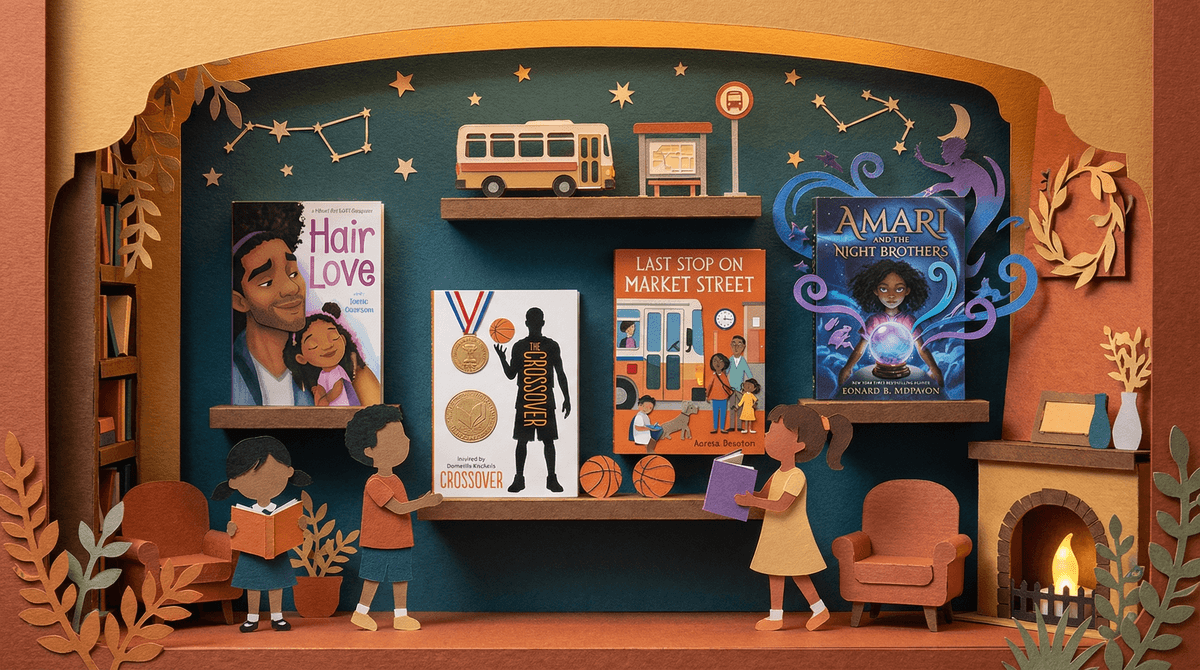
- Last Stop on Market Street by Matt de la Peña — a beautiful story about a boy and his grandmother taking the bus across town
- Hair Love by Matthew A. Cherry — a dad learning to do his daughter's hair (also an Oscar-winning short film)
- Sulwe by Lupita Nyong'o — about a girl with dark skin learning to love herself
- Anything by Jacqueline Woodson, seriously
Ages 6-8 (Early Readers):
- Juana & Lucas series by Juana Medina — Colombian-American girl in Bogotá
- Yasmin series by Saadia Faruqi — Pakistani-American second grader solving everyday problems
- Ivy + Bean series by Annie Barrows — interracial friendship between two very different girls
Ages 8-12 (Middle Grade):
- New Kid by Jerry Craft — Black kid navigating a predominantly white private school (graphic novel, won basically every award)
- Front Desk by Kelly Yang — Chinese immigrant family running a motel
- The Crossover by Kwame Alexander — basketball, family, and growing up (verse novel)
- Ghost by Jason Reynolds — track team, trauma, and finding yourself
- Amari and the Night Brothers by B.B. Alston — Black girl discovers magical world (think Percy Jackson vibes)
Ages 12+ (YA):
- The Hate U Give by Angie Thomas — police violence and activism (heavy but important)
- Children of Blood and Bone by Tomi Adeyemi — West African-inspired fantasy epic
- With the Fire on High by Elizabeth Acevedo — Afro-Latina teen mom who's an incredible chef
- Anything by Nicola Yoon (The Sun Is Also a Star, Everything, Everything)
Audit what you have. Seriously, go look at your kid's bookshelf right now. What percentage features characters of color as main characters? If it's under 30%, you've got work to do.
Don't make it weird. You don't need to announce "Today we're reading a book about a Black family!" Just... read the book. Representation should be so normal it doesn't require commentary.
Use your library. You don't need to buy everything. Libraries are amazing for trying out new authors and seeing what resonates with your kids before investing.
Ask for recommendations. Librarians are your secret weapon here. Tell them what your kid likes (dragons? sports? mysteries? graphic novels?) and ask for diverse options in that genre.
Follow diverse book awards. The Coretta Scott King Award, Pura Belpré Award, and American Indian Youth Literature Award highlight excellent books. Check out our guide to children's book awards for a full list.
Building a diverse home library isn't about being performatively woke or checking boxes. It's about giving all kids — yours included — a reading life that reflects the actual world they live in. A world where kids of every background get to be heroes, villains, sidekicks, love interests, comic relief, and everything in between.
The good news? There are SO many incredible books out there now. The hard part isn't finding them — it's choosing which ones to read first.
- Do a bookshelf audit — count how many books feature characters of color as protagonists
- Make a library run — ask your librarian for 5 recommendations based on your kid's interests
- Join a diverse book club — many communities have groups focused on reading diverse literature together
- Follow diverse book creators — Instagram and TikTok have amazing communities of diverse authors and illustrators sharing recommendations
And if you want to dig deeper into specific titles or get personalized recommendations based on what your kid already loves, Get book suggestions .
.