

Fourth grade is this sweet spot where kids are finally reading independently but still figuring out what they actually like. They're around 9-10 years old, reading levels are all over the map, and honestly? This is when we either hook them on reading or lose them to YouTube shorts forever.
The reading level thing is real—some fourth graders are crushing chapter books while others are still building confidence with shorter texts. And that's completely normal. The goal isn't to push them into books that feel like work; it's to find books they'll actually want to read.
Fourth grade is when standardized testing ramps up, when teachers expect more independent reading, and when kids start comparing themselves to their peers. It's also when many kids decide whether they're "readers" or not—a label that can stick for years.
But here's the thing: there's no such thing as a kid who doesn't like reading, only kids who haven't found the right book yet. Your job isn't to force them through award-winning literature if they'd rather read graphic novels about farting ninjas. Your job is to keep them reading anything.
The research backs this up—kids who read for pleasure (whatever that looks like) develop better comprehension, vocabulary, and writing skills than kids who only read assigned texts. So if your fourth grader wants to reread Dog Man for the seventh time, that's actually fine.
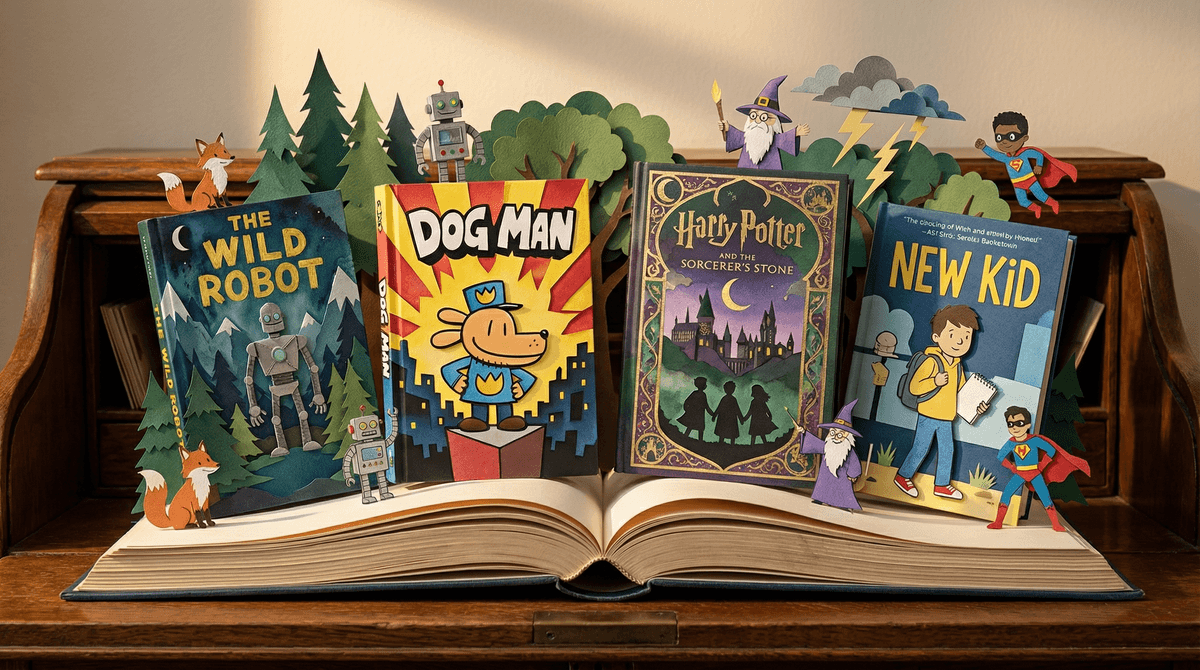
Based on what's popular in classrooms and libraries right now, here's what's landing with this age group:
Graphic Novels (Yes, They Count as Real Reading)
- Dog Man and Captain Underpants series—potty humor, visual storytelling, confidence builders
- Amulet series—fantasy adventure with gorgeous art
- Real Friends by Shannon Hale—navigating friendship drama
- New Kid by Jerry Craft—identity, code-switching, being the only Black kid at a fancy school
Classic Chapter Book Series
- Percy Jackson series—Greek mythology meets middle school, genuinely funny
- Harry Potter (usually starting around 4th-5th grade)—yeah, the author's tweets are problematic, but the books remain popular
- Wings of Fire series—dragons with complex politics, huge with this age group
- The One and Only Ivan—gorilla in a mall, beautiful and heartbreaking
Books That Hook Reluctant Readers
- Diary of a Wimpy Kid series—part comic, part novel, very accessible
- Who Would Win? series—shark vs. train type scenarios, great for fact-loving kids
- I Survived series—historical disasters, short chapters, high drama
- Anything by Raina Telgemeier—relatable middle school stories in graphic novel format
Books for Strong Readers
- Wonder by R.J. Palacio—kid with facial differences starting school, empathy builder
- Holes by Louis Sachar—interconnected storylines, actually clever
- The Wild Robot by Peter Brown—robot learns to survive in nature
- Esperanza Rising—Mexican immigration story, historical fiction done right
Let's address this head-on: some parents worry that graphic novels are "easier" or don't count as real reading. That's not how it works. Graphic novels require kids to integrate text and visual information simultaneously—it's actually a complex literacy skill. Plus, they're often gateways to longer texts.
If your kid only wants to read graphic novels, that's not a problem to solve. It's a reading preference. Would you rather they read graphic novels or spend another hour on Roblox?
Here's something teachers know but don't always communicate clearly: a book's reading level and its interest level are different things. Your fourth grader might be reading at a second-grade level but interested in topics that are age-appropriate for their grade.
This is where hi-lo books (high interest, low reading level) come in clutch. The Dog Man series is actually brilliant for this—the humor is age-appropriate for 9-year-olds, but the text isn't intimidating for struggling readers.
Don't force a kid reading below grade level into "baby books" just because that's their technical reading level. Find books that match their interests with accessible text. Your librarian can help with this.
Real talk: books compete with screens now. Your fourth grader can read Percy Jackson or they can watch YouTube videos about Minecraft builds. Both are technically learning, but one builds sustained attention and imagination in ways the other doesn't.
This doesn't mean screens are evil—it means you might need to protect reading time the same way you protect sleep or outdoor play. Twenty minutes of reading before bed, no devices in the bedroom, whatever works for your family.
Some families do audiobooks during car rides or while kids play Minecraft—that counts too. The goal is engagement with stories and language, not performative page-turning.
Let them choose their own books. Yes, even if they pick something you think is too easy or too weird. Autonomy matters.
Make library trips a regular thing. Most libraries let kids check out 20+ books at a time. Let them go wild. They won't read them all, and that's fine.
Read the same books they're reading. Not to quiz them, but so you can talk about the story. "Wait, did Percy really just fight a Minotaur in the Gateway Arch?" is bonding.
Don't make them write book reports. Unless it's for school, reading at home should be pressure-free. The reward for reading is getting to read more, not filling out a worksheet.
Model reading yourself. If you're scrolling TikTok while telling them to read, they notice. If you're reading your own book (or even just articles on your phone), that matters.
Fourth grade reading isn't about literary merit or grade-level benchmarks—it's about building a habit and an identity. Kids who see themselves as readers in fourth grade tend to stay readers. Kids who decide reading is boring or hard often check out for years.
So meet them where they are. Graphic novels count. Rereading the same book seventeen times counts. Audiobooks count. Reading Minecraft guides counts. The goal is engagement, not performance.
And if your kid genuinely isn't finding books they like, talk to your school librarian —they're basically book matchmakers and they've seen every type of reader.
This week: Let your fourth grader pick three books at the library with zero input from you. See what they choose. You might be surprised.
This month: Read one of the books they're reading. Ask them questions about it like you're genuinely curious (because you should be).
This year: Stop tracking reading minutes or pages. Just notice whether they're choosing to read during free time. That's the real metric.
And remember—some kids are just going to prefer screens, and that's a different conversation about balance, not a reading failure. But books offer something screens don't: sustained attention, imagination building, and the quiet satisfaction of getting lost in a story. That's worth protecting.