

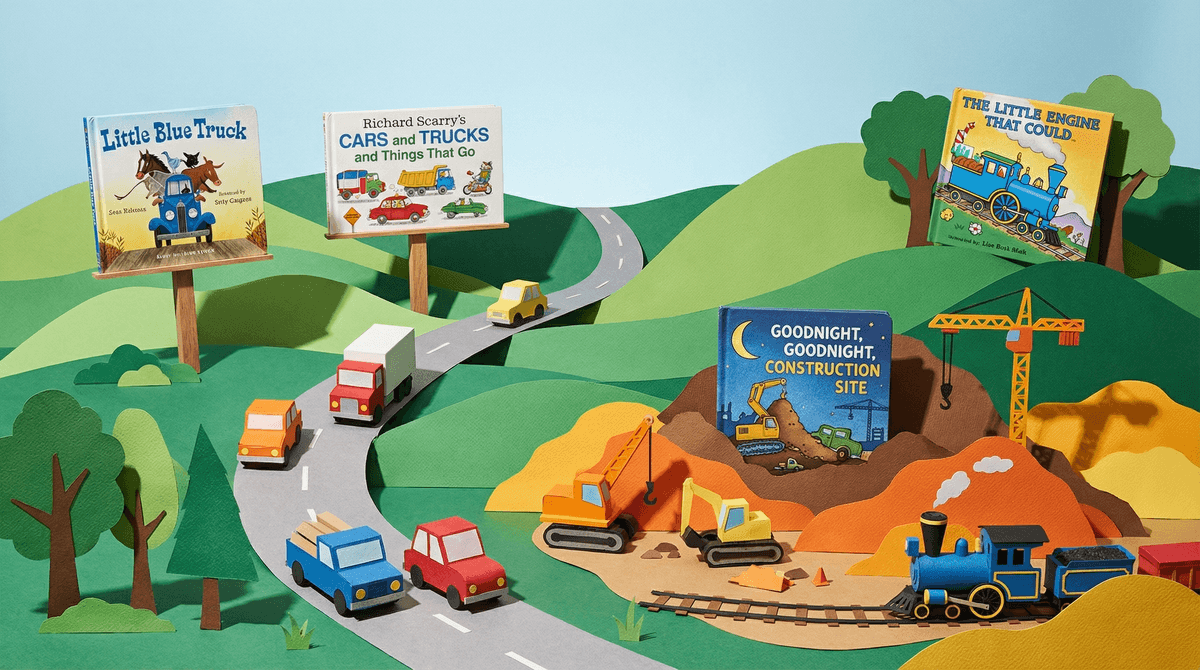
You know those board books with the bright red fire truck on the cover that your toddler insists you read seventeen times before breakfast? That's a vehicle book. From chunky board books for babies to detailed encyclopedias for elementary schoolers, vehicle books are basically any children's book where trucks, trains, planes, boats, or construction equipment are the star of the show.
These aren't just picture books with wheels—they're a whole genre spanning board books, concept books, stories, non-fiction, and even early readers. Think Goodnight, Goodnight, Construction Site, The Little Blue Truck, Richard Scarry's Cars and Trucks and Things That Go, and countless others that have survived being chewed, thrown, and read until the pages fell out.
If you've ever watched a toddler's face light up at the sound of a garbage truck, you already get it. Vehicle books tap into something primal for young kids:
They move and make noise. Vehicles are loud, they have parts that go up and down, they beep and honk and rumble. For little kids still figuring out cause and effect, vehicles are endlessly fascinating machines that DO things.
They're everywhere in real life. Unlike dragons or talking animals, kids see vehicles constantly. That connection between the book and the garbage truck that just drove by? That's powerful stuff for early learning.
They offer predictability and patterns. Many vehicle books follow routines—the garbage truck picks up trash, the fire truck goes to the fire, the train goes down the track. Young kids LOVE predictable patterns. It's soothing and helps them understand how the world works.
They're entry points to STEM thinking. How does a crane lift something heavy? Why do boats float? What makes a plane fly? Vehicle books introduce engineering concepts, physics, and problem-solving in ways that feel accessible to young minds.
And yeah, let's be real—marketing has told us these are "boy books," which is complete nonsense, but that cultural messaging means some kids (especially boys) get funneled toward vehicles early and often. Any kid can love trucks. Any kid can love princesses. We're not doing the gender thing here.
Here's the thing parents sometimes miss: it doesn't matter WHAT your kid reads, as long as they're reading. Vehicle books aren't "lesser" than story books or chapter books. They're doing serious literacy work.
Vocabulary explosion. Vehicle books are vocabulary goldmines. Excavator. Hydraulic. Cargo. Propeller. Suspension bridge. These are sophisticated, specific words that kids absorb like sponges when they're interested in the topic. Research shows that interest-driven reading leads to significantly better vocabulary acquisition than forcing kids to read "higher quality" books they don't care about.
Building background knowledge. Those details about how things work? That's schema-building. Understanding how a construction site operates or how trains run on tracks creates mental frameworks that help with reading comprehension later. When they encounter these concepts in other contexts, they already have the foundation.
Motivation to read. A kid who's obsessed with diggers will sit still for a vehicle book when they won't sit for anything else. That motivation—that willingness to engage with text—is the foundation of reading development. You can't teach a kid to read if they won't look at books.
Print concepts and early literacy. For the youngest kids, vehicle board books teach how books work—turning pages, reading left to right, understanding that pictures and words go together. It doesn't matter if it's about a backhoe or a bunny.
Ages 0-2: Board books and touch-and-feel Start with indestructible board books with simple images and minimal text. Byron Barton's vehicle books are perfect—bold illustrations, one or two words per page. Touch-and-feel books with textured wheels or shiny fire trucks add sensory engagement.
Ages 2-4: Simple stories and concept books This is prime vehicle book age. Look for books with simple plots (Little Blue Truck is the gold standard), counting books with vehicles, and books that follow a vehicle through its day. Goodnight, Goodnight, Construction Site works beautifully as a bedtime book with a gentle narrative.
Ages 4-6: More complex stories and non-fiction Kids this age can handle longer stories, more detailed illustrations, and beginning non-fiction. The Little Engine That Could introduces perseverance themes. DK and National Geographic have excellent photo-based vehicle books with real information.
Ages 6-8: Early readers and detailed non-fiction Transitioning readers can tackle early reader series about vehicles, and kids hungry for information will devour detailed encyclopedias about how things work. This is when some kids get REALLY into specific vehicle types—trains, planes, heavy machinery—and want to know everything.
"My kid ONLY wants vehicle books. Is that okay?" Yes. Full stop. Interest-driven reading is powerful reading. If your kid wants to read 47 books about trains, let them read 47 books about trains. They're building vocabulary, practicing reading skills, and developing the habit of loving books. You can gently offer other options, but don't force it. Many kids who start with obsessive vehicle reading naturally expand their interests over time.
"Are vehicle books just for boys?" Nope. This is pure cultural conditioning. Plenty of girls love trucks and trains. Plenty of boys prefer other topics. Don't let outdated gender stereotypes limit what books you offer your kid. If your daughter is obsessed with excavators, lean into it. If your son couldn't care less about vehicles, that's equally fine.
"What about screen time? My kid wants vehicle videos instead." Books and screens aren't an either/or. A kid can love Blippi videos about garbage trucks AND love garbage truck books. That said, books offer benefits that passive video watching doesn't—tactile engagement, control over pacing, opportunity for conversation, and no algorithm deciding what comes next. If your kid is choosing screens over books 100% of the time, that's worth examining, but both can coexist.
Quality varies WILDLY Not all vehicle books are created equal. Some are gorgeous, well-written, and educational. Others are cheap cash-grabs with bad illustrations and zero educational value. Check reviews, flip through before buying, and don't assume expensive equals good. Library browsing is your friend here.
Vehicle books are legitimate, valuable reading material that support literacy development, vocabulary growth, and STEM curiosity. They're not a phase to endure or a lesser form of reading—they're an entry point into loving books.
If your kid is obsessed with trucks, trains, or construction equipment, use that interest. Hit the library and check out a stack. Find vehicle books that match their current reading level. Let them "read" to you by describing the pictures. Ask questions about how things work. Follow their lead.
And when you're reading Goodnight, Goodnight, Construction Site for the 94th time and you've got the whole thing memorized? You're not just surviving toddlerhood. You're building a reader.
- Hit your library. Most libraries have robust vehicle book collections because they're so popular. Let your kid browse and choose.
- Look beyond the obvious. Try non-fiction vehicle books with photographs, books about how things are made, or story books where vehicles are characters.
- Connect books to real life. Reading about garbage trucks? Watch your local garbage truck together. Reading about trains? Visit a train museum or watch trains at a crossing.
- Don't stress about "moving on." Your kid will naturally expand their interests when they're ready. For now, feed the fascination.