

Let's be real: the phrase "books about depression for 6-8 year olds" can feel heavy. You might be searching because your child is struggling with big feelings they can't name, or maybe you've noticed mood changes that worry you, or perhaps someone in your family is dealing with depression and you want to help your kid understand. Whatever brought you here, you're doing the right thing by looking for age-appropriate resources.
Here's the thing: books about depression for this age group aren't clinical manuals. They're stories that help young children understand sadness, persistent low moods, and the difference between feeling sad sometimes versus feeling stuck in sadness. The best ones normalize talking about mental health, show that help is available, and use language and concepts that make sense to a second grader.
Kids ages 6-8 are in this fascinating developmental sweet spot. They're old enough to notice when something feels off—in themselves or in people they love—but they don't yet have the vocabulary or framework to understand complex emotions. They think concretely. They personalize things. They might think depression is their fault or that it's contagious or that it means someone doesn't love them anymore.
And here's where it gets tricky for parents: you want to be honest without being scary. You want to validate their feelings without pathologizing normal childhood sadness. You want to explain depression in a way that's accurate but not overwhelming.
The right books can do some of this heavy lifting for you. They can:
- Give kids language for what they're experiencing or witnessing
- Show them they're not alone
- Model help-seeking behavior
- Distinguish between everyday sadness and something more persistent
- Open up conversations that might otherwise feel too big to start
Let me break these down by what you might need:
If Your Child Is Experiencing Big, Persistent Sad Feelings
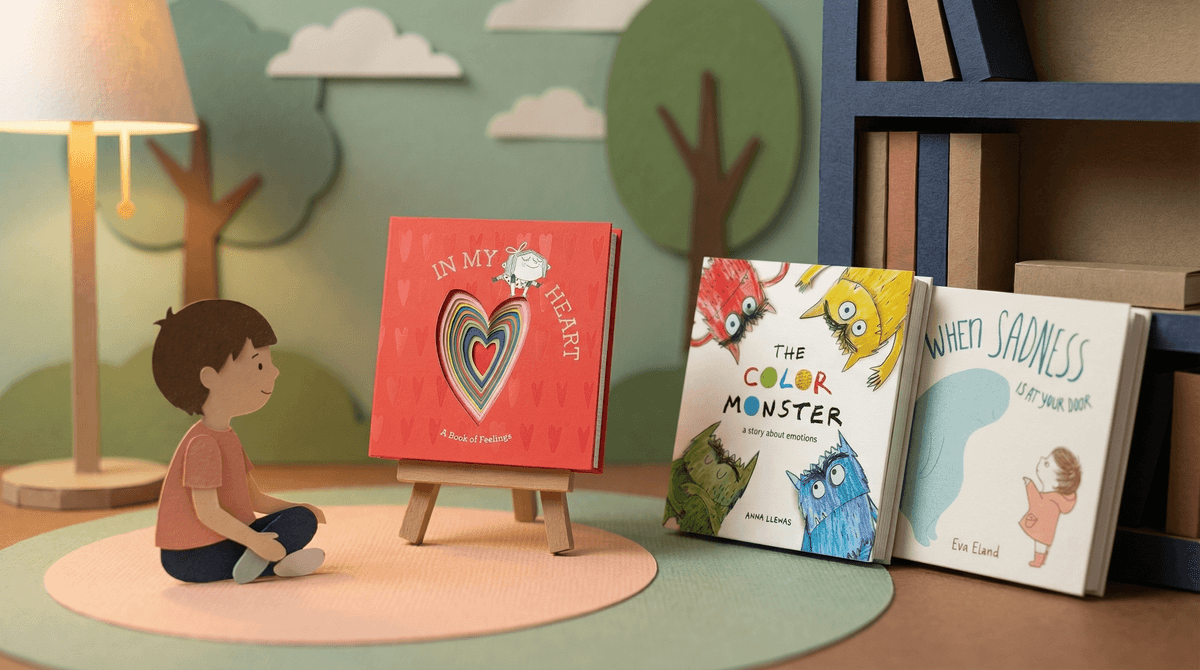
When Sadness Is at Your Door by Eva Eland is gorgeous. It personifies sadness as a visitor—sometimes it shows up, you acknowledge it, you sit with it, and eventually it leaves. The illustrations are gentle, and it doesn't try to "fix" sadness, which is actually really healthy for kids to understand. Perfect for ages 6-8.
The Invisible String by Patrice Karst isn't specifically about depression, but it's incredibly helpful for kids dealing with separation anxiety or persistent worry (which often accompany or mimic depression in young kids). It's about how love connects us even when we're apart.
My Magic Breath by Nick Ortner and Alison Taylor gives kids a concrete tool (breathing exercises) for managing overwhelming emotions. It's empowering rather than just explanatory.
If Someone in Your Family Has Depression
Why Are You So Sad? by Beth Andrews is specifically written for kids whose parents have depression. It's straightforward without being scary, explains that depression is an illness (not the child's fault), and that treatment helps. This one pulls no punches in a good way.
The Sad Dragon by Steve Herman uses a dragon character to explore persistent sadness and how to cope with it. It's part of a series about emotional regulation, and kids this age generally respond well to animal/creature characters.
If You Want to Start General Conversations About Mental Health
In My Heart: A Book of Feelings by Jo Witek is a great starter for ages 6-7. It covers the full spectrum of feelings with die-cut hearts that change with each emotion. It normalizes that hearts can feel many ways.
The Color Monster by Anna Llenas uses colors to represent different emotions and helps kids sort through mixed-up feelings. It's a good entry point before getting into more specific conversations about depression.
These books are tools, not therapy. If your child is showing signs of depression (persistent sadness lasting more than two weeks, loss of interest in activities they used to love, changes in sleep or appetite, talk of worthlessness), you need to talk to your pediatrician or a child mental health professional. Books are supplementary.
Read them together. Don't just hand your kid a book about depression and walk away. Sit with them. Pause to ask questions. Let them guide the conversation. Sometimes kids will open up about page 3, sometimes three days later while you're making dinner.
Watch for their reactions. Some kids feel relieved to see their experience reflected in a book. Others might get more anxious. If a book isn't landing well, it's okay to stop and try a different approach.
Age 6 is different from age 8. A six-year-old is likely still thinking very concretely and may need more visual, simpler stories. An eight-year-old can handle more nuance and might want books that go deeper into feelings and solutions.
Here's what works:
Start with curiosity, not agenda. Instead of "I got you this book because I'm worried about you," try "I found this really interesting book about feelings. Want to read it together?"
Make it a series, not a one-time thing. Read the same book multiple times. Kids process differently on each read-through.
Follow their lead on conversation. Some kids want to talk immediately. Others need time. You might read a book about sadness on Tuesday and get questions about it on Saturday.
Use the book's language. If a book describes depression as "a gray cloud that follows you," your child might later say "I have the gray cloud today" and you'll know exactly what they mean.
Pair books with action. After reading about how the character got help, you might say, "That character talked to a counselor. We could talk to someone too if you ever wanted."
Not all books about "feelings" are actually helpful for depression. Some are toxic positivity dressed up as emotional literacy—they essentially tell kids to just think happy thoughts or that sadness is always temporary and easily fixed. Depression isn't about lacking gratitude or positive thinking.
Also, be careful with books that are too abstract for this age. If you're reading it and thinking "I'm not sure what this metaphor means," your 7-year-old definitely doesn't know.
And honestly? Some books about depression for kids are just... not good. They're preachy or condescending or they treat depression like a simple problem with a simple solution. Trust your gut. If a book feels off to you, it'll probably feel off to your kid.
Books about depression for 6-8 year olds work best when they're part of a bigger conversation, not a replacement for it. They can give your child language, normalize big feelings, and open doors to discussions that might otherwise feel impossible to start.
But they're not magic. If your child is struggling, if you're worried, if something feels persistently wrong—talk to professionals. These books can ride shotgun on that journey, but they shouldn't be driving.
The fact that you're here, researching this, trying to find the right resources? That's the kind of intentional parenting that makes a real difference. Your kid is lucky to have someone who takes their emotional world this seriously.
If you're not sure where to start: Begin with When Sadness Is at Your Door. It's gentle, age-appropriate, and opens conversations without being heavy-handed.
If you need to explain a family member's depression: Go with Why Are You So Sad?. It's direct and helpful.
If you're concerned about your child: Read one of these books together, but also start a conversation with your pediatrician . Early intervention matters.
Want to explore more resources about mental health for kids? Check out our guide to talking to kids about mental health for age-by-age approaches.