

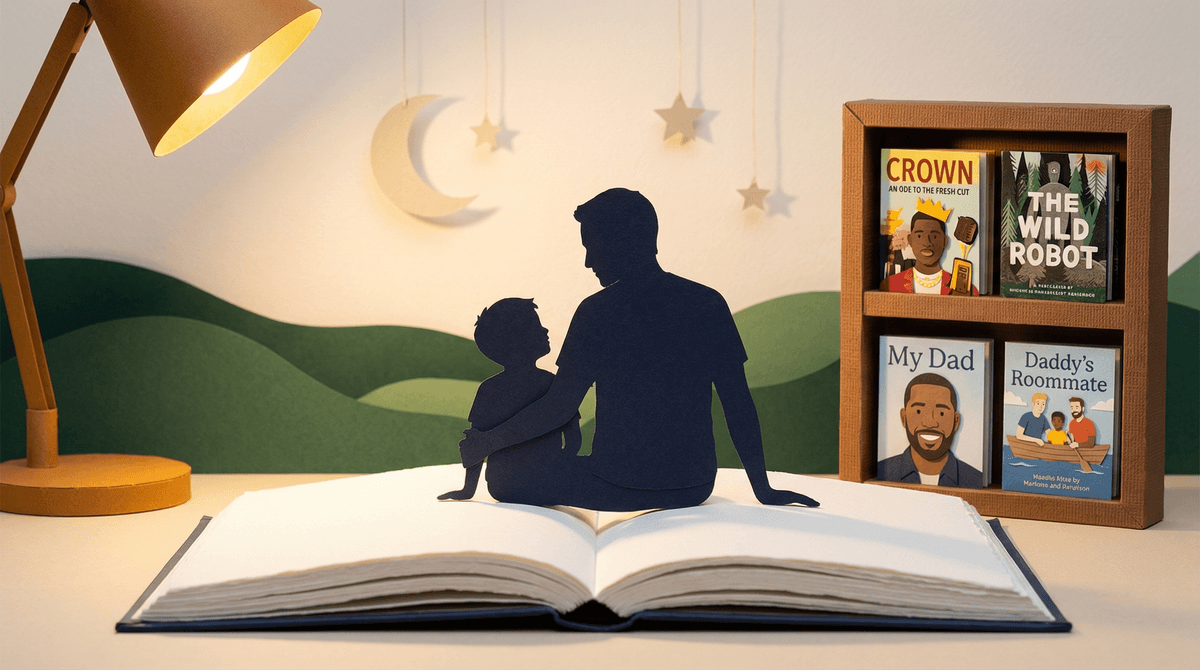
Look, we talk a lot about screen time and digital wellness around here, but let's be real — sometimes the best antidote to the glow of a tablet is a really good book. And books about dads? They're having a moment.
These aren't just Father's Day gift guides or dusty collections gathering cobwebs on library shelves. Books exploring fatherhood — from picture books about silly dads to YA novels grappling with absent fathers, complicated relationships, and what it actually means to show up as a parent — offer something screens often can't: space to process feelings, see yourself reflected, and understand that every family looks different.
Whether you're looking for books to read with your kids, books your teens might actually pick up on their own, or honestly, books that might help you think through your own relationship with fatherhood or your own dad, this genre has depth.
Here's the thing about representation in media: it matters. And for too long, dads in kids' books were either bumbling comic relief, completely absent, or just... there. The landscape has shifted. Modern children's literature features single dads, adoptive dads, stepdads, grandfathers stepping up, two dads, dads who cry, dads who mess up, dads who are trying their best.
For kids, seeing different types of father figures normalized in stories helps them:
- Process their own family dynamics (especially important if their family doesn't look like the "traditional" model)
- Develop empathy for different family structures
- Understand that all parents are human and make mistakes
- Build emotional vocabulary around complex family feelings
And let's be honest — in an era where kids are watching endless YouTube videos and TikToks, books offer something irreplaceable: sustained attention on nuanced emotional experiences. No jump cuts, no algorithm, just a story that unfolds at a human pace.
Picture Books (Ages 3-7)
Daddy Hugs by Nancy Tafuri is pure sweetness — simple, warm illustrations of animal dads with their babies. Perfect for toddlers.
My Dad by Anthony Browne takes the "my dad is the best" energy every kid has and runs with it. He's strong as a gorilla, happy as a hippo, and yeah, sometimes as soft as a teddy bear. Kids love the exaggeration.
Last Stop on Market Street by Matt de la Peña features CJ and his grandmother (technically not about a dad, but about caregiving and perspective that's too good not to mention). If you want actual father figures, Crown: An Ode to the Fresh Cut by Derrick Barnes celebrates Black fathers and sons in barbershop culture.
Daddy's Roommate by Michael Willhoite — yes, this one's been around since 1990 and was controversial then. Now? It's just a simple story about a kid whose parents are divorced and whose dad lives with his boyfriend. Matter-of-fact, age-appropriate, and honestly kind of groundbreaking for its time.
Middle Grade (Ages 8-12)
Ghost by Jason Reynolds — Castle Cranshaw (Ghost) is dealing with trauma from his father, who's now in prison. It's about running, literally and figuratively, and finding father figures in unexpected places (his coach). Reynolds doesn't pull punches but writes with so much heart.
The Wild Robot by Peter Brown — okay, hear me out. This is about a robot learning to parent a gosling. It's about what it means to care for someone, to adapt, to become a family. It's beautiful and works on multiple levels.
Wonder by R.J. Palacio — Auggie's dad is present, loving, and dealing with his own feelings about his son's facial differences. The whole family dynamic is refreshingly real.
Front Desk by Kelly Yang — Mia's dad is an immigrant struggling to find work and maintain his dignity. It's about family resilience and the sacrifices parents make.
Young Adult (Ages 13+)
Long Way Down by Jason Reynolds — written in verse, takes place in 60 seconds in an elevator, and unpacks generational trauma, absent fathers, and the cycle of violence. It's devastating and necessary.
The Hate U Give by Angie Thomas — Starr's dad, Maverick, is a former gang member trying to protect his family and community. He's flawed, present, and one of the most memorable father characters in recent YA.
Aristotle and Dante Discover the Secrets of the Universe by Benjamin Alire Sáenz — both boys have complicated relationships with their fathers. Ari's dad is a Vietnam vet with PTSD who struggles to communicate. It's tender and painful and real.
All American Boys by Jason Reynolds and Brendan Kiley — explores father figures, police violence, and what it means to be a role model. Heavy topics, but written in an accessible way for teens.
Not all of these books are comfortable. Some deal with abuse, absence, death, incarceration, and trauma. That's not a bug — it's a feature. Kids living these realities need to see themselves in stories. Kids not living these realities need to develop empathy.
Check the content warnings. If you're reading with younger kids, preview the book. Common Sense Media is your friend here. For teens, trust them more than you think you should — they can handle complex topics, and honestly, they're already encountering them on TikTok and YouTube anyway.
Use these as conversation starters. "What did you think about how the dad handled that?" is an opening. You don't need to force a discussion, but having read the same book gives you shared language.
Representation isn't just for kids who "match" the story. White kids should read about Black families. Kids with two parents should read about single-parent homes. This is how we build empathy and understanding.
In a digital world where Roblox and Fortnite dominate after-school hours, books offer something irreplaceable: depth, nuance, and the space to sit with complex emotions. Books about dads — whether they're present or absent, perfect or flawed, biological or chosen — help kids understand that families come in all forms and that showing up, even imperfectly, matters.
These stories won't replace screen time entirely (nor should they), but they offer an alternative that's worth protecting. And honestly? Some of these books might hit you right in the feelings too.
Next step: Pick one book from the age range that fits your kid. Read it together, or if they're older, read it separately and then casually ask what they thought. You might be surprised by what comes up.