

Books About Addiction for Teens: A Parent's Guide to Starting Difficult Conversations
Look, talking to your teen about addiction is hard. Like, really hard. Whether you're concerned about their own choices, worried about friends who might be struggling, or dealing with addiction in your family, finding the right words can feel impossible.
Here's the thing: books can be conversation starters in a way that lectures can't. A well-chosen book about addiction gives teens a safe way to explore heavy topics through someone else's story first. It's less confrontational than "we need to talk" and more like "hey, I thought this might be interesting."
This guide covers books that tackle addiction honestly—from substance abuse to behavioral addictions—without being after-school-special preachy. These are books that actually respect teen intelligence and lived experience.
Teens are hardwired to push back against direct parental warnings. It's developmental, it's normal, and it's absolutely maddening. But a book? That's different.
A book lets them:
- Process difficult topics at their own pace
- See themselves (or people they know) in characters
- Explore consequences without experiencing them
- Feel less alone if they're struggling
- Build empathy for people dealing with addiction
Plus, when you both read the same book, you suddenly have a shared reference point. Instead of "drugs are bad, mkay?" you can say "remember when Nic in Tweak talked about how he felt invincible? What did you think about that?"
For Ages 13-15
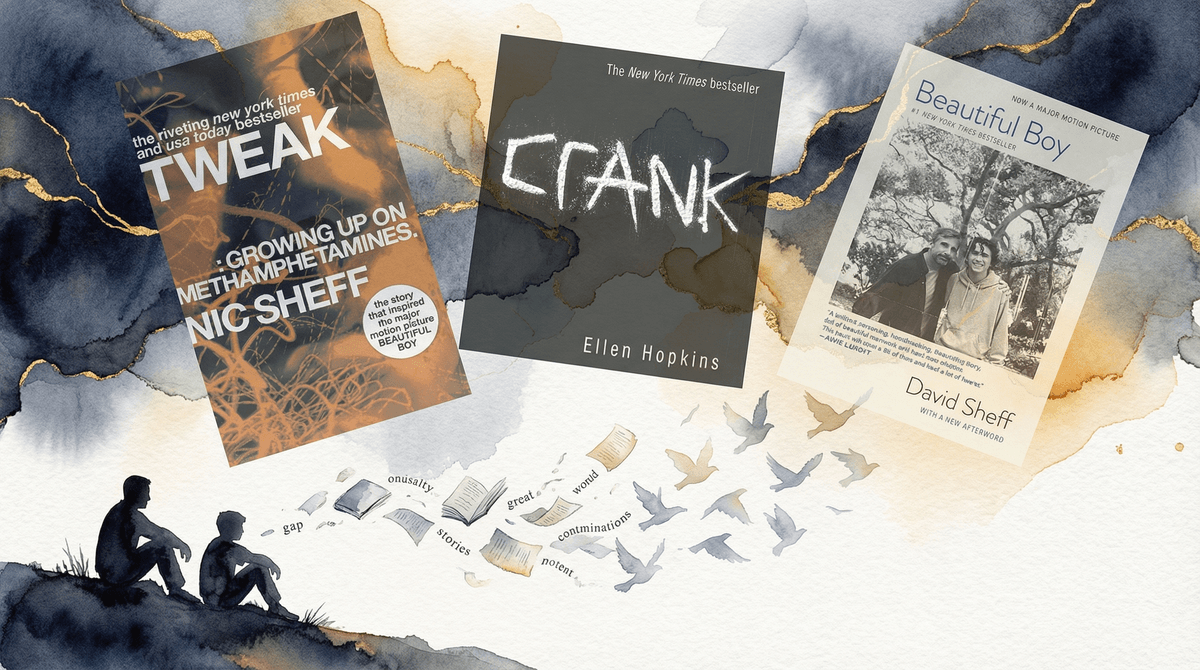
Tweak by Nic Sheff - This memoir of meth addiction is raw, honest, and doesn't pull punches. Sheff was a teen when his addiction began, and he writes about it with brutal clarity. His father David Sheff wrote the companion book Beautiful Boy (yes, the one they made into a movie), which gives the parent perspective. Reading both can be powerful.
Fair warning: This book contains graphic descriptions of drug use and risky behavior. It's not sanitized. That's also why it works—teens can smell BS from a mile away.
Crank by Ellen Hopkins - Written in verse (which sounds weird but actually makes it more digestible), this novel follows Kristina as she gets involved with meth. Hopkins based it on her own daughter's addiction, and the format makes the descent feel visceral. There are sequels (Glass and Fallout) if your teen wants to continue the story.
Content heads-up: Sexual situations, drug use, family dysfunction. This is for mature 13+ readers.
For Ages 15-18
Go Ask Alice by Anonymous - Yes, it's older (1971), and yes, there's controversy about whether it's actually a real diary. But it remains one of the most-read books about teen drug addiction for a reason. The diary format makes it feel immediate and personal.
The catch: Some of it feels dated, and it can come across as somewhat fear-mongering. Use it as a conversation starter about how drug culture has changed, not as a documentary.
Clean by Amy Reed - Five teens in rehab, each with their own story. This one's great because it shows different paths to addiction—not just the stereotypical "bad kid" narrative. It explores trauma, mental health, and the messy reality of recovery.
All the Bright Places by Jennifer Niven - While primarily about mental health and suicide, this book touches on self-medication and the blurry line between coping mechanisms and addiction. It's beautifully written and has sparked countless parent-teen conversations about depression and getting help.
For Families Dealing With Addiction
The Absolutely True Diary of a Part-Time Indian by Sherman Alexie - This semi-autobiographical novel deals with alcoholism in the protagonist's family and community. It's also funny and hopeful, which makes it more accessible than pure tragedy. Great for teens who are dealing with a parent's or sibling's addiction.
Staying Fat for Sarah Byrnes by Chris Crutcher - Tackles alcoholism, abuse, and loyalty. Crutcher is a master at writing about hard topics without making them feel like homework.
Don't just hand them over. That's the equivalent of leaving a pamphlet on their bed. Instead:
-
Read it yourself first. You need to know what you're recommending. These books don't shy away from difficult content.
-
Be honest about why you're suggesting it. "I read this and thought it was really powerful" works better than "I think you need to read this."
-
Make it optional but available. Leave it on the coffee table. Mention it casually. Don't make it assigned reading unless you want guaranteed resistance.
-
Create space for conversation. "What did you think?" is better than "What did you learn?" One's a conversation, the other's a test.
-
Share your own reactions. "The part where [character] lied to their parents really got me. I kept thinking about..." This models vulnerability.
Not every teen is a reader, and that's okay. Consider audiobooks—many teens will listen while gaming, doing homework, or zoning out. Tweak and All the Bright Places both have excellent audio versions.
Or try movies/shows based on books. Beautiful Boy (2018) adapts both Nic and David Sheff's memoirs. 13 Reasons Why (the show) sparked massive conversations about teen mental health and substance use—though watch it together and be prepared for some seriously heavy content.
Books are tools, not solutions. If you're genuinely concerned about your teen's substance use or if addiction is affecting your family, these books should be part of a bigger conversation that includes:
- Actual conversations with your teen (not lectures, conversations)
- Professional help if needed—therapists who specialize in teen substance use
- Family support if a parent or sibling is struggling
- Understanding that curiosity about drugs/alcohol is normal, but patterns of use are different
If you're worried about what's normal experimentation vs. problem use , that's a conversation worth having with a professional.
The best book about addiction is the one your teen will actually read. Some kids need the raw honesty of Tweak. Others need the poetry of Crank. Some need to see addiction in the context of family or community, like in The Absolutely True Diary of a Part-Time Indian.
The goal isn't to scare them straight. Research shows that fear-based approaches don't work and often backfire. The goal is to open a door to honest conversation about something that affects their world—whether directly or through friends, family, or the news they scroll past on their phones.
These books won't prevent every bad choice. But they might give your teen language to talk about hard things. They might help them recognize warning signs in themselves or friends. They might make them feel less alone if addiction is already part of their story.
And sometimes, that shared understanding—that moment when you can both reference the same character, the same scene, the same moment of clarity or despair—is worth more than a hundred lectures.
Start with one book. Read it yourself. If it resonates, leave it somewhere visible. If your teen picks it up, great. If not, you've still learned something about how to talk about this topic.
And remember: having these conversations early and often is way more effective than waiting until there's a crisis. Books are just one tool in the toolkit, but they're a good one.