

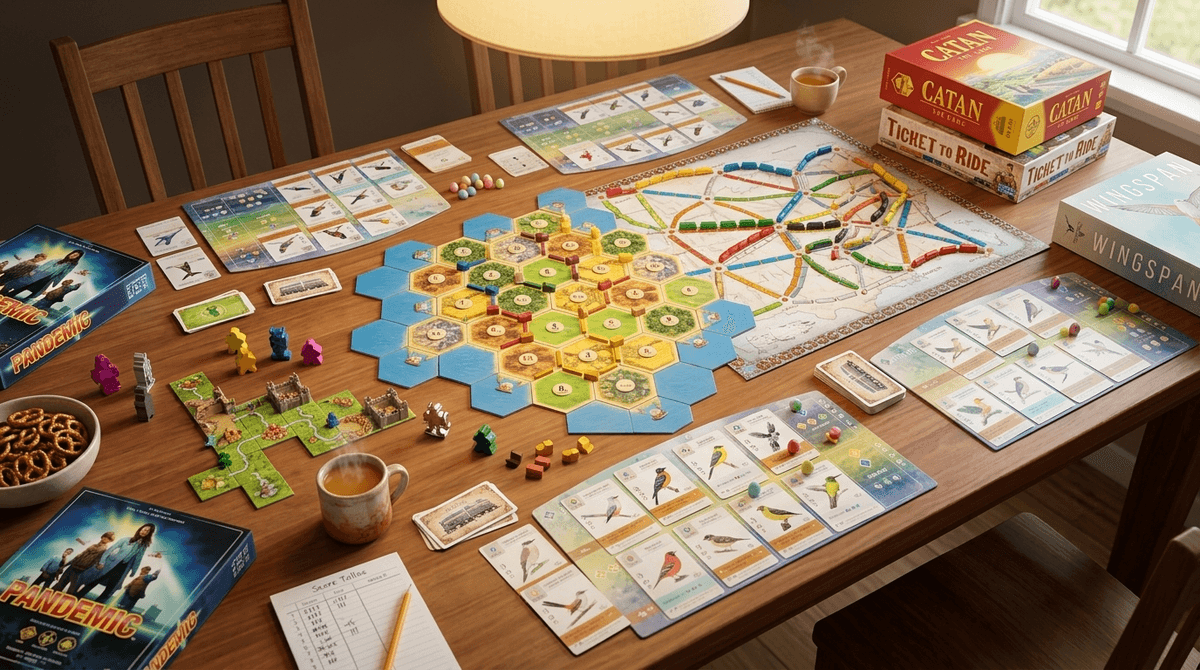
TL;DR: The Analog Logic Kit
If you’re looking to pull your kids away from the dopamine loops of Roblox or the "just one more round" pull of Brawl Stars, modern board games are the ultimate pivot. They offer the same strategic depth as a complex video game but require the social finesse of a boardroom meeting.
Top Picks for Critical Thinking:
- Best for Negotiation: Catan — Resource management and "the art of the deal."
- Best for Spatial Planning: Ticket to Ride — Long-term mapping and blocking moves.
- Best for Logic & Systems: Wingspan — Complex "engine building" and efficiency.
- Best for Teamwork: Pandemic — Collaborative problem solving under pressure.
- Best for Quick Logic: Codenames — Linguistic deduction and association.
Find board game recommendations based on your kid's favorite video game
We spend a lot of time worrying about "brain rot"—that specific flavor of mindless scrolling or low-effort content like Skibidi Toilet that seems to turn kids into zombies. But when we talk about "educational" alternatives, we often default to boring math apps or dry historical documentaries.
The truth is, some of the most intense "brain work" your kid can do happens around a kitchen table with a pile of cardboard hexagons and a handful of wooden sheep. Modern board games have moved lightyears beyond the luck-based slog of Monopoly. They are sophisticated "analog engines" that force kids to weigh risks, manage resources, and—most importantly—read the room.
In a video game like Fortnite, critical thinking is fast-twitch. It’s about immediate tactical decisions. Board games require "slow logic." You have to think three, four, or five moves ahead while accounting for the fact that your sister is definitely going to steal the port you need just to be annoying.
When a kid plays Catan, they aren't just playing a game; they are learning the fundamentals of probability and scarcity. When they play Wingspan, they are learning how to build a system where one small action triggers a chain reaction of benefits. This is systems thinking, and it’s the exact skill set needed for coding, engineering, and high-level management.
Ages 10+ This is the "gateway drug" of modern gaming for a reason. It moves away from "roll and move" mechanics and into "resource management." The Critical Thinking Hit: Kids have to learn to negotiate. If they are "Ohio" (weird/cringe) about their trades, nobody will deal with them, and they’ll lose. It teaches them that being a fair trading partner is often more profitable than being a cutthroat one. It’s a masterclass in social capital.
Ages 8+ The premise is simple: build train routes across North America. But the strategy is deep. The Critical Thinking Hit: It’s all about delayed gratification and spatial reasoning. Do you take the cards you need now, or do you grab that crucial track before someone else blocks you? It forces kids to hold a complex map in their head and pivot their entire strategy when a "bottleneck" gets taken.
Ages 12+ Don't let the theme of birdwatching fool you—this game is a beast. It’s what gamers call an "engine builder." The Critical Thinking Hit: This is pure logic and efficiency. You have a limited number of turns to create a "machine" of bird cards that generate points. It’s basically a beautiful, physical version of a spreadsheet. If your kid likes the optimization aspect of Minecraft or Terraria, they will find the "math" of Wingspan incredibly satisfying.
Ages 10+ Most games are "me vs. you." Pandemic is "us vs. the board." You’re a team of specialists trying to stop global outbreaks. The Critical Thinking Hit: This is the ultimate tool for teaching collaborative problem-solving. It also highlights the "Alpha Player" problem—where one kid tries to tell everyone else what to do. Learning how to contribute your ideas without steamrolling the team is a vital social-emotional skill that Discord chats rarely teach.
Ages 10+ You are a Renaissance merchant buying gemstone mines. It sounds dry, but it’s fast-paced and addictive. The Critical Thinking Hit: ROI (Return on Investment). Kids have to decide which "mines" will pay off the fastest. It’s a very pure distillation of economic logic without the predatory "spend real money for Robux" mechanics found in digital worlds.
We hear a lot about how Roblox teaches kids to be entrepreneurs because they can "build games and make money." While that's true for the top 0.1%, for most kids, Roblox is more about consumption and "clout" than actual business logic.
Board games like Catan or 7 Wonders teach the mechanics of a market—supply, demand, and scarcity—in a controlled environment where the "bank account" resets every hour. It’s a safer, more focused way to learn how money and resources actually move.
Elementary (Grades K-5)
At this age, focus on games that build spatial awareness and pattern recognition.
- Carcassonne: A tile-laying game that’s basically a physical puzzle where you build a medieval landscape.
- Sushi Go!: A "card drafting" game that teaches kids to think about what their opponents are picking.
Middle School (Grades 6-8)
This is the sweet spot for negotiation and complex strategy.
- Codenames: Great for building linguistic logic and understanding "how other people think."
- Exploding Kittens: It’s high-energy and funny, but it actually requires a lot of "push your luck" probability math.
High School (Grades 9-12)
Teenagers can handle heavy systems and asymmetrical gameplay (where everyone has different powers).
- Scythe: A complex alternate-history game that requires balancing popularity, military might, and resource production.
- Terraforming Mars: If your teen is into science or Kerbal Space Program, this is the gold standard for high-level critical thinking.
Digital games often shield kids from the consequences of losing. You just hit "respawn" and try again. In a board game, you have to sit there and watch your strategy crumble in real-time while your dad celebrates his victory.
This is a feature, not a bug.
Board games are a safe space to practice "losing well." If a kid flips the table because they lost at Ticket to Ride, that’s a much better time to have a conversation about emotional regulation than when they are screaming into a headset during a Fortnite match.
Instead of saying, "We're playing this to help your brain," try framing it through the lens of their favorite digital hobbies:
- "This game is basically a physical version of Civilization."
- "If you like the crafting in Minecraft, you'll probably be really good at the resource management in this game."
- "Let's see if you can out-negotiate me; I bet you can't."
Critical thinking isn't a subject you study; it’s a muscle you build. While there are plenty of great educational websites and coding apps, there is something uniquely powerful about the physical, social, and logical requirements of a tabletop game.
It’s one of the few times in 2026 where you can get a teenager to put their phone in another room, look you in the eye, and spend an hour trying to figure out how to trade you two bricks for a sheep.
- Start Small: Don't buy a 4-hour epic. Start with Sushi Go! or Codenames to get the "buy-in."
- Model the Thinking: Talk your logic out loud. "I'm taking this card because I think you're going for the blue route, and I need to block you."
- Check the "Community Norms": Use the Screenwise survey to see what other families in your grade are playing. You might find a local "board game cafe" or a school club where your kid can find their tribe.
Learn more about how to start a family game night that actually sticks