

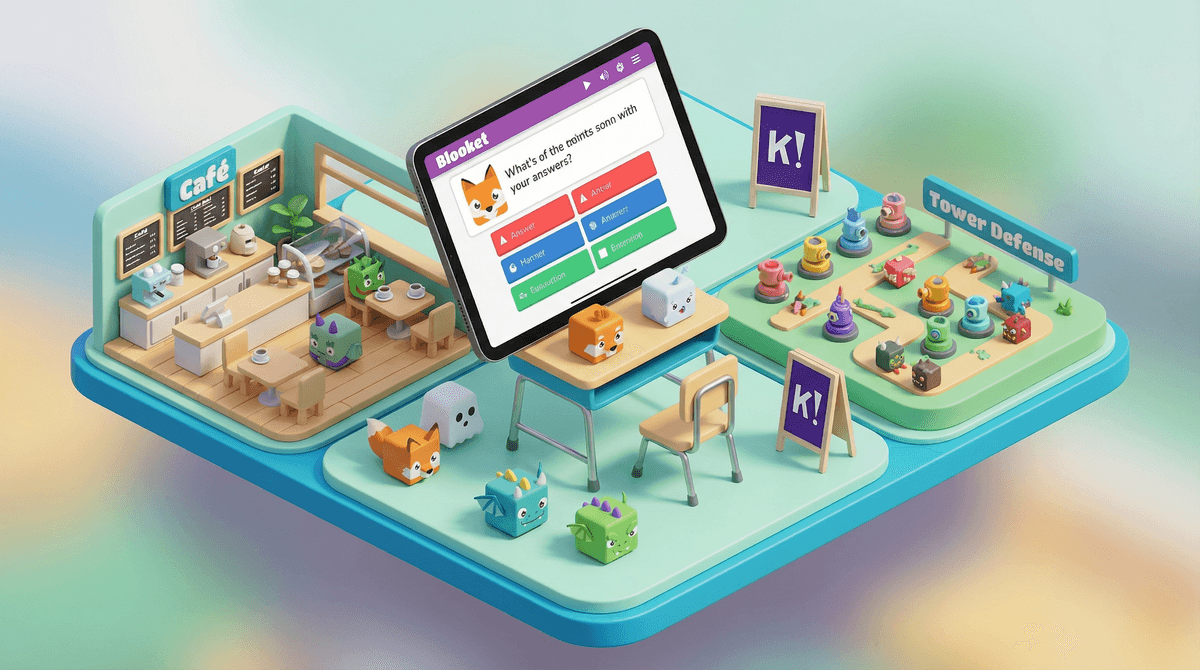
Blooket Safety Tips for Elementary Kids: A Parent's Guide
Blooket is the cleanest ed-tech platform your elementary kid is going to encounter. There's no chat or messaging (kids only see usernames on the leaderboard), no friend system, no real-money purchases for students (tokens and Blook characters are earned, not bought), and no account required to play — most kids just join with a teacher's code.
So when parents Google "Blooket safety tips," they often arrive expecting a "how to lock down chat" guide. There's no chat to lock down. The actually useful safety conversation for 6-10 year-olds is about competition, time, and the Blook collection loop — three things that are real for this age, and worth handling on purpose.
TL;DR: The "safety" things parents worry about (strangers, chat, ad targeting, secret purchases) genuinely aren't part of Blooket. The things to handle: time-box sessions (15-20 min), pick calmer game modes for sensitive kids (Tower of Doom, Café > Battle Royale, Crypto Hack), and talk about the leaderboard before it makes anyone cry. That's most of it.
Quick rundown of what parents most often ask about — and where Blooket genuinely doesn't have the issue:
- Strangers / chat / messaging. Blooket has no chat, no friend system, no DMs. Players see other usernames on the leaderboard during a game; that's the entire social surface. Kids cannot communicate with strangers, classmates, or teachers inside the platform.
- In-app purchases. None for students. Tokens are earned by playing. Blook characters are unlocked by spending earned tokens on Blook Packs — there's no real-money equivalent. Blooket's paid plans go to teachers and schools, not kids.
- Ads. Blooket is ad-free in the student experience.
- Data selling. Blooket is COPPA-compliant for under-13 users (with parental consent for optional accounts) and doesn't sell or share student data with advertisers.
- Account creation. Not required. Most kids play through a teacher-shared join code with just a session nickname. Optional accounts let kids save their Blook collection — and require parental consent for under-13s.
If a different parenting site is telling you to "disable chat" or "block in-app purchases" in Blooket, the article is outdated or wrong. Those features don't exist. Save the energy for what's actually worth managing.
For a fuller version of this rundown, our parent guide to Blooket is the place to start.
The Leaderboard Can Hit Different at 7
Most game modes show a real-time leaderboard. For an 8-year-old, this is motivating — they can see their position climb. For a 6- or 7-year-old, it can be the opposite. Watching a name (theirs) sit at the bottom of a screen, while everyone else's name is higher, is genuinely tough for some kids at this age.
This isn't a "Blooket problem" — it's a normal-developmental-stage thing — but it's worth being ready for.
What helps:
- Frame the game as "answer the questions" not "win the round." Most leaderboard pain comes from having framed the game as a competition first.
- Calm modes (Tower of Doom, Café) put less weight on the leaderboard than Battle Royale or Crypto Hack.
- If your kid is hosting solo or with you, you can change the mode mid-session. If they're in a class game, ask the teacher about which modes the class uses.
The Blook Collection Loop Is Real
Earning tokens, opening random Blook Packs, hoping for a "legendary" Blook — that's the same psychology that makes Pokémon cards or trading cards so sticky. There's no money at stake (which is a meaningful difference from real loot boxes), but the dopamine pull is real.
For some kids this is delightful. For others it tips into "I need to play more so I can get more tokens so I can open more packs" — which is when it stops being study and becomes the goal.
Signals it's tipped over:
- They're talking more about Blooks they want than questions they answered
- "I need to play more Blooket" comes up at random non-study times
- They check their Blook collection more than they play games
- Frustration / sadness when packs don't contain rare ones
If you see this, Blooket is doing what it's designed to do (keep them engaged) but not what you want it to do (help them learn). The fix isn't banning — it's restructuring. See signs Blooket has crossed from motivating to compulsive below for more.
Time Runaway
The Blooket hook is genuinely well-tuned. "I'll just play one more round" can turn into 90 minutes. For elementary kids who don't yet have strong time-self-regulation, this is the most common Blooket friction point.
The fix: set a timer before they start. Twenty minutes is a good study session. After thirty, the marginal learning per minute drops fast.
User-Generated Question Sets
Most Blooket play uses a teacher's question set, but kids can also browse the public library. Some sets in the library are great; some are weird user-generated stuff. If your kid is playing solo at home, default them to teacher-assigned sets or sets you've vetted.
For more on this, our parental controls guide for Blooket covers how to host games yourself with question sets you've chosen.
The 2-minute conversations that prevent the most friction:
Before they start:
- "The point is the questions, not the leaderboard. Try to get them right."
- "Tokens and Blooks are earned by playing. Nobody can buy them, including us."
- "We're going to play for [time]. When the timer goes off, we're done."
After a tough round:
- "Losing one round is part of the game. Did you learn anything from it?"
- "Some kids on the leaderboard are older than you / have played longer. That's okay."
If they're getting Blook-fixated:
- "It's cool to have rare Blooks. Let's also remember the point is what you're learning."
- "We're playing Blooket because it makes [math facts / vocab] fun. The Blooks are a bonus."
Not all Blooket modes hit the same way. Rough guide for elementary:
Calmer / lower-pressure:
- Tower of Doom — turn-based, builds over rounds, no live elimination
- Café — restaurant theme, cumulative progress
- Gold Quest — has the "steal gold" mechanic, but rounds are short
Higher-intensity:
- Tower Defense — real-time, active strategy
- Battle Royale — direct elimination one-on-one
- Crypto Hack — chaotic, "guess passwords" of other players
- Racing — speed-focused
For sensitive kids or younger elementary (6-8), stick with the calmer column. For older elementary kids (9-10) who want some intensity, Tower Defense and Racing are usually fine. Battle Royale and Crypto Hack are best saved for kids who can handle losing without it ruining the day.
Some kids develop what's basically "Blook anxiety" — stress about their collection, comparison with friends who have rarer Blooks, sadness about pack openings that didn't go their way.
This isn't unusual, and it doesn't mean Blooket is bad. It's the same dynamic kids have with Pokémon cards, Squishmallows , or any collection-driven thing. Some kids handle it fine, some need the conversation.
If you see it tipping over:
- Don't ban — restructure. Banning makes it forbidden fruit. Restructuring (timer, fewer sessions, calmer modes) usually solves it.
- Take a break from collection. Some weeks, focus only on classroom-assigned Blooket and skip the home pack-opening.
- Have a conversation about chance. "Some packs are great, some aren't. That's how randomness works. You can't make a rare Blook show up by playing more."
- Offer alternatives. Sometimes a kid pivots to Blooket because their other study tools are dry. Quizlet or Khan Academy are less collection-driven.
If your kid wants to play Blooket outside school, the practical setup:
- First check if their teacher has homework assigned. Many teachers assign Blooket as homework via a join code or link. That's the easiest path.
- Or sign up as a parent/teacher yourself at blooket.com and host private games with vetted question sets. Full setup guide here.
- Set the timer. 15-20 minutes for elementary.
- Sit with them the first few times. This is when you learn how your kid responds to the format — the leaderboard, the modes, the Blook openings.
Quick visual of what the hosting flow looks like:
For elementary specifically, Blooket sits in a relatively safe corner of the kid-game landscape:
- Safer than Roblox (which has open chat, microtransactions, and user-generated experiences with wildly varying quality)
- Safer than YouTube (algorithmic content, ads, comments)
- Safer than Minecraft servers (chat, third-party servers)
- Roughly equivalent to Kahoot on the safety dimensions; Blooket has the additional collection layer to be aware of
For our broader picks for this age, see our digital guide for elementary school.
Q: Is Blooket safe for elementary kids?
Yes — on the dimensions parents usually mean by "safe." Ad-free, COPPA-compliant, no chat or stranger contact, no real-money purchases for students. The things to manage are time and competition pressure, not external safety risks.
Q: Can my kid talk to other people on Blooket?
No. Blooket has no chat, messaging, or friend system. Students only see other usernames on the leaderboard during a game.
Q: Does Blooket have in-app purchases?
Not for students. Tokens and Blook characters are earned by playing — nothing in the game is purchasable with real money. Blooket's paid plans (Plus, Plus Flex) are sold to teachers and schools.
Q: How long should my elementary kid play Blooket?
15-20 minutes is the sweet spot for a productive study session. Beyond 30 minutes, the marginal learning per minute drops fast. Set a timer before they start.
Q: My kid melts down when they lose a Blooket round. What do I do?
Switch to calmer game modes (Tower of Doom, Café), reframe the game as "answer the questions" rather than "win," and consider sticking to teacher-hosted classroom games rather than home solo play for now. They may grow into the more competitive modes by 9-10.
Blooket is genuinely safe for elementary kids in all the dimensions that worry parents most — no strangers, no chat, no purchases, no ads. The things worth handling at this age are the competition, the time, and the collection loop. None of those are dealbreakers, but they're worth being deliberate about.
For more, see our parent guide to Blooket, parental controls setup, and is Blooket suitable for younger kids (5-7).
Start here: The parent's guide to Blooket — the full overview, with what Blooket actually is, what it isn't, and how it fits across ages.
Also relevant: