

What Parents Need to Know About Blooket
Blooket is a quiz-game platform that turned classroom review into something kids actually beg to do. If your kid keeps asking to play "Tower of Doom" or "Gold Quest" at home, they're not playing a game — they're answering math problems. They just don't think of it that way, which is the whole trick.
TL;DR: Blooket is one of the safer ed-tech tools out there. There's no chat, no friend system, no direct messaging — kids only see other usernames on the leaderboard. There are no in-app purchases for students — tokens and Blook characters are all earned through gameplay; paid plans are sold to teachers, not kids. And kids don't need an account — they can join games with just a code from their teacher. The thing to actually watch isn't safety or spending. It's the gamification pull: kids will play 90 minutes when 20 was the goal. Treat it as a study tool, not a free-time pick.
Teachers create or import a question set (or grab one from a public library), pick a game mode, and share a six-digit join code. Students enter the code on blooket.com, pick a username, and play. The questions stay the same — math facts, vocab, science, history — but the wrapper changes everything.
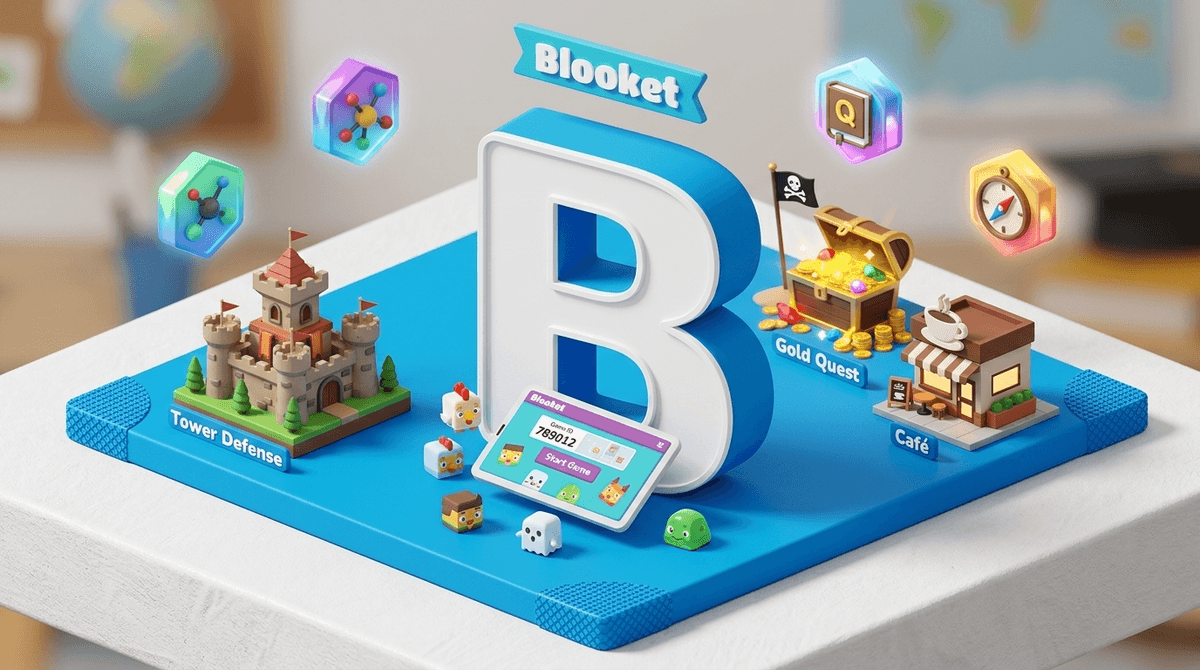
A few of the game modes:
- Tower Defense: answer questions to build towers and defend against waves of enemies
- Gold Quest: answer to open chests; you can also "steal" gold from other players (it's a game mechanic, not a chat feature)
- Café: answer to serve customers and restock your café
- Battle Royale: last student standing in head-to-head face-offs
- Crypto Hack: the most chaotic one; you can guess passwords to "hack" other players
Here's a quick walkthrough of what Blooket looks like in action:
The hook isn't the game modes, though. It's the Blooks — collectible cartoon avatars (chickens, ghosts, llamas, etc.) with rarity tiers. After every game you earn tokens. Tokens open random Blook Packs. Some Blooks are common, some are rare, some are "chroma" or "mythical." It's the same dopamine loop as Pokémon cards.
A lot of secondhand parent discourse about Blooket conflates it with games it isn't. The Blooket team flagged these three corrections specifically:
1. No chat, no friends, no messaging
There is no in-game chat in Blooket. There is no friend system. There is no DM feature. Students cannot send messages to each other or to the teacher inside the platform. The only way kids see each other in-game is by username on the leaderboard. The "stealing gold" or "hacking" interactions in some game modes are pure mechanics — buttons clicking on abstract avatars, not communication channels.
This means the "stranger danger" model parents apply to Roblox or Discord doesn't transfer here. There are no strangers to talk to. If your kid is playing Blooket alone in their room, they're playing a single-player or classroom-instanced game with anonymous usernames.
For more on what to watch instead, see our Blooket safety tips for elementary kids or privacy considerations for tweens.
2. No in-app purchases for students
This is the big one. Tokens and Blooks cannot be bought with real money. There is no "buy 100 tokens for $4.99" prompt. There is no Blook marketplace where kids spend dollars. The whole in-game economy — earn tokens by playing, spend tokens to open Blook Packs, collect Blooks — runs on time, not money.
Blooket's paid plans (Blooket Plus, Plus Flex) are sold to teachers and schools. They unlock things like detailed game reports, additional question import options, and custom game-mode controls — features useful in a classroom, not features kids see or want. Students are never prompted to upgrade.
If you're worried about "loot box" mechanics: the random Blook Pack pull does scratch that itch, and that's worth a conversation about chance and expectation. But it's chance with no money at stake, which puts it in a fundamentally different category than Overwatch lootboxes or FIFA Ultimate Team. It's closer to opening a free pack of trading cards.
3. Kids don't need an account
Most Blooket play happens through teacher-shared links and join codes. Students just enter the code, pick a username for that game, and play. No email, no password, no account.
Account creation is optional — kids who want their Blook collection and stats to persist across sessions can sign up. For under-13 accounts, Blooket requires verifiable parental consent (COPPA-compliant). But "I want to play Blooket at home" is a much smaller ask than parents often assume — it's usually "click a link from the teacher," not "make an account."
How to set up Blooket parental controls in 5 minutes walks through this exactly, including how to use a parent-side teacher account if you want to host games for your kid yourself.
The real friction point with Blooket isn't safety or spending. It's the gamification pull.
Three things specifically:
1. Time runaway. Kids will start "studying" and end up 90 minutes deep. The collection loop is genuinely well-tuned — there's always one more pack to open. If your kid is playing at home, set a timer before they start. "One Blooket session" needs a hard time bound or the platform will eat the afternoon.
2. Competition spillover. The leaderboard and "steal gold" mechanics get genuinely intense. For some kids, that's part of the fun. For others, it tips into frustration, comparison, or post-game crashes. Calmer modes (Tower of Doom, Café) are a softer landing than Battle Royale or Crypto Hack. If your kid melts down after a bad round, switch the mode, don't ban the platform.
3. The "fun > content" trap. Multiple teachers flag the same thing: kids race to win, not to learn. They'll memorize "the answer is C" without retaining what C means. Used in short, structured sessions, Blooket reinforces material well. Used as a free-form study substitute, the content can become decorative.
For more on this dynamic, our guide on signs Blooket has crossed from motivating to compulsive covers the warning signs — and what's normal vs. when to step in.
Here's a longer parent-facing walkthrough that goes deeper on how kids actually use it:
Ages 5-7 (K-1). The game pace is fast and the reading load is real — younger kids often need an adult next to them. Stick to teacher-created or you-created question sets at the right reading level. Full breakdown for this age in our 5-7 year-olds guide.
Ages 8-10 (2nd-5th). Sweet spot. They can navigate independently, the competitive element lands without melting them down, and the content scope (math facts, vocab, multiplication, state capitals) is exactly what Blooket is built for. Look at elementary-age safety tips for the home-vs-classroom playbook.
Ages 11-13 (middle school). Engagement is highest here. So is the gamification pull. The privacy considerations matter more — they may want optional accounts, social usernames, etc. Privacy concerns for tweens covers what's actually worth tracking. If they want comparisons, Blooket vs. Kahoot for middle schoolers breaks down which platform fits which kind of class.
Ages 14+ (high school). Most teens find Blooket gimmicky. The format works better for fact-recall classes than the analytical / discussion-heavy work that defines high school. If your high schooler's class uses it, it's probably for vocabulary or history-fact review. For more rigorous game-based study tools, see the best Blooket alternatives for high schoolers.
If your kid wants to play Blooket outside school, the play itself is fine. Two practical setups:
- Teacher's homework code. Many teachers assign Blooket homework. Your kid clicks the link, plays for 10-20 minutes, done. Easiest path. Look for the "Solo" or "Homework" mode in the teacher's assignment.
- You as host. If you want to use Blooket as a study tool at home, sign up for a free Blooket teacher account, browse the public question set library (or import one), and host a private game your kid joins with a code. Takes about 3 minutes to set up.
For more on turning Blooket into a study habit instead of a free-play time-sink, using Blooket to boost homework motivation walks through specific routines that work.
If your kid plays often, how to monitor Blooket usage at home covers what's visible from your end and how to track what they're actually playing.
A classroom-side view of how Blooket gets used in a real lesson, if you want to see what your kid's teacher might be doing:
Q: Is Blooket safe for kids?
Yes, on the dimensions parents usually mean by "safe." It's ad-free, COPPA-compliant, has no chat or friend system (no stranger contact), no real-money purchases, and no data selling. The thing to watch is the gamification pull, not external safety risks.
Q: Does Blooket cost money?
Not for students. The platform is free for kids and free at the basic tier for teachers. Paid plans (Blooket Plus, Plus Flex) exist for teachers and schools who want extra reporting and game-mode features — but kids are never prompted to buy anything, and nothing in the game is purchasable with real money.
Q: Do kids need an account to play Blooket?
No. Most Blooket play happens through join codes shared by teachers — kids just enter the code, pick a username for that game, and play. Account creation is optional, and used by kids who want to save their Blook collection across sessions. Under-13 accounts require verifiable parental consent.
Q: What's the deal with "Blooks" and tokens?
Blooks are collectible cartoon characters (chickens, ghosts, etc.) earned by opening Blook Packs. Tokens are the in-game currency you spend on packs — earned by playing, not bought with money. Some Blooks are common, some are rare, some are "chroma" or "legendary." It's a collection mechanic; nothing is purchasable with real money.
Q: What ages is Blooket best for?
Sweet spot is roughly 2nd-8th grade (ages 7-13), where the format genuinely makes review feel like a game. Younger kids (K-1) can play with an adult helping read questions; high schoolers usually find it gimmicky for the kind of analytical work they're doing.
Blooket is one of the cleanest ed-tech tools your kid will encounter — no ads, no chat, no real-money economy, no data exploitation. The thing that's "wrong" with it is the same thing that's "right" with it: kids will play it for the love of playing. Use it as a structured study tool with a timer, not as a screen-time-doesn't-count freebie, and it earns its keep.
If you want to dig deeper on a specific angle, the spokes:
- Is Blooket suitable for 5-7 year olds?
- Blooket safety tips for elementary kids
- Blooket privacy concerns for tweens
- How to set up Blooket parental controls
- How to monitor Blooket usage at home
- Blooket vs. Kahoot for middle school learning
- Using Blooket to boost homework motivation
- Best Blooket alternatives for high schoolers
