

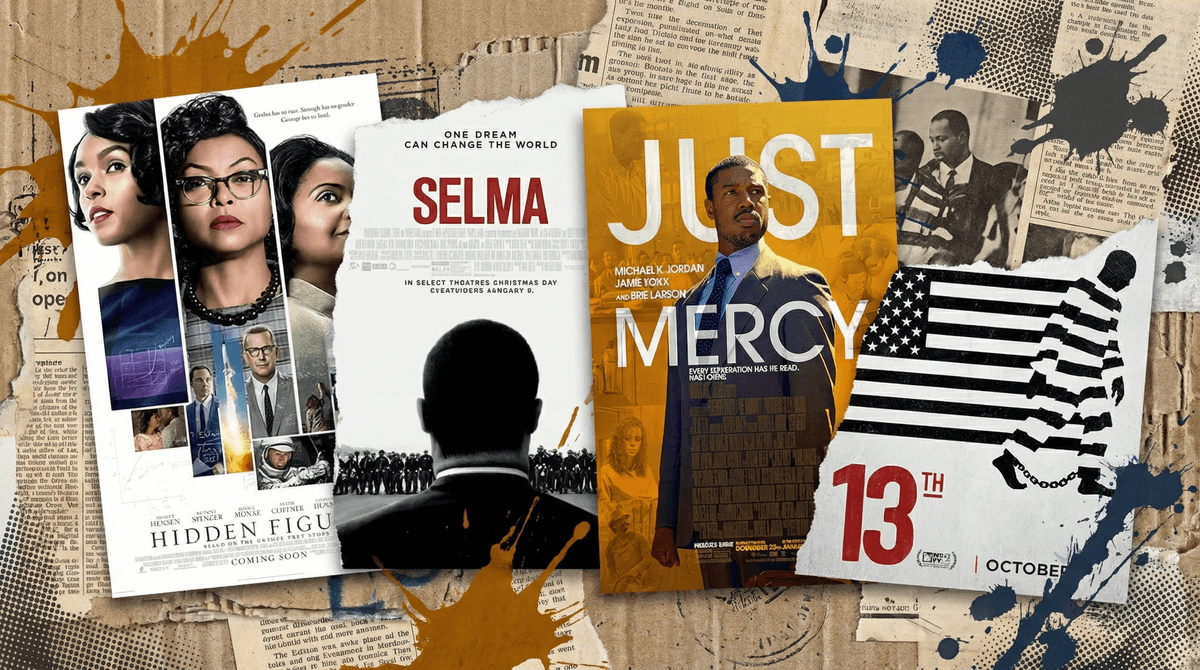
Let's be real: February rolls around and suddenly every streaming service is promoting their "Black History Month" collections. But here's the thing—films about civil rights, activism, and the fight for justice aren't just February content. They're powerful tools for helping kids understand how change happens, why speaking up matters, and how ordinary people can do extraordinary things.
These aren't your dusty classroom documentaries (though some of those are actually great). We're talking about compelling stories—some heartbreaking, some inspiring, all important—that show the real struggles and victories of people who fought for equality and justice. From the civil rights movement to modern activism, these films can open up conversations about racism, protest, courage, and what it means to stand up for what's right.
The challenge? Finding movies that are age-appropriate, historically accurate, and actually watchable for kids who've grown up on Marvel movies and YouTube. Because let's face it, if it feels like homework, they're tuning out.
Your kids are growing up in a world where they're seeing protests on TikTok, hearing about social justice movements in their classrooms, and probably asking questions you weren't expecting. They need context. They need to understand that the fight for civil rights didn't end with Martin Luther King Jr.'s "I Have a Dream" speech (which, spoiler alert, many kids think happened like a hundred years ago, not in 1963).
These films help kids understand:
- How change actually happens (spoiler: it's messy, slow, and requires people willing to risk everything)
- The difference between learning history and understanding it (dates vs. feeling the weight of what people endured)
- That activism isn't abstract (it's real people making hard choices)
- Why these stories are still relevant (because, well, look around)
Plus, if you're a white family, these conversations can feel intimidating. These films can be a starting point—not the whole conversation, but a way in.
Elementary (Ages 6-10)
Hidden Figures (PG) This is the gateway drug. It's inspiring, it's about brilliant women who literally sent people to space, and it shows racism in a way that's clear but not traumatizing for younger kids. The scene where Katherine has to run across campus to use the "colored" bathroom? That lands with kids in a way that's powerful without being graphic.
Ruby Bridges (TV Movie) The story of the six-year-old who integrated an all-white school in 1960. It's made for kids this age, so it's accessible, but it doesn't sugarcoat what she faced. Good for conversations about bravery and what it means to be the first.
Middle School (Ages 11-13)
Selma (PG-13) This is THE film for this age group. It's about strategy, leadership, and the Selma to Montgomery marches. Yes, there's violence (it's rated PG-13 for the bridge scene where peaceful protesters are beaten), but it's historically important violence that kids this age can process with support. Watch it together.
The Hate U Give (PG-13) Based on the incredible YA novel, this film connects historical civil rights struggles to modern police violence and activism. It's about a teen finding her voice after witnessing a police shooting. Heavy, yes. But if your middle schooler is on social media, they're already seeing this stuff—this film gives context and shows activism in action.
42 (PG-13) Jackie Robinson breaking baseball's color barrier. It's a sports movie, which makes it more accessible for some kids, but it doesn't shy away from the racism he faced. Good for kids who need an entry point that feels less "serious" but still delivers the message.
High School (Ages 14+)
13th (Documentary, TV-MA) Ava DuVernay's documentary about mass incarceration and the 13th Amendment. It's dense, it's challenging, and it will make your teen angry (in a good way). This is college-prep level content that connects slavery to the modern prison system. Watch it with them and be ready to pause and discuss.
Just Mercy (PG-13) Bryan Stevenson's work fighting for wrongly condemned prisoners. It's about the legal system, racism in the justice system, and one man's determination to make things right. Michael B. Jordan and Jamie Foxx are incredible, and it shows modern activism through legal advocacy.
Malcolm X (PG-13) Spike Lee's epic biography. It's long (over 3 hours), but it's essential for understanding the full spectrum of civil rights activism beyond the "peaceful protest" narrative. Malcolm X's evolution and philosophy are crucial for teens to understand.
Fruitvale Station (R) The last day of Oscar Grant's life before he was killed by police in 2009. It's rated R for language and the shooting, but for older teens ready to engage with modern police violence and activism, it's powerful. This one requires serious discussion afterward.
These films can be heavy. You might cry. Your kids might cry. That's okay. Actually, that's kind of the point. If we're not feeling something, we're not really engaging with the history.
Historical accuracy varies. Hollywood is still Hollywood. Selma took some liberties with LBJ's role. Hidden Figures compressed timelines. Use these as starting points, not endpoints. Follow up with actual history.
White savior narratives are still a thing. Some films center white characters in Black stories (looking at you, The Help). Be critical about whose story is being told and who's telling it. The Help isn't on my main list for a reason—it's more about white guilt than Black resistance.
Content warnings matter. These films include racial slurs, violence, and depictions of systemic racism. Preview them yourself first. Know your kid. A sensitive 10-year-old might not be ready for what a mature 10-year-old can handle.
Don't just press play and walk away. These aren't babysitters. Sit with your kids. Pause when they have questions. Be ready for "Why did people do that?" and "Is this still happening?"
Create space for feelings. Your kid might be angry, sad, confused, or all of the above. That's appropriate. Don't rush to make them feel better or explain it all away.
Connect past to present. Help them see the through-lines. The tactics used in Selma show up in modern protests. The systemic issues in 13th explain what they're seeing on the news.
Follow their lead on follow-up. Some kids will want to read more, watch more, do something. Others need time to process. Both are fine. Have resources ready but don't force it.
For white families especially: This is uncomfortable. It should be. Don't center your discomfort. Don't make your kid comfort you about racism. And please, please don't watch Hidden Figures and think "See? It all worked out!" The work is ongoing.
These films aren't just about Black history—they're about American history. They're about how change happens, what courage looks like, and why the fight for justice is never really over.
Start where your kids are. A 7-year-old doesn't need Fruitvale Station, but Hidden Figures might blow their mind. A high schooler who thinks they know everything about civil rights might need 13th to connect the dots.
And remember: watching a movie is the beginning, not the end. These films should spark conversations, questions, and maybe even action. If your kid finishes Selma and wants to know how they can make a difference now, that's not a problem to solve—that's the whole point.
Want to dig deeper? Check out our guides on talking to kids about racism, age-appropriate documentaries, or books about civil rights for kids.
Looking for lighter viewing that still matters? Try shows that teach empathy or movies about standing up to bullying.
And if you're wondering how to talk about current events with kids , we've got you.