

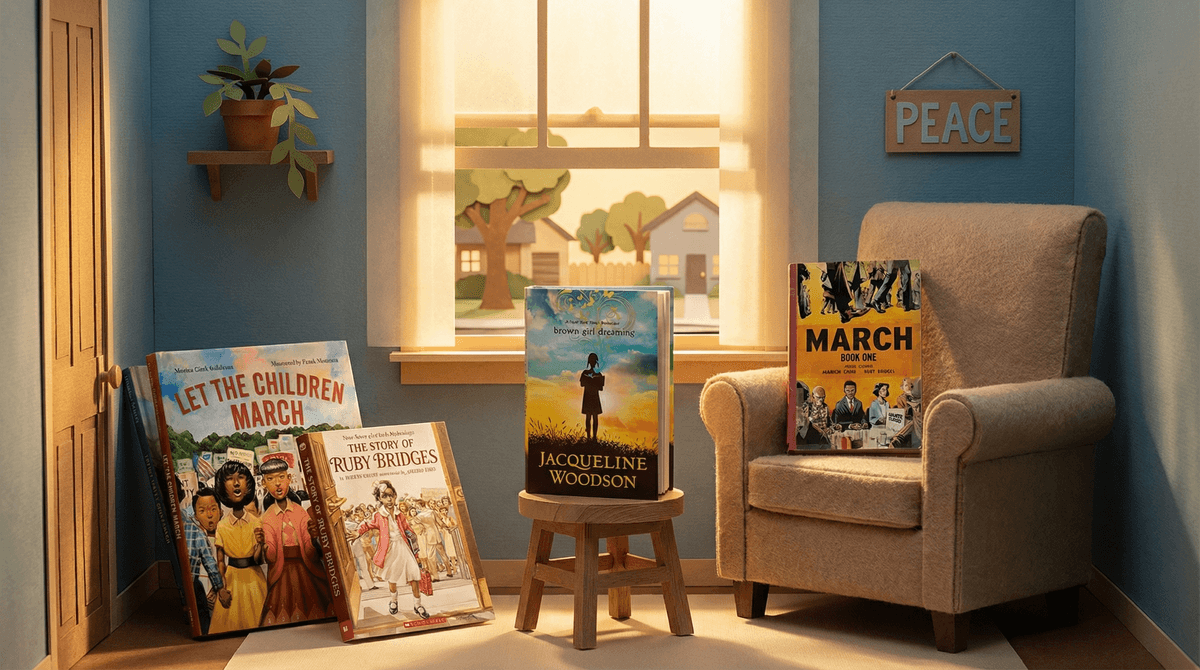
Civil rights books for kids are stories—both fiction and nonfiction—that introduce children to the history of social justice movements, the people who fought for equality, and the ongoing work of creating a more just world. These aren't just history lessons. They're stories about courage, community, and what happens when ordinary people decide enough is enough.
The best civil rights books don't sanitize the past or present activism as something that only happened "back then." They help kids understand that the fight for equality is ongoing, that injustice still exists, and that they have a role to play in making things better.
Here's the thing: kids are going to encounter injustice. They're going to see it in the news, in their communities, maybe even in their own schools. And when they do, they're going to have questions. Books give us a framework for those conversations that doesn't start from scratch every time something happens.
Reading about civil rights also builds empathy in a way that abstract lectures can't. When kids read about Ruby Bridges walking into that school, or learn about the kids who organized the Children's Crusade in Birmingham, they see themselves in those stories. They realize that young people have always been part of social movements, and that their voices matter.
Plus, let's be honest: the curriculum in many schools still treats civil rights as a "Martin Luther King Jr. had a dream and then everything was fine" situation. These books fill in the gaps, introduce kids to activists beyond the usual suspects, and show that social change is messy, complicated, and ongoing.
Ages 4-7: Picture Books That Plant Seeds
Start with stories that introduce big concepts in kid-friendly ways:
-
Let the Children March by Monica Clark-Robinson tells the story of the 1963 Children's Crusade in Birmingham through a child's perspective. It's powerful without being traumatic.
-
The Story of Ruby Bridges by Robert Coles is a classic for a reason. It introduces the concept of school integration through one brave six-year-old's experience.
-
A Sweet Smell of Roses by Angela Johnson follows two young girls who sneak out to join a peaceful march, showing kids as active participants in the movement.
At this age, the goal is exposure to the concepts of fairness, courage, and standing up for what's right. You're not diving into the brutal details yet—you're building a foundation.
Ages 8-11: Digging Deeper
This is when kids can handle more nuance and historical context:
-
March (the graphic novel trilogy) by John Lewis is absolutely essential. It's Lewis's firsthand account of the civil rights movement, and the graphic novel format makes it incredibly accessible. Yes, there are some intense moments, but this is the real history, told by someone who lived it.
-
The Watsons Go to Birmingham—1963 by Christopher Paul Curtis weaves the church bombing into a family story that helps kids understand the personal impact of historical events.
-
Brown Girl Dreaming by Jacqueline Woodson is a beautiful memoir in verse about growing up during the civil rights era. It's more subtle than some books on this list, but incredibly powerful.
-
Hidden Figures (the young readers' edition) by Margot Lee Shetterly shows how the fight for equality intersected with the space race. It's a great entry point for kids who might not initially be drawn to "civil rights books."
Ages 12+: The Full Picture
Middle schoolers can handle books that don't shy away from the complexity and ongoing nature of civil rights work:
-
Stamped: Racism, Antiracism, and You by Jason Reynolds and Ibram X. Kendi is a remix of Kendi's "Stamped from the Beginning" for young readers. It's direct, it's honest, and it connects historical racism to what's happening today.
-
The Hate U Give by Angie Thomas is fiction, but it's civil rights education wrapped in a gripping story about police violence, activism, and finding your voice.
-
All American Boys by Jason Reynolds and Brendan Kiely tells the story of a police brutality incident from two perspectives—the Black teen who's beaten and the white teen who witnesses it.
These books will spark hard conversations. That's the point. Your kid is going to ask why people were so mean, why laws allowed discrimination, why this is still happening. Have those conversations. Don't deflect with "that was a long time ago" because they're smart enough to know it wasn't.
Representation matters here. If your family is white, these books are especially important—they're how your kids learn that the default American experience isn't universal. If your family is Black or another marginalized group, these books can be affirming and empowering, but also potentially heavy. Check in with your kids about what they're feeling.
Don't just read during Black History Month. Civil rights books shouldn't be a February thing. They should be part of your regular rotation, just like any other genre.
Follow up with action. After reading about activists, talk about what activism looks like today. Maybe that's volunteering together, attending a community meeting, or writing letters to elected officials. Books are great, but they shouldn't be where the conversation ends.
Civil rights books aren't optional enrichment—they're essential education. They teach kids about their country's real history, introduce them to heroes who aren't always in the textbooks, and show them that social change is possible when people work together.
The best part? These are genuinely good books. They're not preachy or boring. They're stories that kids actually want to read, with characters they care about and narratives that stick with them long after they've finished the last page.
Start with one book that feels right for your kid's age and interests. Read it together if they're younger, or read it yourself first if they're older so you're ready for the conversations that follow. And remember: it's okay if you don't have all the answers. Learning together is part of the process.
Not sure where to start? Think about what your kid is already interested in. Love graphic novels? Start with March. Into science? Try Hidden Figures. Want something current? Go with Stamped.
And if you're looking for more books that build empathy and understanding, check out our guides on books about immigration for kids and diverse family structures in children's literature.
The conversation about justice and equality starts at home, and books are one of the best tools we have for starting it right.