

Look, we all know the drill. You're 45 minutes into a road trip, someone's already whining about being bored, the tablet battery is at 12%, and you're white-knuckling it through traffic while mentally calculating if you can make it to the next rest stop without a full meltdown.
Enter: podcasts.
Not just any podcasts—vacation podcasts for kids are audio shows specifically designed to entertain, educate, and (let's be honest) keep everyone from losing their minds during travel. They're screen-free, don't require Wi-Fi once downloaded, and actually build listening comprehension skills while you're just trying to make it to Grandma's house in one piece.
The best part? Unlike that one YouTube channel that somehow always ends up playing unboxing videos, podcasts encourage kids to use their imagination. They're creating mental pictures, following narratives, and learning to focus on audio alone—which is basically a superpower in our visual-everything world.
For kids: Podcasts feel like having a friend in their ear. They're not being talked at like in school—they're being invited into stories, mysteries, and adventures. Plus, there's something special about audio-only content that lets their imagination run wild in a way screens just don't.
For parents: They're the holy grail of travel entertainment. No fighting over who gets the tablet. No "I can't see the screen from the back seat." No motion sickness from staring at a device. Just pure, blissful audio that works whether you're on a plane, in a car, or waiting in an airport terminal.
And unlike music (which, let's face it, gets repetitive after the 47th play of the Encanto soundtrack), podcasts have episodes. Plural. Hours of content. It's like having a secret weapon in your parenting arsenal.
Ages 3-6: Short, Sweet, and Simple
Little kids need shorter episodes (10-15 minutes max) with clear storylines and engaging sound effects.
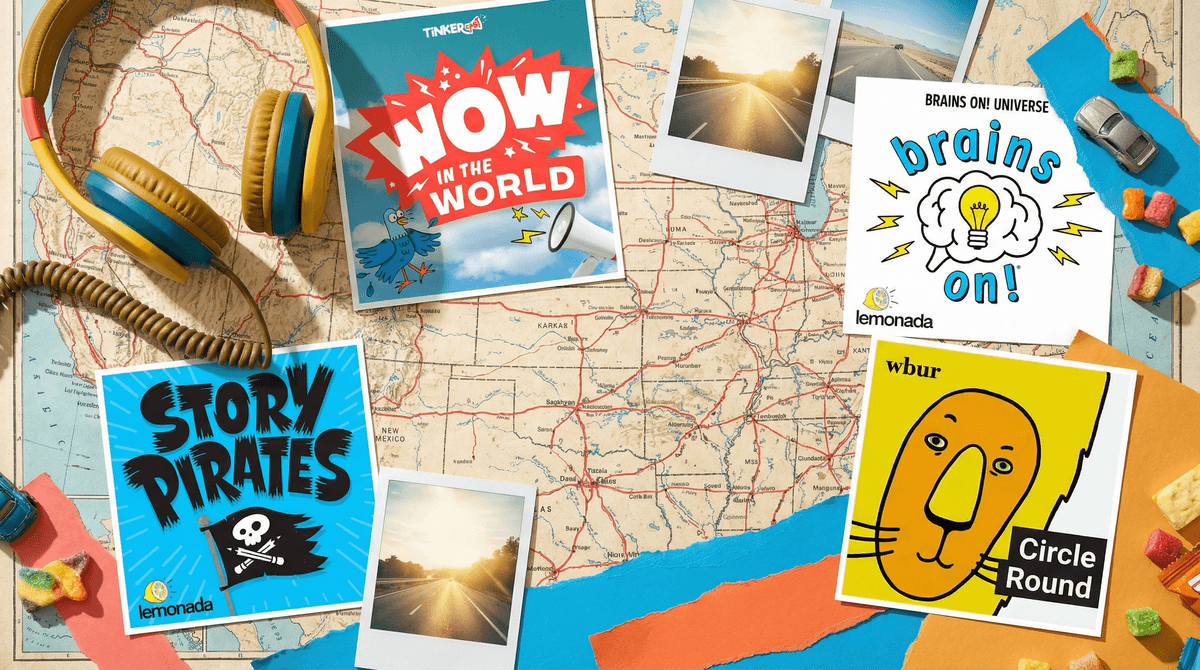
Story Pirates — Professional comedians and musicians turn stories written by real kids into hilarious songs and sketches. Episodes are 15-20 minutes, and the energy is infectious. Fair warning: your kid will want to submit their own story.
Circle Round — Folktales from around the world, beautifully produced with celebrity voices and original music. Each episode is under 20 minutes and teaches a life lesson without being preachy. Perfect for building cultural awareness while keeping little ones engaged.
Wow in the World — Technically for ages 4-10, but the younger episodes are pure gold for preschoolers. Hosts Mindy and Guy Raz explore real science and technology with infectious enthusiasm. The sound effects alone will have them giggling.
Ages 7-10: Ready for Longer Stories
This age can handle 20-30 minute episodes and more complex narratives. They're also starting to develop specific interests.
Brains On! — Science questions answered by real scientists, with kid co-hosts asking the questions adults are too embarrassed to ask. "Why is the ocean salty?" "Can you dig a hole to China?" It's legitimately educational without feeling like homework.
The Alien Adventures of Finn Caspian — A serialized science fiction story about an 8-year-old explorer on a spaceship. Each episode ends with a cliffhanger, which is either genius or torture depending on how many episodes you've downloaded. The storytelling is genuinely good—adults will find themselves invested too.
But Why: A Podcast for Curious Kids — From Vermont Public Radio, this show tackles the big questions kids actually ask. "Why do we have to wear clothes?" "How do you fall in love?" The answers are thoughtful, age-appropriate, and never condescending.
Ages 11-14: Sophisticated Stories and Real Learning
Tweens and early teens can handle adult-length content (30-45 minutes) and appreciate more sophisticated humor and storytelling.
Radiolab for Kids — The iconic science show, curated for younger listeners. The production quality is movie-level, and the topics are genuinely fascinating. Fair warning: these episodes will spark hours of follow-up questions.
Tumble Science Podcast for Kids — Real scientists telling real stories about their research. Not dumbed down, not boring—just accessible. Great for kids who are starting to think about what they might want to study or do professionally.
The Past and The Curious — History podcast that focuses on the weird, wild, and unexpected stories from the past. Think "the time a molasses tank exploded in Boston" rather than "memorize these dates about the Revolutionary War."
The Download Situation
Most podcast apps (Apple Podcasts, Spotify, Pocket Casts) let you download episodes for offline listening. Do this before you leave. Nothing kills the vibe faster than realizing you have no service and no downloaded content.
The Binge Factor
Some podcasts are serialized (ongoing stories), others are episodic (standalone episodes). For vacation, episodic tends to work better—you can start anywhere, and if someone falls asleep, no big deal. Serialized shows are great for longer trips where you can commit to the storyline.
The Ad Reality
Many kids' podcasts are ad-supported, but the ads are usually for other kids' podcasts or family-friendly products. Still, preview a few episodes first to make sure you're comfortable with what's being advertised. Some shows offer ad-free versions through apps like Spotify Premium.
The "Educational" Question
Are podcasts actually educational? Yes—they build listening comprehension, vocabulary, and focus. But also, it's vacation. If your kid wants to listen to comedy sketches instead of science content, that's fine. The real win is that they're engaged with audio storytelling instead of staring at a screen.
Create a shared playlist. Let each kid pick 2-3 episodes they want to listen to, then take turns. Democracy in action.
Use one earbud each. If you've got multiple kids sharing a device, this actually works. They can each have one earbud and listen together. Weird but effective.
Have a backup plan. Even the best podcast can't compete with a kid who desperately needs to move their body. Build in stops, bring fidget toys, and remember that podcasts are a tool, not a miracle solution.
Don't force it. Some kids just aren't audio learners, and that's okay. If podcasts aren't clicking, there are other screen-free travel options that might work better for your family.
Vacation podcasts are one of those rare parenting wins that actually live up to the hype. They're free (or cheap), educational (or at least not brain rot), and genuinely entertaining for a wide age range.
Will they magically transform your road trip into a peaceful meditation? No. Will they buy you 30-45 minutes of relative quiet while teaching your kid something about the world? Absolutely.
Start with one or two podcasts from the list above, download a few episodes, and see what sticks. The worst case scenario is you're back to the Encanto soundtrack. The best case? Your kid discovers a new passion for science, storytelling, or history—all while you're just trying to make it through the Appalachians without stopping every 20 minutes.
Pro tip: Once you find a podcast your kid loves, check if they have a back catalog. Most of these shows have years of episodes available, which means you've just unlocked hundreds of hours of content. You're welcome.
Safe travels, and may your Wi-Fi be strong when you need it and your downloads be plentiful when you don't.