

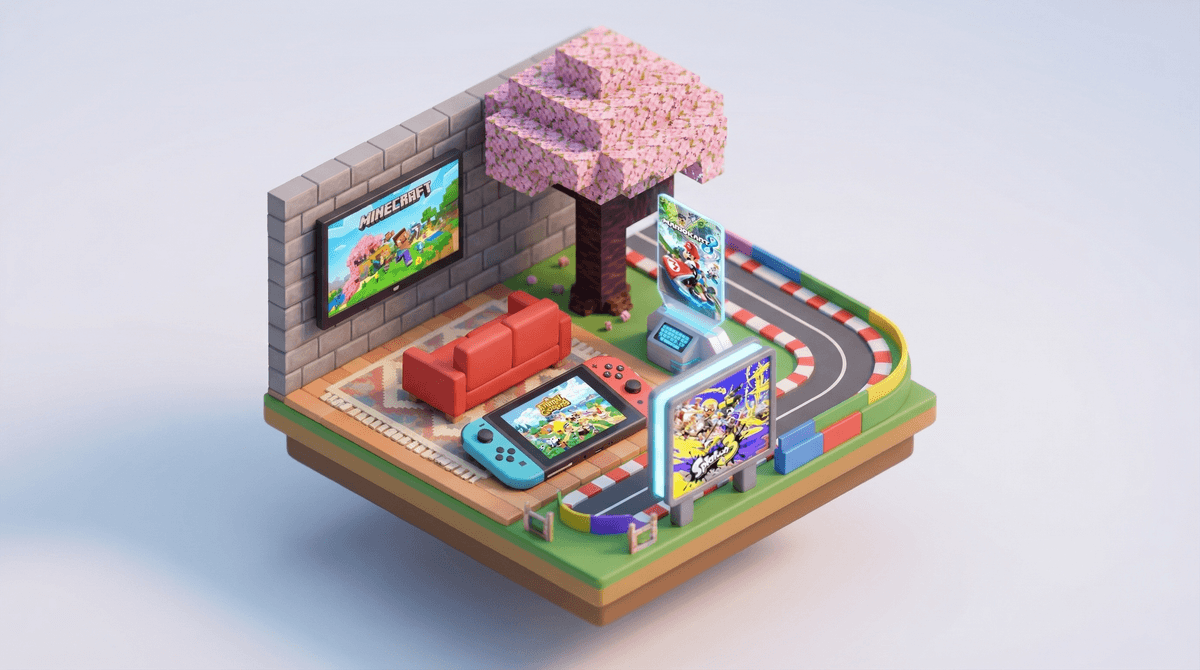
The Best Nintendo Switch Games for 8-10 Year Olds
The Switch is genuinely perfect for this age range—portable, social, and packed with games that respect kids' growing skills without the online chaos of other platforms. Here are the standouts:
Top picks: Mario Kart 8 Deluxe | Minecraft | Super Mario Odyssey | Animal Crossing: New Horizons | Splatoon 3
Creative builders: The Legend of Zelda: Link's Awakening | Kirby and the Forgotten Land | Pokémon Scarlet/Violet
The 8-10 age range is the sweet spot for the Switch. Kids have the motor skills and patience for real gameplay, they're reading well enough to follow instructions, and they're starting to develop actual gaming preferences beyond "colorful thing go brrr." But they're also not quite ready for the intensity (or toxicity) of online multiplayer shooters or the darker themes in teen-rated games.
The Switch library is uniquely suited for this developmental stage. Most first-party Nintendo games are designed with this exact age group in mind—challenging enough to feel rewarding, but with difficulty curves that don't require YouTube walkthroughs every five minutes.
It's genuinely portable. An 8-year-old can take it to a friend's house without you worrying about a $500 console getting damaged. Road trips, waiting rooms, the backseat—the Switch makes all of it more manageable.
Local multiplayer is built-in. The Joy-Cons split into two controllers, so siblings can play together without buying extra hardware. This matters more than you'd think for teaching turn-taking and cooperative play.
The online environment is (mostly) safer. Nintendo's online features are limited compared to Xbox or PlayStation. Voice chat requires a separate phone app (annoying for adults, protective for kids), and most games don't have open communication with strangers. When kids do play online, they're usually matched with other Nintendo players—still not perfect, but statistically less toxic than other platforms.
This is the game that justifies the console purchase. Every kid plays Mario Kart, and this version has enough depth that parents won't be bored playing along. The auto-accelerate and steering assist features mean even younger siblings can participate without completely ruining the race.
Why it works: Multiple difficulty levels, local multiplayer up to 4 players, online play that's relatively benign. The tracks are creative without being overwhelming, and losing doesn't feel devastating because there's always another race.
Parent tip: Turn on Smart Steering for new players—it prevents them from falling off edges while they learn the controls.
This is Nintendo's masterclass in game design for this age group. The main story is accessible enough for an 8-year-old to complete independently, but there are hundreds of additional challenges for kids who want to keep exploring. The two-player mode lets a younger sibling control Mario's hat, which is perfect for mixed-age play.
Why it works: No game-over screens (you just lose a few coins), vibrant worlds that reward exploration, and genuine moments of discovery. Kids at this age are developing spatial reasoning and problem-solving skills—Odyssey exercises both without feeling like homework.
Yes, Minecraft is available everywhere, but the Switch version hits differently for this age. It's the full game (not the limited mobile version), but without the pressure of PC servers or the chaos of cross-platform voice chat.
Why it works: Creative mode removes survival pressure, split-screen lets siblings build together, and the Switch's portability means kids can work on projects anywhere. This is where a lot of 8-10 year olds start understanding game design concepts—if you want to learn more about how Minecraft teaches computational thinking , it's genuinely fascinating.
Parent tip: Start them in Creative mode. Survival mode's death mechanics can be frustrating for kids who just want to build.
This game became a cultural phenomenon during the pandemic for good reason. It's a cozy game that runs on real-world time, which naturally limits binge sessions. Kids design their island, catch bugs, fish, decorate their house, and interact with anthropomorphic animal neighbors who are unfailingly kind.
Why it works: No combat, no fail states, no pressure. It teaches resource management, delayed gratification (some things take real-world days to complete), and basic economics. The creative expression is genuinely impressive—kids can design custom clothing, furniture arrangements, and entire island layouts.
Parent consideration: The real-time clock means kids will ask to play at specific times for in-game events. This can be annoying but also provides natural stopping points.
If your kid found Mario Odyssey a bit too challenging, Kirby is the perfect entry point. It's Nintendo's "baby's first 3D platformer," but that's not an insult—it's thoughtfully designed to build confidence.
Why it works: Extremely forgiving difficulty, adorable aesthetic, two-player co-op where the second player is even more powerful (great for a parent helping out). The "Mouthful Mode" where Kirby inhales objects is genuinely hilarious and creative.
This is Nintendo's take on online multiplayer shooters, and it's remarkably well-designed for kids. Instead of guns, players use paint-based weapons. Instead of death, you "splat" and respawn immediately. The objective is covering the map in your team's color, not racking up kills.
Why it works: It's a shooter that doesn't feel violent. The matches are short (3 minutes), the aesthetic is vibrant and weird, and the online community is surprisingly positive. This is where a lot of kids start developing teamwork and strategic thinking.
Parent consideration: This does require Nintendo Switch Online ($20/year), and it is online multiplayer with strangers. However, there's no voice chat without the separate app, and the gameplay doesn't encourage toxic behavior the way other shooters do.
The full 3D Zelda games (Breath of the Wild, Tears of the Kingdom) are incredible but better suited for 10+. Link's Awakening is a remake of a classic 2D Zelda with a toy-like art style and more manageable scope.
Why it works: Puzzle-solving, exploration, and light combat without overwhelming complexity. Perfect for kids ready to graduate from pure platformers but not quite ready for open-world epics.
Pokémon remains evergreen for this age group. The latest games are open-world, which means kids can tackle challenges in any order and explore at their own pace. The core loop—catch creatures, train them, battle—is immediately satisfying.
Why it works: Strategic thinking, collection mechanics, and a difficulty level that scales with player choices. Kids who love Pokémon will play for hundreds of hours.
Parent note: These games have some performance issues (framerate drops, visual glitches). They're still playable and kids generally don't care, but it's worth knowing.
A puzzle-adventure game where Luigi explores a haunted hotel with a vacuum that catches ghosts. It's mildly spooky but in a Scooby-Doo way, not a nightmare-inducing way.
Why it works: Excellent two-player co-op, clever puzzles, and a difficulty level that challenges without frustrating. The humor is genuinely funny.
This sounds like a weird concept—Mario meets the Rabbids franchise in an XCOM-style tactical strategy game—but it absolutely works. It's a gentler introduction to turn-based strategy than most games in the genre.
Why it works: Teaches strategic thinking and planning ahead without being punishingly difficult. The Rabbids humor is chaotic and appeals to this age group.
Fortnite: Available on Switch but runs poorly compared to other platforms. More importantly, the online environment can be toxic, and the social pressure around skins and Battle Passes is real. Not saying no, but read this guide first.
Roblox: Technically available but the Switch version is limited. If your kid is playing Roblox, they're probably better off on a tablet or computer where you can set up proper parental controls.
Breath of the Wild/Tears of the Kingdom: These are masterpieces, but they're genuinely challenging and require sustained attention. Some 10-year-olds will love them; some 8-year-olds will bounce off. Know your kid's frustration tolerance.
Digital vs. Physical: Physical cartridges can be shared, traded, and resold. Digital games are tied to your account forever. For games you know will get heavy use (Mario Kart, Minecraft), digital is convenient. For games you're not sure about, physical gives you options.
Nintendo Switch Online: Required for online multiplayer in most games ($20/year for basic, $50/year for the expansion pack with classic games). The family plan ($35/year) covers up to 8 accounts if you have multiple kids or want to split with friends.
Screen time considerations: The Switch tracks playtime in your parental controls app. You can set daily limits, restrict online features, and get weekly reports. Unlike tablets, the Switch is purpose-built for gaming—no YouTube rabbit holes or social media to worry about.
Multiplayer dynamics: Local multiplayer (everyone in the same room) is generally positive. Online multiplayer introduces variables you can't control. Start with local, add online features gradually as your kid demonstrates good digital citizenship.
8-year-olds: Stick with games that have clear objectives and forgiving difficulty. Mario Kart, Kirby, and Animal Crossing are perfect. They're building gaming literacy and frustration tolerance.
9-year-olds: Ready for more complexity. Mario Odyssey, Minecraft, and Link's Awakening offer deeper challenges. They can start understanding game mechanics and developing strategies.
10-year-olds: Can handle open-world games, strategic thinking, and some online play with supervision. Pokémon, Splatoon, and potentially the bigger Zelda games are on the table. They're developing preferences and gaming identity.
The Switch is legitimately the best gaming platform for this age range. The games are designed with kids in mind without being condescending, the hardware is durable and portable, and the online environment is significantly safer than alternatives.
Start with Mario Kart and one other game based on your kid's interests (creative kids get Minecraft or Animal Crossing, adventure kids get Mario Odyssey or Kirby). Let them play, watch what they gravitate toward, and expand from there.
The games listed here represent hundreds of hours of quality entertainment. They teach problem-solving, spatial reasoning, strategic thinking, and persistence—all while being genuinely fun. That's not marketing speak; these are well-designed games that respect young players' intelligence.
Next Steps:
- Set up parental controls through the Nintendo Switch Parental Controls app (seriously, do this first)
- Start with 1-2 games and see what sticks
- Play together when possible—you'll understand what they're experiencing and it's actually fun
- Learn about Nintendo's online features before enabling them
The Switch won't solve all your screen time challenges, but it's one of the better screens your kid can be looking at.