

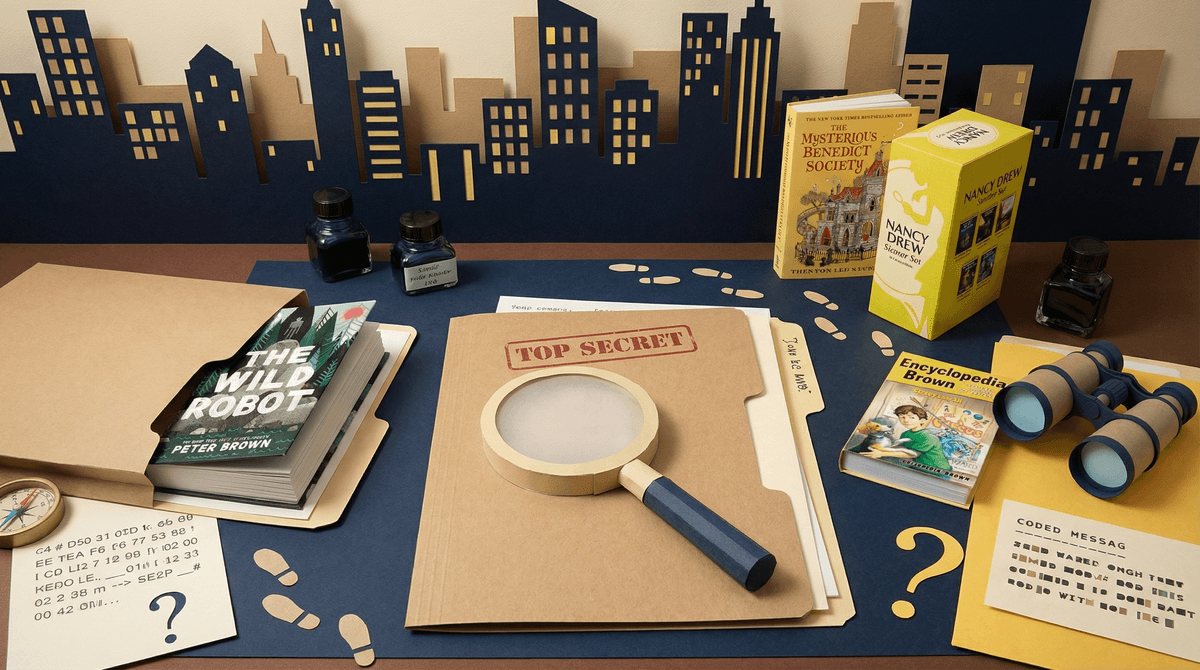
Mystery books for kids are stories built around a central puzzle—a missing object, a suspicious event, a whodunit scenario—that young readers get to solve alongside the characters. Think Nancy Drew, Encyclopedia Brown, or more modern series like The Wild Robot (which has mystery elements) and Enola Holmes.
These aren't just entertaining page-turners (though they absolutely are that). Mystery books are essentially critical thinking workouts disguised as fun. Kids are gathering evidence, making inferences, questioning assumptions, and revising theories—all while being completely absorbed in whether the butler actually did it.
And here's the thing: in a world where kids are constantly fed algorithmic content designed to keep them passively scrolling, mystery books require active engagement. Your kid can't just zone out. They have to pay attention, remember details, and think ahead. It's the opposite of brain rot.
Mystery books hit a sweet spot for young readers because they're inherently interactive. Unlike other genres where you're just along for the ride, mysteries invite kids to play detective. They're looking for clues, making predictions, and feeling genuinely smart when they figure something out before the reveal.
There's also something deeply satisfying about the structure of a mystery. The world feels chaotic and unpredictable to kids (because it is), but a good mystery promises that everything will make sense eventually. All those seemingly random details? They matter. That weird thing the neighbor said in chapter three? It's actually the key to everything. For kids who crave order and logic, this is catnip.
Plus, let's be real—mysteries can be genuinely suspenseful without being scary. They give kids that thrill of tension and anticipation in a way that feels safe and manageable, especially compared to horror or intense action stories.
Here's what's actually happening in your kid's brain when they read mysteries:
Evidence evaluation: They're learning to distinguish between relevant information and red herrings. This is the same skill they'll need later to evaluate sources, spot misinformation, and not fall for every conspiracy theory on TikTok.
Logical reasoning: Mysteries teach cause-and-effect thinking. If X happened, what does that tell us about Y? This is foundational for everything from math to science to understanding why their actions have consequences (revolutionary concept, I know).
Memory and attention to detail: Kids learn that small details matter. That throwaway line about someone being left-handed? That's going to be important later. This kind of active reading builds comprehension skills across the board.
Hypothesis testing: Kids make predictions, gather more information, and revise their theories. This is literally the scientific method, just with more secret passages and fewer lab coats.
Perspective-taking: Good mysteries require understanding different characters' motivations and viewpoints. Why would the librarian lie? What does the suspicious gardener have to hide? This builds empathy and social reasoning.
Ages 5-7 (Early Readers) Start with simple mysteries that have clear clues and satisfying resolutions. Nate the Great is perfect for this age—short chapters, straightforward mysteries, and a detective who takes his job very seriously (he wears a detective costume to solve the case of the missing pancake recipe, which is objectively excellent).
Cam Jansen is another solid choice. The protagonist has a photographic memory, which gives kids a model for paying close attention to details.
Ages 8-10 (Middle Elementary) This is prime mystery age. The 39 Clues series combines mystery with adventure and history. A to Z Mysteries gives you 26 books to work through (one for each letter), which is perfect for kids who get obsessed with series.
Enola Holmes is fantastic for this age group—smart, independent protagonist, historical setting, and genuinely clever mysteries. Plus, if they love it, there's a Netflix movie they can watch after.
Ages 10-12 (Upper Elementary/Middle School) Kids this age can handle more complex plots and morally ambiguous situations. The Westing Game is a classic for a reason—it's basically a puzzle box of a book where everyone's a suspect and nothing is what it seems.
One of Us Is Lying works for mature tweens/early teens (note: deals with heavier themes like death and social pressure, so preview if your kid is sensitive). The Mysterious Benedict Society is perfect for kids who love puzzles and codes—it's like a mystery wrapped in a treasure hunt wrapped in a spy adventure.
Not all mysteries are created equal. Some are genuinely clever with fair-play clues (the reader has all the information they need to solve it). Others just pull the solution out of thin air at the end, which is frustrating and doesn't teach critical thinking—it teaches kids that the author is just messing with them.
Scary vs. suspenseful: Most kid mysteries lean into suspense rather than fear, but some can get spooky. If your kid gets anxious easily, preview the book or check reviews. Common Sense Media has good parent reviews that flag scary content.
Series are your friend: Once a kid finds a mystery series they love, they'll often tear through the entire thing. This builds reading stamina and confidence. Don't fight it—let them read the same type of book over and over. They're still building skills.
Audiobooks count: If your kid resists reading but loves stories, mystery audiobooks are fantastic for car rides or quiet time. They still get all the critical thinking benefits while building listening comprehension.
Mystery books are one of those rare things that kids genuinely enjoy AND that actually build important cognitive skills. They're teaching your kid to think critically, pay attention, and solve problems—all while being completely entertained by whether the dog actually ate the homework or if something more sinister is afoot.
In a digital landscape where so much content is designed to be consumed passively, mysteries require active engagement. Your kid has to think, remember, and reason. That's not nothing.
So yeah, if your kid wants to read 47 Geronimo Stilton mysteries in a row, let them. They're not just reading about a mouse detective—they're building the thinking skills they'll need to navigate an increasingly complex world.
Start with what they already like: If your kid loves Scooby-Doo, try mystery books with that same vibe. If they're into Harry Potter, point out that those books are basically mysteries (who opened the Chamber of Secrets? Who's trying to steal the Sorcerer's Stone?).
Make it social: Some kids love discussing theories and clues. Ask "who do you think did it?" at dinner. Let them explain their reasoning. This reinforces the critical thinking and makes reading feel more interactive.
Check out mystery book recommendations by age for more specific suggestions tailored to your kid's reading level and interests.
And if you want to explore other types of books that build critical thinking while keeping kids engaged, check out our guide to chapter books that aren't boring.