

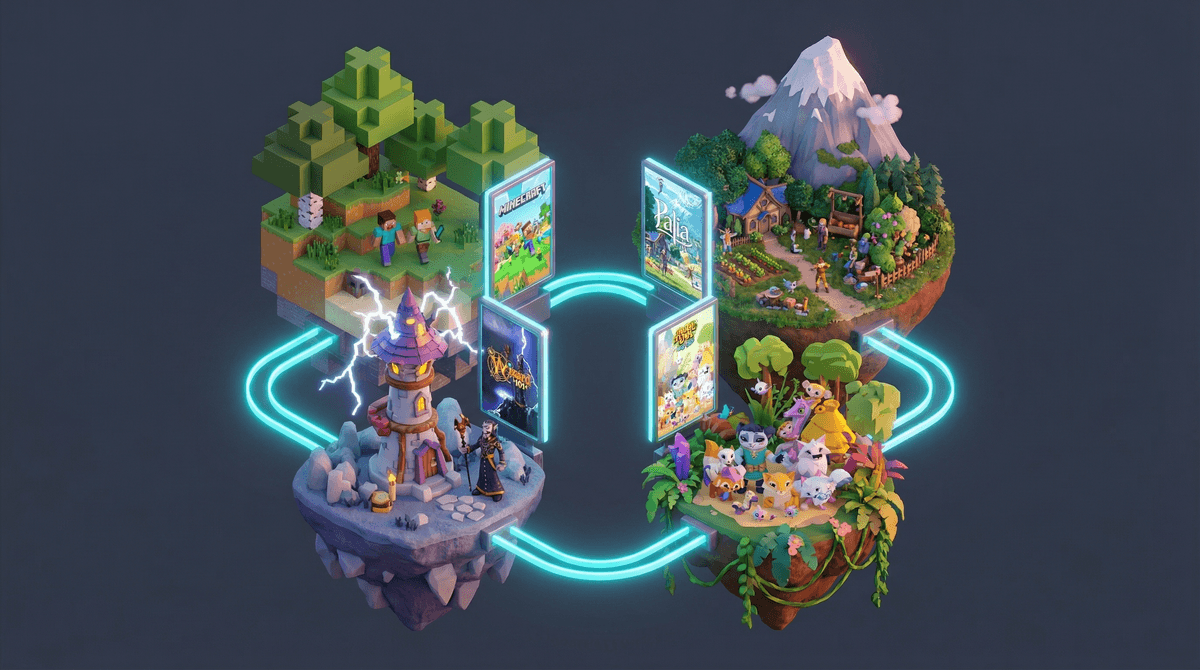
MMO stands for "Massively Multiplayer Online" — basically, these are games where hundreds or thousands of players share the same virtual world at the same time. Think of it like a digital playground where kids can run around, complete quests, build things, and interact with other players from around the world.
Unlike single-player games or even games with basic multiplayer modes, MMOs are persistent worlds that keep going whether your kid is logged in or not. Other players are always there, events happen on schedules, and there's usually some kind of economy where players trade items or currency.
The appeal is obvious: it's social, it's immersive, and there's always something new happening. But it also means your kid is interacting with strangers online, which is why finding age-appropriate MMOs with good safety features is crucial.
MMOs scratch a very specific itch that other games don't. They're not just about beating levels or scoring points — they're about being part of a living community. Kids can make friends, join guilds or clans, work together on challenges, and build reputations as skilled players or helpful community members.
There's also the progression element. MMOs are designed to keep you coming back with daily quests, seasonal events, and that dopamine hit of leveling up or getting rare loot. For some kids, this is genuinely engaging and teaches goal-setting. For others, it can become a bit obsessive (more on that later).
And honestly? MMOs can be legitimately creative and social spaces. Kids learn cooperation, strategy, resource management, and sometimes even basic economics. The question isn't whether MMOs are "good" or "bad" — it's about finding ones that match your family's values and your kid's maturity level.
Ages 6-10: Training Wheels MMOs
Wizard101 is the gold standard for younger kids. It's a turn-based card game wrapped in an MMO, set in a magical school (yes, very Harry Potter-adjacent). The chat system is heavily moderated with preset phrases for younger players, and the gameplay is genuinely educational with math and strategy elements. The downside? It's got a freemium model that constantly nudges kids toward paid content.
Animal Jam is another solid option for this age group. It's focused on wildlife education with a social element. Kids create animal avatars, explore different habitats, and play mini-games. The chat is filtered, and there's a decent parent dashboard. That said, it also has membership pressure and some kids find it gets repetitive quickly.
Poptropica has been around forever and still holds up. It's more quest-focused than social, which actually makes it a gentler introduction to MMOs. Kids solve puzzles and explore different themed islands. Limited chat means limited risk, though also limited social interaction.
Ages 10-13: The Sweet Spot
Roblox is technically a platform, not a single MMO, but it's where most kids this age are spending their time. The variety is incredible — from role-playing games to obstacle courses to full-on MMO experiences within Roblox itself. The catch? Wildly inconsistent moderation and a real money economy (Robux) that can drain your wallet fast. If your kid is on Roblox, you need to understand how to set up Roblox parental controls and have ongoing conversations about online safety.
Minecraft (multiplayer servers) is where a lot of kids are getting their MMO-lite experience. Public servers can be huge communities with minigames, economies, and social hierarchies. The good news: Minecraft is fundamentally creative and collaborative. The bad news: server quality varies wildly, and chat moderation is minimal on most servers. Stick to kid-friendly servers like Mineplex or Hypixel with friends, or better yet, set up a private realm.
Prodigy Math is Pokemon-meets-math-class. Kids battle monsters by solving math problems, and there's a social world where they can interact with classmates. It's heavily used in schools, which gives it some built-in safety and familiarity. The educational value is real, though the membership upsell is aggressive.
Ages 13+: Real MMO Territory
Palia is a newer "cozy MMO" that's like Stardew Valley meets Animal Crossing, but multiplayer. It's genuinely wholesome — you're building a homestead, making friends, and exploring a beautiful world. There's no combat, which makes it less intense than traditional MMOs. The community skews older and more chill, and it's free-to-play without aggressive monetization. This is probably the best first "real" MMO for teens.
Guild Wars 2 is a more traditional MMO that's actually pretty teen-appropriate. It's got combat and fantasy violence, but it's not gory, and the community is known for being helpful rather than toxic. The base game is free, and there's no subscription, which is nice. That said, it's complex and time-consuming — expect a learning curve and significant time investment.
Final Fantasy XIV is often recommended as the "nicest" MMO community. It's got a great story, beautiful design, and players who are genuinely welcoming to newcomers. But it's also got a monthly subscription, it's deeply complex, and it can be a massive time sink. This is for the teen who's ready for a serious gaming hobby, not a casual player.
You might be wondering why Fortnite or Destiny 2 aren't on this list. Technically, they're not pure MMOs — they're more like "shared world shooters" where you see other players in hubs but play in smaller instances. They're also more intense in terms of violence and competitive pressure. Fortnite especially has voice chat with strangers, which is a whole other conversation. They're not bad games, but they're different beasts than the MMOs on this list.
Here's the thing about MMOs: your kid is playing with strangers. Sometimes those strangers are other 10-year-olds. Sometimes they're adults. Sometimes they're adults pretending to be 10-year-olds.
Every MMO on this list has some level of chat moderation, but none of them are perfect. Predators do use these spaces to target kids. It's not common, but it happens. Your kid needs to know:
- Never share personal information — no real names, schools, locations, or social media handles
- Don't click links from other players
- Tell you immediately if someone makes them uncomfortable or asks to talk outside the game
- Use reporting features when they see inappropriate behavior
Beyond predators, there's also regular old bullying, scamming (especially in games with economies), and exposure to language or topics that might not match your family's values.
The good news? You can dramatically reduce risk by:
- Starting with games that have strong built-in safety features (like Wizard101's filtered chat)
- Playing together when your kid is starting out
- Keeping gaming devices in common areas
- Having ongoing conversations about online safety (not just one "talk")
- Knowing your kid's in-game friends and usernames
Let's talk about money, because MMOs have figured out how to extract it from kids (and their parents) with surgical precision.
Most "free" MMOs make money through:
- Subscriptions that unlock full content (Wizard101, FFXIV)
- Cosmetic items like skins, outfits, and emotes (Fortnite, Roblox)
- Convenience items that speed up progress (most mobile MMOs)
- Loot boxes or randomized rewards (increasingly regulated but still common)
Some of this is fine. Paying $10/month for a game your kid plays for hours is actually a decent value. But the pressure is real, especially when "everyone else" has the cool cosmetics or when game design deliberately frustrates free players.
Set clear boundaries early. Maybe that's a monthly budget, maybe it's "you can spend birthday money but not allowance," maybe it's "cosmetics only, no pay-to-win." Whatever it is, decide before your kid is begging for Robux at the grocery store.
MMOs are designed to be sticky. Daily login rewards. Time-limited events. Friends who are online right now. The fear of missing out is built into the game design.
For some kids, this is fine. They play for an hour, log off, and go outside. For others, it becomes the only thing they want to do. You know your kid better than anyone, but watch for:
- Resistance to logging off that goes beyond normal disappointment
- Declining interest in other activities they used to enjoy
- Mood changes when they can't play
- Sneaking game time or lying about how long they've played
If you're seeing these signs, it's not about the specific game being "bad" — it's about your kid's relationship with gaming in general. That's a bigger conversation about balance, coping skills, and what role screens play in your family.
MMOs can be legitimately great for kids — they build friendships, teach collaboration, and create memorable experiences. But they're also complex social spaces with real risks around safety, money, and time.
The best MMO for your family depends on your kid's age, maturity, and interests. For younger kids, start with heavily moderated games like Wizard101 or Animal Jam. For tweens, Roblox and Minecraft servers are where their friends probably are (just set up those safety features). For teens ready for a real MMO, Palia is the most accessible entry point.
Whatever you choose, stay involved. Ask about their in-game friends. Watch them play sometimes. Know the game's safety settings. And keep talking about online safety, not as a scary lecture, but as an ongoing conversation about navigating digital spaces responsibly.
- Check out our guide to Roblox parental controls if that's where your kid is spending time
- Explore alternatives to Minecraft if you're looking for creative multiplayer options
- Have questions about a specific game? Check if an MMO is safe for your kid
