

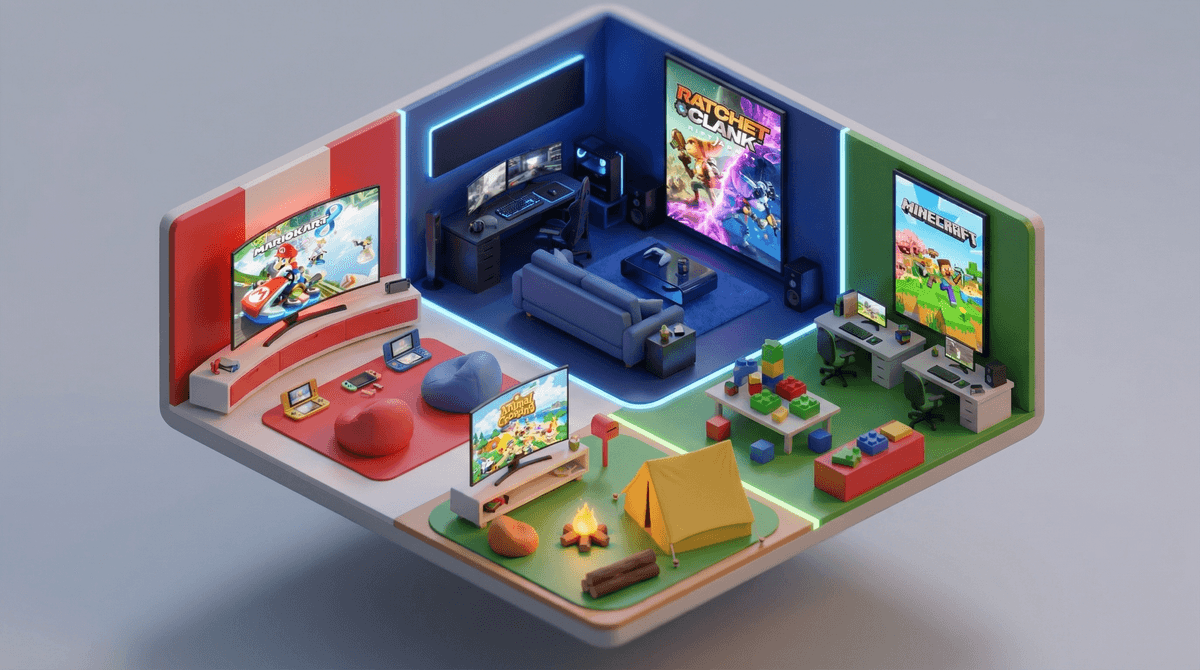
Let's cut to the chase: there's no universal "best" console for kids. The right choice depends on your family's gaming style, budget, and what kind of experience you want your kids to have. But here's the good news — the three major consoles (Nintendo Switch, PlayStation 5, and Xbox Series X/S) each have distinct personalities, and once you understand them, the decision gets a lot easier.
Think of it this way: Nintendo Switch is the family-friendly gateway, PlayStation is the cinematic storyteller, and Xbox is the value-maximizing subscription service. Each has trade-offs, and honestly, each can be great depending on what matters most to you.
Nintendo Switch: The Family Console
Price: $299 (standard), $199 (Switch Lite), $349 (OLED model)
The Switch is the console most parents default to, and for good reason. It's portable, it has the most robust parental controls, and its game library is practically designed for kids. We're talking Mario Kart, Animal Crossing, Pokémon, Splatoon — games that are genuinely fun without being violent or inappropriate.
The upside: The Switch is versatile. Kids can play on the TV or take it in the car. The game library skews younger and more creative. And honestly? Parents end up playing too. There's something about a cozy evening playing Stardew Valley or getting destroyed by your 8-year-old in Mario Kart that just works.
The downside: Games are expensive and rarely go on sale. You're looking at $50-60 per game, and Nintendo doesn't do the deep discounts that other platforms offer. Also, the Switch's online capabilities are limited compared to PlayStation and Xbox — which might actually be a feature, not a bug, depending on your perspective on online gaming.
Best for: Ages 5-13, families who want couch co-op gaming, parents who value content safety over cutting-edge graphics.
PlayStation 5: The Blockbuster Experience
Price: $499 (standard), $449 (digital edition)
PlayStation is where you go for cinematic, story-driven games. Think Spider-Man, Horizon, Ratchet & Clank — games that feel like interactive movies. The graphics are stunning, the controller (DualSense) has incredible haptic feedback, and the exclusive games are genuinely special.
The upside: If your kid is a bit older (10+) and gravitating toward more sophisticated gaming experiences, PlayStation delivers. The game library has depth, and PlayStation Plus gives you access to a catalog of games for a monthly fee. Also, many of the best family-friendly games like Astro's Playroom come pre-installed or are very affordable.
The downside: It's expensive upfront, and the games skew older. While there are kid-friendly options, you'll need to be more intentional about curation. Also, the online gaming community can be... intense. Parental controls are solid, but you'll want to use them.
Best for: Ages 10+, kids who love story-driven games, families willing to invest in premium gaming experiences.
Xbox Series X/S: The Value Play
Price: $499 (Series X), $299 (Series S)
Xbox's superpower is Game Pass — think Netflix for games. For $10-17/month, you get access to hundreds of games, including day-one releases. If your kid wants variety and you don't want to drop $60 every time they get bored of a game, this is your console.
The upside: Game Pass is legitimately incredible value. You get access to Minecraft, Forza, tons of indie games, and even EA Sports titles. The Series S is also the most affordable next-gen console at $299. Plus, Xbox has strong backward compatibility — games from older Xbox consoles still work.
The downside: Xbox has fewer exclusive games that appeal to younger kids compared to Switch. The game library skews older and more "gamer-y." Also, the subscription model means you're paying monthly, which can add up over time.
Best for: Ages 8+, families who want variety without breaking the bank, kids who already love Minecraft or Roblox (both available on Xbox).
Real talk: gaming PCs are amazing but they're also expensive, require more technical knowledge, and give kids access to the entire internet. If you're considering a PC, make sure you're ready to manage Steam accounts, Discord, and a much more open ecosystem. For most families with younger kids, consoles offer a more contained, manageable experience.
Here's what the console price doesn't include:
- Extra controllers: $50-80 each (and you'll want at least two)
- Online subscriptions: $10-20/month for multiplayer and free games
- Games: $30-70 each, or $10-17/month for Game Pass
- Storage: You might need external storage as game files are huge
- Accessories: Headsets, charging stations, carrying cases for Switch
A $299 Switch can easily become a $500+ investment once you add games and accessories. Budget accordingly.
Ages 5-8: Nintendo Switch is your best bet. The game library is designed for this age group, and the portability means less fighting over the TV. Start with Mario Kart, Kirby, or Pokémon.
Ages 9-12: This is the transition age. Switch is still great, but kids start wanting more "grown-up" games. Xbox with Game Pass offers good variety without committing to expensive individual games. PlayStation works if they're drawn to specific franchises.
Ages 13+: All three are viable. Let your teen's preferences guide you. If they have friends on a specific platform, that matters — gaming is increasingly social. Also, learn about online gaming safety before they dive into multiplayer.
Parental controls matter: All three consoles have robust parental controls, but you need to actually set them up. You can limit screen time, restrict purchases, filter content by age rating, and control who they can communicate with online. Here's how to set up Nintendo Switch parental controls.
Physical vs. digital games: Physical games can be resold or shared, but digital games are more convenient and can't be lost. With younger kids, physical is often better — it teaches responsibility and has resale value.
The subscription trap: Game Pass and PlayStation Plus are great value, but they're also recurring costs. Make sure you're comfortable with the monthly commitment. Also, if you cancel, you lose access to those games.
Online gaming is a big deal: If your kid is playing online, they're interacting with strangers. Voice chat, text chat, and multiplayer lobbies can expose them to toxic behavior, inappropriate language, and even predators. This isn't fear-mongering — it's just reality. Use parental controls to limit communication, and have ongoing conversations about online behavior.
If you want the safest, most kid-friendly option with the best portability: Nintendo Switch.
If you want the best value and variety for older kids: Xbox Series S with Game Pass.
If you want premium, story-driven experiences for tweens and teens: PlayStation 5.
Honestly? You can't go wrong with any of them if you're intentional about game selection and parental controls. The "best" console is the one that fits your family's gaming style, budget, and values.
Before you buy, sit down with your kid and talk about expectations:
- How much screen time is reasonable?
- What types of games are allowed?
- How will they earn game purchases?
- What are the rules around online gaming?
Then, check out our guides on setting up healthy gaming habits and age-appropriate games by console. And if you're still stuck, See which console fits your specific situation — we're here to help.
Happy gaming! 🎮