

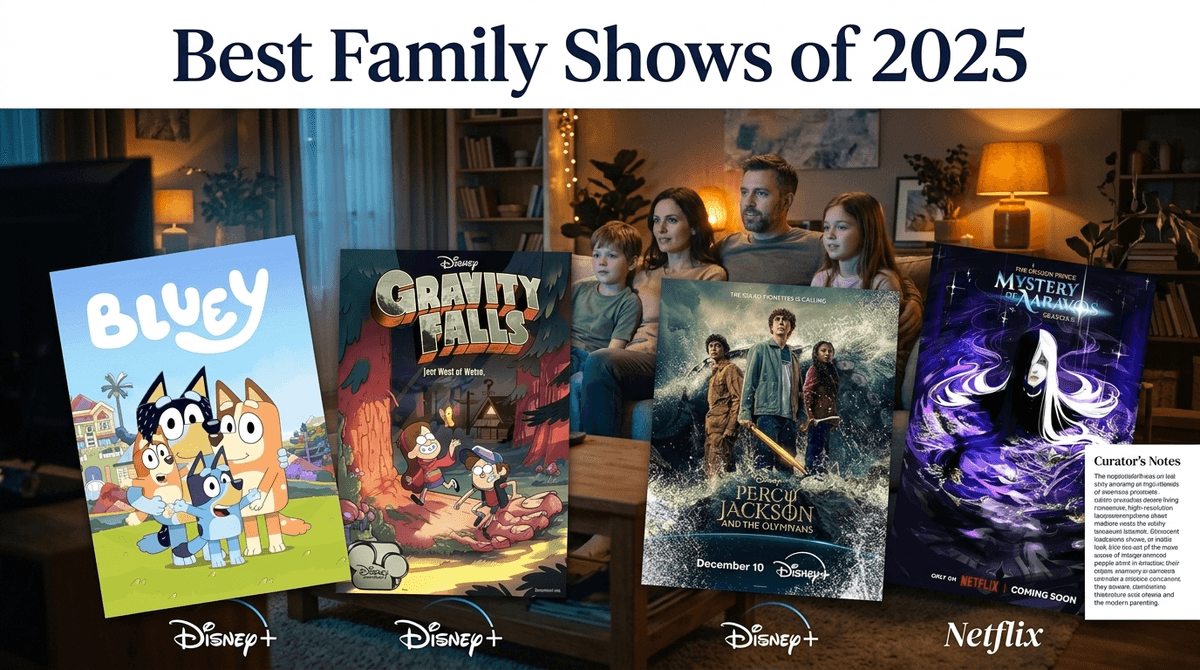
TL;DR: The 2025 "No-Cringe" Watchlist
If you’re standing in the living room with a remote in your hand and three different age groups staring at you, here are the immediate winners. No filler, no "brain rot," just solid storytelling.
- For the "Still Love Cartoons" Crowd (Ages 6-12): Bluey (obviously), Gravity Falls, and The Dragon Prince.
- For the "I’m Too Cool for This" Crowd (Ages 10-15): Percy Jackson and the Olympians, American Born Chinese, and The Mysterious Benedict Society.
- For the "We Just Want to Relax" Crowd (All Ages): The Great British Baking Show and Is It Cake?.
- The "Legacy" Hits (Timeless): Avatar: The Last Airbender and The Simpsons (early seasons).
Get a show playlist based on your kids' specific ages
We’ve all been there. You finally get everyone in the same room at the same time, the popcorn is hot, and then you spend forty-five minutes scrolling through Netflix until the toddler has a meltdown and the teenager retreats to their room to watch Skibidi Toilet on a phone.
The "Family Movie Night" has evolved into "Family Streaming Friction."
Finding a show that bridges the gap between the "Ohio" energy of a middle schooler (where everything is weird or "cringe") and the earnestness of a younger child is the ultimate parenting challenge. You want something that isn't just "brain rot"—that mindless, high-decibel, low-substance content that seems to melt their attention spans—but you also don't want to force them to watch a dry documentary about the history of salt.
Co-watching isn't just about supervising content; it’s about building a shared language. When you watch a show together, you’re creating "inside jokes" that don't involve a singing head in a toilet. You’re finding common ground in a digital world that usually tries to pull every family member into their own private algorithm.
Before we get to the good stuff, we have to acknowledge the enemy. Kids today are bombarded with short-form content designed to keep them clicking. Whether it’s YouTube Shorts or the endless loop of Roblox "let's play" videos, their brains are being trained for 15-second payoffs.
High-quality family shows are the antidote. They require a longer attention span, they develop empathy through character arcs, and—most importantly—they actually have a point. If your kid is calling everything "Sigma" or "Skibidi," they’re just looking for a cultural tribe. A great family show gives them a better tribe to belong to.
Learn more about the "Brain Rot" phenomenon and digital wellness
Animation isn't just for the little ones. In 2026, some of the best writing on television is happening in cartoons.
Ages: 2 to 102 If you haven’t watched Bluey yet, forget everything you think you know about "preschool" TV. This isn't Cocomelon (which is essentially digital candy—sweet, but zero nutritional value). Bluey is a show about parenting disguised as a show for kids. It’s funny, it’s poignant, and it’s one of the few shows that will make the adults in the room cry while the kids are laughing at a dog wearing a traffic cone.
Ages: 7+ This is the gold standard for "bridge" content. It’s a mystery-adventure show about twins Dipper and Mabel spending the summer with their "Grunkle" Stan in a town full of paranormal weirdness. It’s smart, the continuity is incredible, and it respects the intelligence of its audience. If your kids like Minecraft or mystery books, this is a slam dunk.
Ages: 8+ For families who want to get into epic fantasy but aren't ready for the "everyone dies" vibe of adult fantasy, this is it. Created by the head writer of Avatar: The Last Airbender, it deals with complex themes like war, sacrifice, and diverse family structures without ever losing its sense of wonder.
This is the hardest demographic to hit. They’re too old for cartoons (or so they claim) but too young for the "edgy" teen dramas that dominate Netflix.
Ages: 9+ The 2024/2025 series is a massive improvement over the old movies. It stays true to the Percy Jackson books and captures that feeling of being a "misfit" kid who discovers they have a greater purpose. It’s a great way to spark an interest in mythology—or at least get them to put down Fortnite for an hour.
Ages: 8+ Think Wes Anderson for kids. It’s visually stunning, quirky, and celebrates being "gifted and weird." It’s about four orphans recruited to go undercover at a boarding school to stop a global emergency. It’s smart, low on violence, and high on intellectual puzzles.
Ages: 10+ The latest seasons (featuring Ncuti Gatwa) have injected a fresh, vibrant energy into this 60-year-old franchise. It’s sci-fi, it’s goofy, it’s scary, and it’s deeply human. It’s the perfect show for a family that likes to talk about "what if" scenarios.
Check out our guide on whether Doctor Who is too scary for younger kids
Sometimes you don't want a plot. You just want to see someone build something or bake something.
Ages: All The ultimate "low-stakes" television. In a world of "toxic" competition shows, this is the opposite. People are nice to each other. They help each other when their cake collapses. It’s the visual equivalent of a warm blanket.
Ages: All It’s a meme turned into a show, and honestly? It works. It’s silly, it’s impressive, and it’s the perfect background show for a Friday night when everyone is too tired for a complex narrative.
When we talk about "age-appropriate," we usually mean "is there swearing or violence?" But in 2026, parents are equally worried about "is this show going to make my kid act like a jerk?"
A lot of modern "tween" sitcoms rely on kids being incredibly disrespectful to their parents or peers for laughs. While we don't need to be Victorian about it, it's worth noting that shows like The Simpsons (while classic) or Family Guy (definitely for older teens/adults) have a level of cynicism that might not be what you want for a 7-year-old.
The "Vibe Check" for 2026:
- 6-9 Years: Focus on "Cooperative Humor." Shows where characters solve problems without being mean-spirited. Wild Kratts is great for the science-loving kid.
- 10-13 Years: Focus on "Identity and Mystery." They want to see kids their age doing big things. Stranger Things is the obvious choice here, but be warned: Season 4 is basically a horror movie. Stick to Season 1 if they're on the younger side.
- 14+ Years: Focus on "Authenticity." They can smell a "parent-approved" show from a mile away. Try The Good Place—it’s funny, it’s about ethics, and it doesn’t talk down to them.
Co-watching is a wasted opportunity if you don't talk about it. You don't have to turn it into a book report, but a few casual questions can help you gauge how they’re processing the digital world.
- "Who is the most 'Sigma' character in this show?" (Using their slang shows you're paying attention, even if you’re using it slightly wrong to annoy them—which is a parent's prerogative).
- "Do you think [Character] made the right choice there?" Especially in shows like The Dragon Prince, where choices have consequences.
- "Is this show better than the YouTube stuff you watch?" Get them to think critically about production value and storytelling vs. the "constant noise" of short-form video.
The "streaming maze" is designed to keep us in our own little silos. Netflix wants you watching your true crime documentary while your kid watches MrBeast in the next room.
Fighting that takes effort. It means sometimes watching a cartoon about a blue heeler when you’d rather be watching HBO. But the payoff—the shared jokes, the common references, and the simple act of sitting on the same couch without a device between you—is worth the "cringe."
Pick a show from the list above, put the phones in the charging station, and just watch. Even if it's "Ohio." Especially if it is.
- Audit your subscriptions: Are you paying for Paramount+ just for one show?
- Set a "No-Phone" Rule: Make family show time a sacred, device-free zone.
- Let them pick (sometimes): Give them three "Screenwise-approved" options and let them have the final vote. It gives them a sense of agency in their digital life.
Check out our full guide on setting up a digital family mission statement