

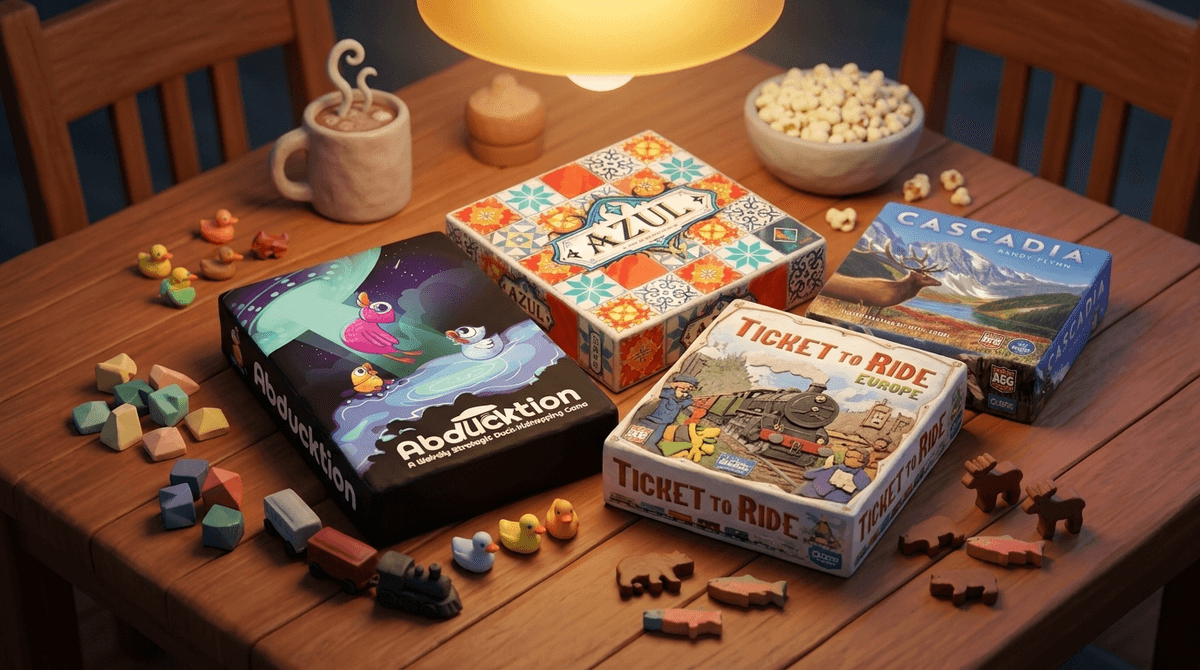

The Best Family Games to Reconnect Without the Screens
Finding the best family games for all ages shouldn’t feel like a chore. Whether you have 15 minutes before bed or an hour on a rainy Sunday, the right unplugged fun can turn a standard evening into a core memory. We’ve curated a list of the top family games that are easy to learn, highly replayable, and perfect for busy families looking to unplug.
Best Family Game for Your Situation
- Best For Laughter: Kids Against Maturity – Family-friendly party word game with lots of laughs
- Best For Beginners: Taco Cat Goat Cheese Pizza or Sleeping Queens – both take minutes to teach, and nobody’s left confused while everyone else gets ahead.
- Best For Big Groups: Quacks – Has a few rules, so learn before teaching. Camel Up – Is a fun, engaging, unpredictable dice game.
- Best For Strategy: Azul – Puzzle – tile laying game. Splendor – Card/Gem collection for buying cards/points to win. Ticket to Ride Europe – Fabulous, easy-to-learn, train route-laying game.
- Best for younger children: Dragomino – a tile-laying game. Sleeping Queens – simple enough to grasp fast.
- Best racing game: Camel Up – Betting on which Camel will come first
- Best Party Game: Codenames – A team-based social word and party board game focused on deduction, clues,
- Best Relaxed Game: Cascadia – A calm, puzzle-like strategy game.
Best Family Board Games Overview
Abducktion
-
Age Rating: 12+ · Players: 2–4 Players · Game Time: 15–20 Minutes · Game Type: Spatial Logic / Light Strategy
-
Objective: Act as a UFO intern and use “Action Cards” to rearrange colourful ducks into specific patterns on your board to “abduct” them for points.
Beyond the charm, this is a genuinely thinky game for anyone who likes spatial puzzles — think Azul, Sagrada, or Calico — where you’re planning a couple of moves ahead. It’s quick enough to be a nice change of pace from our longer games, but there’s real strategy underneath the fun. We love the adjustable difficulty too, since it means our whole family can play, no matter who’s at the table. The ducks are genuinely adorable and well-made, and it strikes that rare balance of luck and strategy that keeps every round a little different.
Kids Against Maturity
-
Age Rating: 10+ · Players: 4+ Players · Game Time: 30–60 Minutes · Game Type: Party Game / Humorous Card Game
-
Objective: A family-friendly “fill-in-the-blank” game where players compete to provide the funniest (and often silliest) answer to a question card to win the round.
We’ve had so many laughing fits with this one that it’s become a game night staple. Easy enough that some say an 8-year-old can pick it up right away.
It’s much cleaner alternative to Cards Against Humanity — though we did pull a few surprisingly suggestive cards out – if this might be a concern, pull out the cards you might not be happy with or get them to choose another.
Quacks
-
Age Rating: 10+ (Maybe 8+ with help) · Players: 2–4 Players · Game Time: 45 Minutes · Game Type: Bag Building / Push-Your-Luck
-
Objective: Pull ingredients from your bag to brew the most valuable potion. Be careful—pulling too many “cherry bombs” will make your pot explode and cost you points!
This one’s earned a permanent spot in our game night rotation. It’s easy to teach, easy to learn, and it’s fun watching who gets braver as the rounds go on. The built-in variations keep it from getting stale — just when we think we’ve got it figured out, there’s a new twist to work through.
Azul
-
Age Rating: 8+ · Players: 2–4 Players · Game Time: 30–45 Minutes · Game Type: Abstract Strategy / Tile Placement
-
Objective: Draft beautiful Mediterranean tiles from a central market to decorate the walls of the Royal Palace. Score points by creating specific patterns and completed rows.
We love this puzzle, tile placement game. Its like in strategy but keeps you engaged in play. We prefer to play 3 or 4 players. As if you have someone highly competitive, 2 players can get mean.
Cascadia
-
Age Rating: 10+ · Players: 1–4 Players · Game Time: 30–45 Minutes · Game Type: Tile-Laying / Nature Strategy
-
Objective: Create a harmonious ecosystem in the Pacific Northwest by drafting habitat tiles and matching them with wildlife tokens (like bears, salmon, and elk) to fulfil secret scoring goals.
A fabulous strategic game with different options for scoring points. Beautiful pieces, rewarding, puzzle type game where you think about how to gain points by placing cards in a specific way.
Splendor
- Age Rating: 10+ (Splendor Pokémon or Disney versions are 6+) · Players: 2–4 Players · Game Time: 30 Minutes · Game Type: Resource Management / Engine Building
- How to Play Guide: Read our full review and how to play here.
- Objective: Play as a gem merchant collecting poker-style chips to buy “Development Cards.” These cards provide permanent gems that help you buy even more expensive cards and attract noble patrons to reach 15 points first.
Probably one of those games that I say is a must buy for families. Light strategy where you are collecting gems to buy cards to gain points.
Sleeping Queens
-
Age Rating: 8+ · Players: 2–5 Players · Game Time: 15 Minutes · Game Type: Card Game / Light Strategy
-
Objective: Wake the most queens from their slumber using kings, while using knights to steal queens and dragons to defend them.
This is one of our go-to picks for family game night — quick to learn, quick to play (usually 15-20 minutes a hand), and genuinely fun for everyone from the youngest player to the adults.
We love that it sneaks in some math practice and early strategy without ever feeling like a lesson.
Taco Cat Goat Cheese Pizza
-
Age Rating: 6+ · Players: 2–8 Players · Game Time: 10–15 Minutes · Game Type: Party / Hand-Eye Coordination
-
Objective: A high-energy “slap” game. Players say the words “Taco, Cat, Goat, Cheese, Pizza” in order while flipping cards. When the card matches the word spoken—slap the pile! The last one to slap takes the cards; the first to empty their hand wins.
We love this for the fun, light nature it brings to the table and of course lots of laughter.
Dragomino
-
Age Rating: 5+ (The kid-friendly version of Kingdomino) · Players: 2–4 Players · Game Time: 15 Minutes · Game Type: Tile Placement
-
Objective: Explore a magical island by matching terrain tiles (like snow, desert, or mountains). Each time you match a terrain, you get a dragon egg. Will it be empty, or will you find a baby dragon for extra points?
For a light introduction to tile placement for younger kids this is fabulous, but if you have kids 8 yrs plus, go for Kingdomino.
Ticket to Ride – Europe
-
Age Rating: 8+ · Players: 2–5 Players · Game Time: 45–60 Minutes · Game Type: Route-Building / Set Collection
-
Objective: Claim train routes across a map by collecting matching coloured cards, racing to connect cities before your opponents block your path.
-
Read our full guide on how to play Ticket to Ride Europe here
-
Best Version: That’s really hard to say. Ticket to Ride (original or USA) is by far a top seller, but lots of people say Ticket to Ride Europe is the best version. Who knows, either way, either game is fabulous and a must-have for your home.
I love this game, I enjoy a light strategy, tile placement, set collection type game. This is probably another game, that I would say is a must buy for families. Perfect for all ages.
Codenames
-
Age Rating: 10+ · Players: 4–8 Players · Game Time: 15–30 Minutes · Game Type: Word Association / Team Party Game
-
Objective: Give your team one-word clues to help them guess which words on the board belong to your side without accidentally leading them to the other team’s words — or the assassin.
This is one we love pulling out when we’ve got a group over — easy enough to pick up fast, but it gets surprisingly competitive once everyone’s a few rounds in.
No two rounds ever play out the same way, so it never gets stale even after playing it a dozen times. A solid go-to for game nights or whenever friends drop by. Definitely one we’d recommend.
Camel Up
-
Age Rating: 8+ · Players: 3–8 Players · Game Time: 30–45 Minutes · Game Type: Betting / Dice Rolling / Party Chaos
-
Objective: Bet on which camel will win a race around a pyramid track — but the camels stack on top of each other and get carried along, so the leader can flip in an instant.
Camel Up has become one of our favorites — it’s easy to learn but somehow never loses its excitement, even after dozens of plays. The pace moves fast, the surprises keep coming, and everyone stays locked in right up until the last camel crosses the line. The stacked-camel racing mechanic is genuinely clever, since no two races ever unfold the same way.
If you like light strategy with a lot of laughs built in, this one’s an easy recommend.
Cascadia & Azul: The Best Strategy Games for Families

Cascadia in Play
If you love a visual puzzle, these two are the gold standard. Cascadia is an award-winning nature-themed board game where you build habitats to settle Pacific Northwest wildlife. If you prefer something more tactile, Azul is a stunning tile-placement game that challenges players to decorate a royal palace with beautiful Mediterranean tiles. Both are excellent gateway games that take less than 45 minutes to play.
How to Play Cascadia
The beauty of this game is its “dual-layer” puzzle. On your turn, you must take a paired set (one habitat tile and one wildlife token) from a central market.
-
Expand Your Map: Place your new habitat tile (mountains, rivers, or prairies) so it connects to your existing terrain. You get bonus points at the end for your largest contiguous area of each habitat type.
-
Place Wildlife: Place your wildlife token (bears, elk, salmon, hawks, or foxes) onto a tile that can support that animal.
-
Score Patterns: Each animal scores differently based on “Wildlife Scoring Cards” that change every game. For example, salmon might want to be in a long “run”, while bears prefer to live in pairs.
How to Play Azul
This game is famous for its chunky, “starburst” resin tiles that look like candy. The gameplay happens in two distinct phases:
-
The Drafting Phase: You pick all tiles of one colour from a central “factory” circle. The leftover tiles are pushed into the centre of the table. You then place your picked tiles onto one of five “pattern lines” on your player board.
-
The Wall-Tiling Phase: Once all tiles are taken, you move one tile from each completed pattern line over to your wall.
-
Scoring and Penalties: You score points for placing tiles adjacent to each other. However, if you take more tiles than you can fit on your pattern lines, they “fall to the floor” and count as negative points.
A family favourite board game because I love the challenge and strategic depth of this game. It’s a brilliant head-to-head strategy game. While it looks beautiful and calm, there is a lot of hidden depth in trying to leave your opponent with a pile of tiles they can’t use and one that you can gain points with. Note: If you play with highly competitive people (who play this game a lot), it can get a bit mean with 2 players.
2026 Strategy Guide: Finding the Best Family Games for Your Next Game Night

Quacks
Splendor & Quacks: Fun Strategic Games For families who enjoy “engine-building”, Splendor is a race to collect gems and win the favour of nobles. It’s one of the best board games for teens and tweens because it’s simple to teach but deep in strategy. If you want more laughter, Quacks is a hilarious “push-your-luck” game where you brew potions—just be careful not to let your pot explode!
How to Play Quacks
In this game, we are all “Quack” doctors brewing secret potions. Everyone has their own pot (player board) and a bag filled with ingredient chips.
-
The Simultaneous Draw: We all reach into our bags at the same time and pull out an ingredient. You place it in your pot, moving further around the spiral to increase your potion’s value.
-
Don’t Explode!: Most chips are helpful, but white cherry bombs are dangerous. If the total value of the white chips in your pot exceeds 7, your potion explodes!
-
The Big Choice: After every pull, you have to decide: Do I stop now and bank my points, or do I reach back in for one more chip?
-
Buy Better Ingredients: At the end of the round, you use the “money” your potion earned to buy better, more powerful ingredients (like owls, spiders, or pumpkins) to put into your bag for the next round.
Because everyone plays at the same time, there is zero waiting around, making it one of the best high-energy games for a Friday family game night.
How to Play Splendor

In Splendor, we are Renaissance merchants trying to buy gemstone mines and transport ships to impress the nobility.
-
Collect Gems: On your turn, you can take three different coloured gem tokens (the heavy, poker-chip-style pieces) or two of the same colour.
-
Buy Cards: Use your gems to “buy” development cards from the centre of the table. These cards are worth victory points, but more importantly, they provide a permanent gem discount for future turns.
-
Build Your Engine: This is the “engine building” part. If you buy enough Blue Diamond cards, you’ll eventually be able to buy expensive Green Emerald cards for free!
-
Attract Nobles: If you build a specific combination of cards, a “Noble” tile will visit you, granting a large chunk of bonus points. The first person to 15 points triggers the end of the game.
What I love about Splendor: it’s a very “clean” game. There’s no reading required once you know the symbols, making it one of the best strategy games for kids and adults to play together. It’s one of our family favourites because it’s easy to learn and each game feels different. Want to read a full review on Splendor? Check out this article.
Top-Rated Family Games 2026: Why Kids Against Maturity and Abducktion are Must-Haves
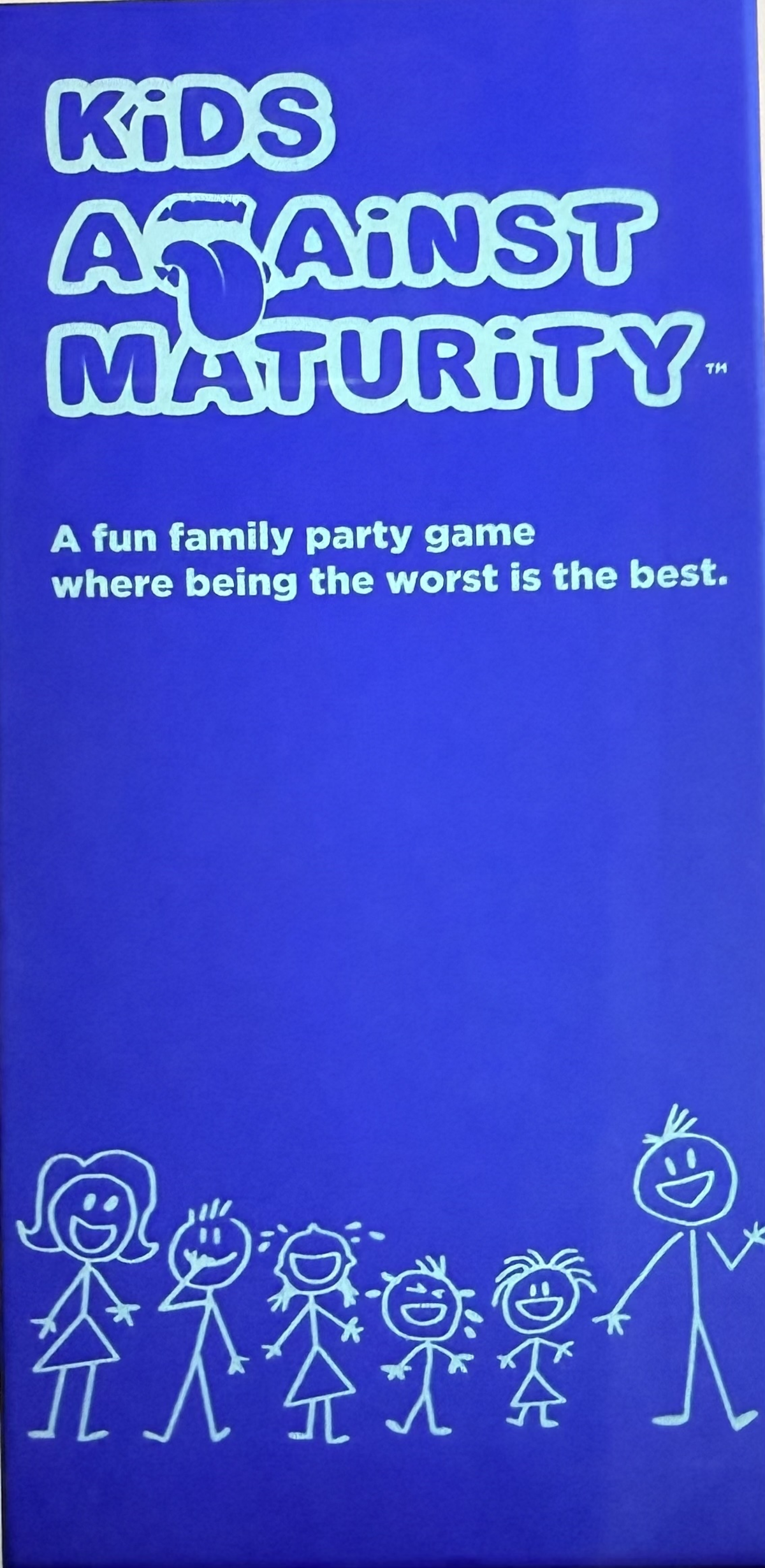
Abducktion & Kids Against Maturity: Laughter & Logic Looking for something unique? Abducktion is a “weirdly strategic” game of duck kidnapping that uses adorable plastic ducks and a UFO to teach spatial logic in under 20 minutes. For pure, unfiltered laughter, Kids Against Maturity is the ultimate party board game for families. It’s a hilarious fill-in-the-blank card game that keeps both kids and parents entertained with age-appropriate (but slightly silly) humour. A fun family game that is perfect for parties but also a great introduction/beginner-friendly “board game” for screen-free time.
How to Play Kids Against Maturity
This is the family-friendly version of the famous “adult” party games. It’s designed to get kids laughing by using “edge-of-the-seat” humour that stays on the safe side of appropriate.
-
The Question: One player is the “Question Master” and reads a blue card out loud (e.g., “Why does the house smell like old socks?”).
-
The Answer: Every other player chooses their funniest white card from their hand to fill in the blank.
-
The Reveal: The question master reads all the answers out loud and picks their favourite.
-
The Win: The person who played the funniest card wins that round. The first person to collect 5 Blue Cards wins the game.
Why I recommend this as one of the best family games: It’s a fantastic way to get kids off their devices and interacting. It’s a great screen-free party game that works specifically well for the 8–12 age range. A great way to introduce board games to families too, especially those reluctant to get into board games. If you have family members who are reluctant, another good one is Just One – a cooperative game.
How to Play Abducktion
In this game, you are an intern on an alien spaceship. Your job? To abduct ducks from a park in specific patterns to satisfy your “alien bosses”.
-
The Duck Board: You have a board representing a pond filled with colourful plastic ducks.
-
The Action: On your turn, you use “Action Cards” to move the ducks around the board. You might swap two ducks, push a whole row, or rotate a group.
-
The Abduction: Your goal is to arrange the ducks to match a “Formation Card” in your hand (like 3 yellow ducks in a row). Once you match it, you “abduct” those ducks and score points.
-
Refill the Pond: New ducks “fall” from the top of the board to replace the ones you took, often creating new puzzles for your next turn.
Why I love it for families: It’s also a great tactile board game. Because it has these cute little plastic ducks that are high quality, and the “gravity” mechanic of ducks falling into place makes it a very unique 2026 board game experience.
What Are The Best Family Games for Early Strategy and Math?
My biggest tip if you are introducing new games to children is to learn the rules before playing. The constant stopping and checking the rules really puts kids off. It breaks up the flow and momentum.
Short on time, wanting easy introductory games for maths and some strategy techniques? These are some of the best family games with kids you will play. If you have a spare ten minutes before dinner or a rainy afternoon at the campsite, Sleeping Queens, Dragomino, and Taco Cat Goat Cheese Pizza are the gold standard for younger families. They are often cited as the best gateway games for kids because they balance simple rules with high-energy interaction, helping little ones develop memory and reflex skills while having a blast.
How to Play Sleeping Queens
This game was famously designed by a 6-year-old, which is why the logic makes perfect sense to kids.
-
Wake the Queens: All the Queen cards are face down (sleeping) in the centre. On your turn, play a King card to wake one up and put it in your collection.
-
The “Take That” Element: Players can play a Knight card to “steal” a Queen from you, but you can stop them if you have a Dragon card in your hand.
-
Magic Wands: If someone tries to put your Queen back to sleep using a potion card, you can defend yourself with a magic wand.
Discarding for New Cards: If you don’t have any power cards, you can discard number cards to draw new ones. If you can make a math equation (like 2 + 3 = 5), you can discard all three cards at once!
How to Play Taco Cat Goat Cheese Pizza

This is pure, hilarious chaos. It’s a high-energy card game that tests your brain and your reflexes.
-
The Chant: Players take turns flipping a card while saying the words in order: “Taco,” then “Cat,” then “Goat,” then “Cheese,” then “Pizza.”
-
The Match: If the card you flip matches the word you just said (e.g., you say “Goat” and the card is a goat), everyone must slap the centre pile immediately.
-
Last One In: The last person to slap the pile has to take all the cards.
-
Special Actions: There are Gorilla, Narwhal, and Groundhog cards that require you to make a specific gesture (like beating your chest) before slapping the pile. If you mess up the gesture or slap at the wrong time, you take the cards!
“If you are looking for the best family board games that take less than 30 minutes, games like Taco Cat Goat Cheese Pizza and Sleeping Queens are top-rated picks for 2026 because they offer high-speed fun without a long setup.”
How to Play Dragomino
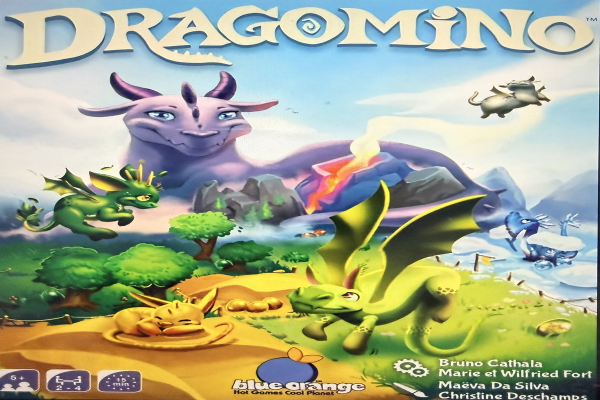
This is the “my first strategy game” version of the award-winning Kingdomino. It’s highly tactile and rewards smart placement.
-
Pick a Tile: On your turn, pick a domino-style tile featuring different landscapes (desert, snow, forest, etc.).
-
Match the Terrain: Place your tile next to your starting tile. If you match two terrains (e.g., forest next to forest), you get to pick a “Dragon Egg” token of that colour.
-
The Reveal: Flip the egg over. If it shows a baby dragon, you get a point! If it’s just an empty shell, you don’t get a point, but you get to take the “Mommy Dragon” token, which lets you go first in the next round.
-
Win the Game: The game ends when all tiles are gone, and the player with the most baby dragons wins.
Here is a super cute video on how to play in detail.
Overview of How to Play Codenames
Codenames splits the table into two teams, each with a Spymaster and a group of Guessers. The goal: figure out which words on the board belong to your team, using only one-word clues from your Spymaster.
Setting Up
- Lay out a 5×5 grid of word cards on the table.
- Each Spymaster gets a secret key card showing which words belong to their team, which belong to the opposing team, which are neutral, and — the one to avoid — the assassin word.
- Split into two teams and pick one Spymaster per team.
Giving Clues
- On your turn, your Spymaster gives a one-word clue plus a number, like “Ocean, 2.” The number tells your team how many words on the board relate to that clue.
- The catch: the Spymaster can’t say any of the words on the board, can’t use part of a word already there, and can’t give any hint beyond the clue and number.
Guessing
- Your team discusses and points to the word or words you think match the clue.
- Guess correctly, and that word flips to reveal your team’s color — you can keep guessing (up to the stated number, plus one extra) or stop and pass the turn.
- Guess a neutral word, and your turn simply ends.
- Guess the other team’s word, and you accidentally help them instead.
- Guess the assassin word, and your team loses instantly — no matter how far ahead you were.
Winning the Game
- The first team to correctly identify all of their words wins.
- Or, if either team guesses the assassin word, the other team wins immediately.
Frequently Asked Questions
What's the best family board game for beginners who've never played modern board games?
Start with something with dead-simple rules and a short playtime, like Taco Cat Goat Cheese Pizza or Sleeping Queens. Both take under five minutes to explain, so nobody’s sitting around confused while everyone else gets ahead.
What age is best for introducing kids to strategy board games?
Around 8 years old is when we noticed a real shift — kids start planning a move or two ahead instead of just reacting. Games like Azul, Ticket to Ride or Splendor are great first “real strategy” games at that age, since the rules are simple even though the thinking gets deep.
Do family board games need to be educational to be worth buying?
Not at all. Some of our most-played games ( Taco Cat Goat Cheese Pizza, Kids Against Maturity) are pure chaos and laughter with zero educational angle — and that’s exactly why they get requested again and again. The best family game is the one that actually gets played.
How long should a family board game night game actually take?
For us, the sweet spot is 20 to 45 minutes. Long enough to feel like a real game, short enough that younger kids don’t lose steam halfway through. Anything over an hour we save for weekend afternoons rather than weeknights.
What's the best family board game for a big group with mixed ages?
Look for games where everyone plays at the same time instead of taking turns in sequence — Quacks is a great example, since nobody’s sitting around waiting. Cooperative games also help even out mixed skill levels, since you’re all trying to beat the game together instead of each other.
Final Thoughts: Choosing the Best Family Games for 2026
Finding what are the best family games isn’t just about picking a box off a shelf; it’s about meeting the needs of your whole family. One that will stick with your kids long after the board is packed away and wanting to play more.
These family games offer a variety from laughing hysterically at a round of Kids Against Maturity, feeling the high-stakes tension of Quacks, betting on the chaos of Camel Up, or enjoying a quiet, strategic afternoon with Cascadia; these games offer a much-needed break from the digital world.
In my experience, the secret to a successful game night is variety. I always keep a mix of fast-paced card games like Taco Cat Goat Cheese Pizza for high-energy groups, “thinky” strategy games like Splendor, Azul, or Ticket to Ride Europe for when we want to flex our brain muscles but the kids aren’t struggling to follow the rules, and something like Codenames on hand for whenever a bigger group ends up around the table.
Why These Games Belong on Your Shelf
-
Kindergarten Readiness: Titles like Dragomino and Sleeping Queens are top-rated for teaching maths and logic without feeling like “homework”.
-
Unplugged Connection: These screen-free family activities foster better communication, patience, and teamwork.
-
Portability: Many of these picks are the best travel board games of 2026, fitting easily into a backpack for camping trips or vacations.
-
New to tabletop games? Consider cooperative games if you have competitive children.
-
Dragonwood is another fun creature-capturing card game rated 8+ for children.
-
Roll and Write Dice games provide another option with a balance between luck and strategy.
-
One of our favourites is Just One—a cooperative word game.
-
Keen for action? Check out these fast-paced card games.
-
Or treat yourself to solo board games
-
Tacta – Learn in less than 60 seconds but a fabulous light strategy card game.